
Best viewed on a wide computer screen
In this book Odysseus reveals himself to Penelope, who eventually accepts that he is her husband, returned.
Eurycleia goes to Penelope’s room to wake her and tell her that Odysseus has returned. But Penelope cannot believe this news. She thinks it more likely that the gods have sent Eurycleia to play a joke on her. She is annoyed at being disturbed since she was sleeping better than at any time since Odysseus left for the war. But Eurycleia insists that she would never mock Penelope. She says the strange beggar who has been staying in the hall is really Odysseus , and that Telemachus knew all along.
Penelope is initially excited. She wants to hear the story of Odysseus’ return and how he despatched the suitors. But Eurycleia says she only heard the sounds of the battle, since she was locked in her room with other women. She only found Odysseus amongst the dead afterwards. She describes how the corpses have been taken outside and the house is being purified. Eurycleia describes the possibility of Penelope reuniting with Odysseus, but she makes the prospect sound like the end of a happy fairy tale.
Penelope decides it must have really been a god who despatched the suitors. Once she decides this, she again reverts to the belief that Odysseus is still lost somewhere over the sea. Eurycleia says she has seen the sign of Odysseus’ old leg scar, given to him by the boar, and insists it is Odysseus who has returned. Penelope is still sceptical, but she agrees to see the man Eurycleia is describing. The fact is, in her heart, Penelope wants to believe and is undecided as to how she should greet this man.
She enters the hall and the man appears to her sight to be Odysseus. Then she is unsure again. Telemachus chides Penelope for not immediately showing his father affection. Penelope assures Telemachus that if this really is Odysseus, that they have secrets signs by which they can identify one another. Odysseus instructs Telemachus to leave them alone. He reminds his son of their great victory together, and then requests he gather the maids and the bard to prepare for a celebration. He wants to make a lot of noise so that anyone passing by on the road outside might think they are celebrating Penelope’s marriage with one of the suitors. Odysseus doesn’t want news of the suitors’ deaths to get out until he has left for their country estates. Telemachus obeys and the sounds of celebration reach out to the road.
The maid, Eurynome, bathes Odysseus and Athena enhances his beauty, making him look taller and stronger, so that he looks godlike when he steps from his bath. He then returns to Penelope. Still, Penelope is reticent. Odysseus is irritated by her. So, he asks Eurycleia to make his bed so he can sleep alone. Penelope objects to being though proud and scornful. But she has thought of a test for Odysseus. Instead of simply casting aside her uncertainty, she orders Eurycleia to move the bed from the bridal chamber to give Odysseus a place to sleep.
Odysseus reacts as he was clearly meant to react. He says the bed can’t be moved from the room unless a god were to do it. He then describes the construction of the bed in detail, from a secret hallmark he made in its design, to the olive tree around which the bedroom is built, and how he modified the tree to fit into the space. He says the bed is their secret sign. He asks has someone chopped away the olive trunk that holds the bed in place in order to remove it.
Penelope finally succumbs to her feelings at Odysseus’ speech. She now believes he is her husband. She laments the time they have lost together, and explains that she always feared a fraudster might turn up in Odysseus’ place. She claims that Helen was tricked by a god into leaving Menelaus for Paris, which led to the Trojan War. But she knows that no one other than one handmaid knew the secrets of their bed. Penelope weeps copiously with joy. Athena delays the coming of dawn to allow them to spend time together.
Eventually, Odysseus explains that he is not yet at the end of his trials. In Book 11 he visited the House of the Dead to seek advice from the blind seer, Tiresias. He tells Penelope that Tiresias said he must go on another journey, carrying a well-planed oar until he comes across people who know nothing of the sea, until someone asks him if the oar is a fan to winnow grain. Then he must plant his oar and sacrifice beasts to Poseidon, before returning home to offer more sacrifices to the gods. But he knows he will live a long life and have a peaceful death surrounded by those who love him.
Eurycleia and Eurynome have made up their bed and so they go retire. The sounds of celebration in the palace stop and everyone sleeps. Odysseus and Penelope make love and then tell each other their stories. Odysseus’ story includes all the fantastical elements that he told to the Phaeacians: the Lotus-Eaters, the Cyclops, Circe, the House of Death, the Sirens, Charybdis and Scylla, Calypso etc. They finally fall asleep.
When Athena thinks they’ve had enough sleep she finally allows the sun to rise and wakes Odysseus. Odysseus acknowledges they have both lived through trials. He asks Penelope to look after what possessions of his remain. He says that he will replenish the flocks he has lost to the suitors by making raids and extracting the shortfall from his fellow Ithacans. But now he plans to go see his father. In the meantime, he asks that Penelope avoid speaking to anyone from outside the house; that she should remain in her chamber with her women for safety, since news of the deaths of the suitors will surely get out.
Odysseus leaves the palace with Telemachus, Eumaeus and Philoetius, armoured. But Athena casts them in darkness to hide them as they head out of town.
Central to this book, and to The Odyssey overall, is the idea of returning the world to as state of normality. In Book 22 Odysseus has taken steps to do this when he slaughters the suitors. The presence of their suitors has been intended to undermine the bonds of marriage by breaking the fundamental customs of xenia, of hospitality, in the Greek world of this time. The suitors effectively wage war on Penelope and her household over the years of Odysseus’ absence. Their presence and their consumption of livestock is like a siege that is meant to make Penelope surrender.
Similarly, the witches and hideous monsters that Odysseus and his men meet on their journey home represent a world that threatens the central institutions of marriage and home, whether it be through physical threat of mishap and death represented by Scylla and Charydis and the Laestrygonians, or the threat to the bonds of love through infidelity, made real by Calypso.
Penelope tells Odysseus she feared a fraudster would come to her claiming to be her husband, and this is why the marriage bed is so important to this book, but is also at the centre of a world that now needs to be reinstated. The marriage bed is the key to unlocking Penelope’s conundrum of how to trust. It represents the privacy and intimacy of marriage, and the unique bond between husband and wife that excludes others. The information Odysseus reveals that proves his identity is that:
The details of the room and its construction, and the care with which Odysseus constructed them suggests the care which he undertook in forming his relationship with. The quality of the design and its materials suggest the quality of their marriage. That the bed was designed so that it could not be moved suggests the strength of their love and their bond to one another. That the room has remained an inner sanctum, despite the presence of the suitors in the palace, shows the firm commitment of Penelope to her marriage. It will be pointed out that Odysseus has had lovers during the long years of his journey home, but according to the values of this culture, Homer keenly delineates sexual congress and a true love that has remained unwavering in Odysseus’ heart. In fact, Odysseus, while recounting the tales of his journey, tells Penelope about Calypso:
Leslie Paterson’s painting, below, is a representation of the romantic reunion of Odysseus and Penelope.
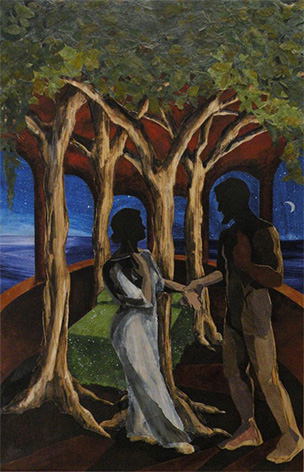
Leslie Paterson’s representation of Odysseus and Penelope’s bed does not match the description given by Homer. Odysseus describes how he built “walls with good tight stonework” around the olive tree before making the bed, which comports with the sense of privacy that is important to the symbolism of the bed. He portrays the bed cornered by four mature trees, while Odysseus had one tree which he cut to fashion a bedpost that was fixed into the ground because it was the stump of that tree. Even so, Paterson captures the romantic moment between husband and wife, and portrays them in shadow, conforming to the detail in Homer, that Athena delays the dawn for them.
The marriage bed of Odysseus and Penelope is a symbol of the fundamental tenets of a civilised society, that places marriage and family at its centre. Through Odyssseus’ suffering and Penelope’s fidelity, we see the cornerstone of the civil human world reasserted.
This is in contrast to the bed of infidelity occupied by Aphrodite and Ares, as described by the song of Demodocus in Book 8 of The Odyssey.
The following was suggested to me by an article posted by Mateusz Stróżyński, The Tale of Two Beds: Wandering and Homecoming in the Odyssey.
Stróżyński identifies the significance of the marital bed of Odysseus and Penelope, also. However, he suggests that it is contrasted by the bed of Aphrodite and Ares in Book 8 of The Odyssey. This story is recounted in the summary for Book 8 on this website which you can access by clicking here.
Hephaestus, the lame blacksmith of the gods, suspects his wife Aphrodite of being unfaithful with Ares, and so prepares a trap. He makes a net so fine that it can hardly be seen, yet so strong that when it is dropped on the lovers it traps them. The privacy of the lovers is put on public display, inviting derision and ridicule from the other gods.
Hephaestus’ net contrasts to the marital bed Odysseus constructs. Odysseus’ bed represents an immovable commitment that seems natural, while Hephaestus’ net seems insubstantial and contrived, revealing false marriage that he exposes to the world through his own jealousy. The fresco by Costantino Cedini imagines the moment when the trap is about to be sprung.
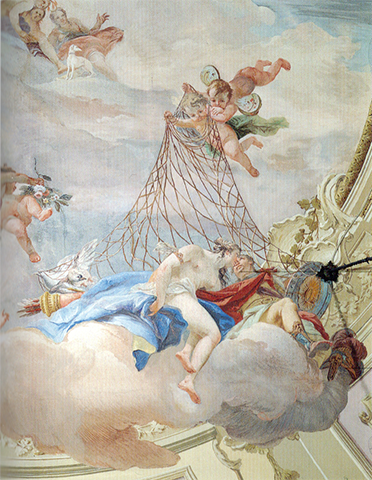
Costantino Cedini’s fresco, which appears in the Palazzo Emo Capodilista, Padua, Italy, is typical of the baroque work of this period. Architectural features are suggested by Trompe l'œil details which draw the viewer’s gaze skyward where the lovers, Aphrodite and Ares, are about to be trapped by the net that Hephaestus has forged. Homer describes the chains, themselves, as “crafty” and “cunning”, terms often applied to Odysseus. Hephaestus’ goal is for revenge and to be repaid the gifts he gave for Aphrodite’s hand in marriage. Eventually he agrees to let them go because Poseidon guarantees to pay the price if the lovers abscond. They do.
The following works of art, ranging from ancient times through to the 20th century, all depict Odysseus and Penelope speaking, or the moment in which Penelope accepts Odysseus is her husband and they embrace.
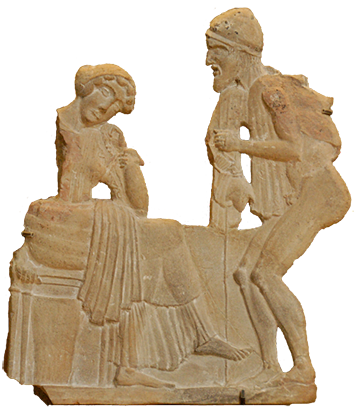
This ancient relief carving, found on Melos, depicts Penelope and Odysseus together before she has accepted that he is her husband. Her crossed legs and her hand that seems to cover her face suggests she is not yet convinced, and her head also appears to be turned away from him. For his part, Odysseus looks directly at Penelope, trying to engage her. His stance is of a man trying to be non-threatening; a man pleading to be heard.
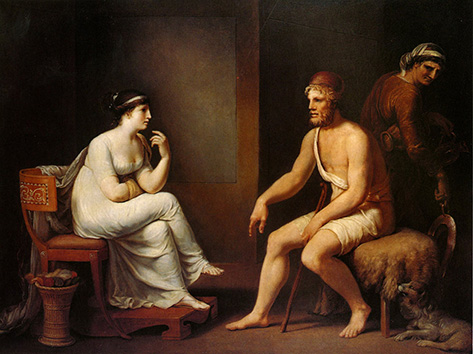
Tischbein’s painting seems to represent the moments before Penelope becomes convinced that Odysseus is her husband. They remain seated and separate, much different to the works of art that follow, although they lean forward, towards each other. Even so, Penelope’s body language suggests hesitation. Her legs are crossed and her right arm is drawn into her body, suggesting her reticence. She is physically unavailable even though she is willing to listen. Her body language is similar to the ancient relief carving shown above. Odysseus’ body language shows he is open and willing, his right hand moving forward as though to touch Penelope.
A woman, presumably Eurycleia who has brought Penelope to Odysseus, watches on and listens with interest, even though she pretends to be performing domestic duties.
The whole scene has the formality and balance of the neoclassical style, which complements the air of restraint in the painting.
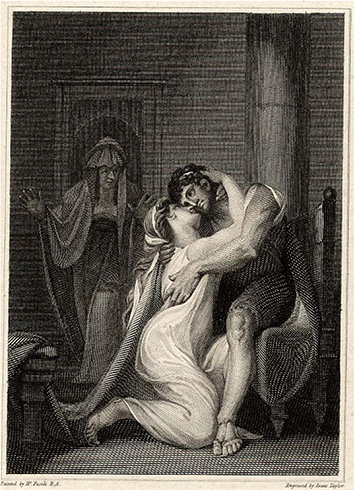
This engraving was made by Isaac Taylor, an English engraver, in 1806, based upon an oil painting by Henry Fuseli, an artist best known for his work, ‘The Nightmare’ (1781). Fuseli favoured subjects with a supernatural theme, although in his painting he chose to depict the moment when Penelope accepts that Odysseus is her husband and embraces him passionately. Taylor copied this image for to illustrate Alexander Pope’s translation of The Odyssey which was released as five volumes between 1725 and 1726.
Apart from Penelope and Odysseus in the foreground, an old women watches them with a look of surprise or glee on her face. She may be Eurycleia, Odysseus’ old nurse, but she can hardly be surprised, since she has had to persuade Penelope to see Odysseus: she has had to try to convince her this man really is her husband.
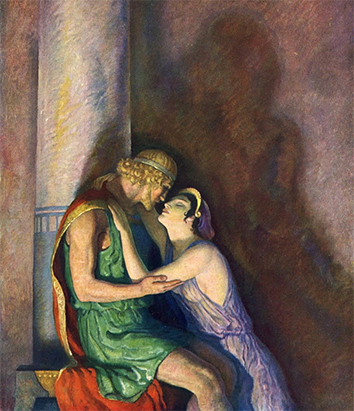
Newell Converse Wyeth 1929 painting of the same scene is reminiscent of Taylor and Fuseli’s work. Penelope clings to Odysseus passionately. However, there is no third figure in the painting. This brightly-coloured oil painting was also produced for a book. It was one of sixteen paintings that Wyeth produced to illustrate George Herbert Palmer’s translation of The Odyssey, which was first privately printed in 1884.
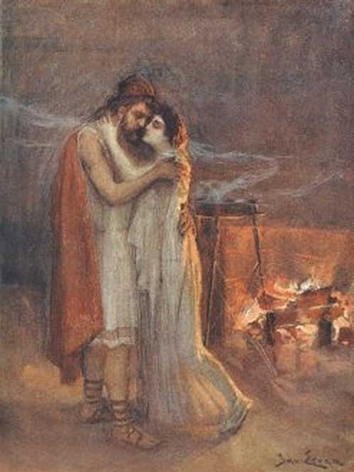
Jan Styka’s painting is part of a series of eighty he painted to illustrate a 19th century French edition of Homer’s Odyssey by Eugène Bareste. It depicts the moment when Penelope accepts that Odysseus is her husband, and captures their passion, which is mirrored by the fire in the fireplace and the smouldering tripod.