
Best viewed on a wide computer screen
In this book of The Odyssey, Odysseus finally makes it home to his native Ithaca.
As Odysseus finishes his tale, King Alcinous encourages the Phaeacian nobles who have been listening to add to the already generous bounty of treasures Odysseus has been given, gifts of tripods and cauldrons, and to recover the cost of this with levies from their people. The next day they bring bronze gifts for him which are then stowed in the ship that will take him home. Sacrifices and libations are made to Zeus. Odysseus seems confident, although he shows some doubt that Penelope will have remained faithful to him. He gives his blessing to the Phaeacians and wishes them well. King Alcinous calls upon his herald, Pontonous, to mix wine for further libations, and then Odysseus wishes Queen Arete well, too. Arete instructs her serving women to carry a sea-cloak, a sturdy chest as well as bread and wine to the ship for Odysseus. When Odysseus boards the ship he is weary and falls fast asleep. The Phaeacian ship departs as he sleeps and it arrives at Ithaca where there is a sheltered harbour and a cave nearby with two entrances: one facing the north wind for mortals; another facing the south wind for immortals. The Phaeacians anchor in this harbour and take Odysseus ashore while he is still sleeping. They also take his gifts ashore and then depart before he awakes.
Poseidon sees that Odysseus has made it back to Ithaca with far more treasure than he could ever have acquired from the Trojan War, itself. He goes to Zeus to complain. Poseidon claims he never wanted to prevent Odysseus from returning home forever, but he is angry that Odysseus has fared so well from the Phaeacian’s generosity. Zeus is not interested in his complaints. Instead, he tells Poseidon to take whatever retribution he wishes. Poseidon admits he has always been fearful to cross Zeus in the past, but having been told this, he plans to take revenge on the Phaeacians who are always helping people cross the oceans safely. He plans to pile a mountain of rocks about their port. Zeus suggests that he turn the Phaeacian boat that carried Odysseus into a rock as it enters the harbour, so the spectacle can be seen by the Phaeacians. Poseidon takes this advice. He goes to Scheria and transforms the returning ship into stone, with its bottom rooted into the ocean floor.
The Phaeacians are shocked. King Alcinous now recalls a prophecy that Poseidon would one day pile a mountain of rock about their port in retribution for helping everyone who came to their shores as castaways. In response, the Phaeacians prepare sacrifices, hoping to appease the god.
Meanwhile, Odysseus awakes on the shores of Ithaca, but he does not recognise his home. Athena has cast a mist about him that prevents him being seen, but it also prevents him from recognising his home. At first, Odysseus is in despair. He believes the Phaeacians have betrayed him by leaving him marooned on yet another foreign shore with his treasures exposed. In fact, he is concerned that the Phaeacian sailors may have stolen from him. He checks his treasures but finds nothing missing.
Athena now appears to him as a shepherd boy. Odysseus asks that he be treated kindly, and asks that Athena help him secure his treasures. He also asks Athena where he is. She praises the land they are in, saying it is world famous, and though it is a rugged land it is capable of growing grain and grapes, and it is suitable for farming goats and cattle. It also has stands of timber. She reveals the island to be Odysseus’ home, Ithaca.
Odysseus’ response is strange. He tells Athena that he has heard of Ithaca, but claims that he had been bound for Pylos or Elis. He says he had asked the Phaeacian crew to land him there after he killed Idomeneus’ son, Orsilochus, because, he claims, Orsilochus had tried to rob him of the treasures he acquired at Troy. He says a wind blew the Phaeacian ship off course to Ithaca, where the Phaeacians left him.
Having heard this, Athena now transforms herself from the shepherd boy into her true form and announces who she is. She upbraids Odysseus for his instinctively cunning nature and his deception. She says that she was instrumental in the Phaeacians accepting Odysseus at Scheria. She says she has again come to help him: to hide his treasure and to help him with a scheme to reclaim his wife and household. But first, he will have to overcome trials in his own palace, and he must reveal his identity to no one.
Odysseus says that after the sack of Troy he never saw Athena again. He still thinks he might be the victim of deception. He asks for Athena’s assurance that he has, indeed, reached home. Athena again marvels at Odysseus’ suspicions. She says Penelope waits for him in hardship, and she explains that she was limited before in what she could do for Odysseus since she did not want to come into conflict with Poseidon. To reassure Odysseus she asks him to look at the landscape – the harbour and the cave – where he has in the past offered sacrifices to the nymphs. At this point, Athena disperses the mist that has prevented Odysseus recognising where he is. Odysseus immediately recognises his home.
Athena encourages Odysseus to hide his treasures: to bury them somewhere in the cave. They do this together. She next encourages him to turn his mind to how he might overcome the suitors who have taken over his household, now, for three years. Odysseus is stunned at this news and wonders if he might also have been murdered like Agamemnon upon his return home had he not been warned by Athena. He asks Athena to help him plan a revenge against the suitors. Athena assures Odysseus that she will support him, and foretells that the suitors will suffer violence at the hands of Odysseus. But first, Athena will disguise Odysseus as an old beggar man. She asks him to stay with his own swineherd, Eumaeus, while she goes to Sparta to bring Telemachus home. She assures Odysseus that Telemachus has not suffered in his absence. In fact, he is well treated in Sparta. There is only the matter of the ambush planned by Antinous and Eurymachus upon Telemachus’ return journey (see Book 4) to consider, although Athena does not seem to be concerned about this.
Having apprised Odysseus of this information, she sets about transforming him into an old beggar, with a sack and a staff. Once this is done, she departs for Sparta.
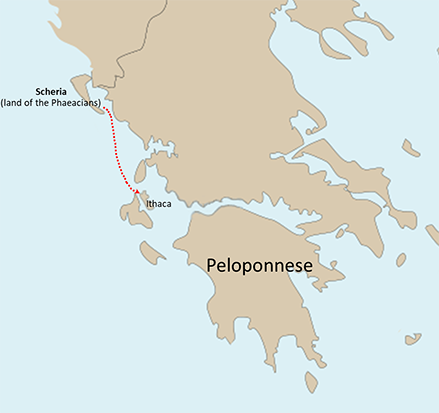
This simple map represents the last stage of Odysseus’ return home to Ithaca from Scheria after being delayed for ten years after the end of the Trojan War. Odysseus is transported by the Phaeacians while he is asleep and he wakes up confused, still unsure where he is.
Odysseus returns to Ithaca in this book and questions of honesty and fidelity are raised. There is the question of Penelope’s fidelity occupying Odysseus’ mind, and there is the further representation of Odysseus as a crafty, cunning man who is loath to reveal himself or his intentions. Odysseus is a man who has learned not to trust the world. This is evident in the lie Odysseus tells Athena when she first reveals he has landed in Ithaca.
When Athena reveals to Odysseus that he has, in fact, made it back to Ithaca, Odysseus attempts to hide not only that this was his intended destination, but even his true identity. Instead, he claims to have killed the Orsilochus, the son of Idomeneus, a Cretan commander at Troy. Odysseus says that he objected to Idomoneus’ presumption that he was under his command, and Orsilochus’ attempts to deprive him of the treasures he won at Troy over the long years of conflict. Odysseus says he killed Orsilochus in response to this personal conflict between them. Odysseus pretends to have landed in an unintended destination after seeking help from Phoenician sailors to return home. It’s a bizarre lie to tell, especially since there is no apparent advantage in telling it. I have looked for explanations online. Some make no sense. It has been suggested that he wishes to protect his identity, since he is unsure whom he can trust. This might make some sense, although as far as Odysseus knows, at this moment, he is speaking only to a simple shepherd boy, and such a tale might only serve to frighten a young man whom Odysseus has just asked for help to secure his valuables. Online responses also suggest that he intends to test the loyalty of his household by first appearing in disguise. However, it is Athena who introduces the idea to send Odysseus home in disguise and warns him not to reveal his identity.
Yet Odysseus’ decision to tell this lie is in keeping with the gods’ practice of disguising their own identities – Athena, herself is currently in disguise – and in keeping with his own nature, since he is “always invoking the cunning in his heart” (13:289)
I can find no mythological source upon which the tale might be based. Idomeneus, Orsilochus’ reputed father, is a Greek fighter in the Trojan War who commands the Cretan contingent. As a name, ‘Orsilochus’ is associated with several men who are clearly not the man Odysseus claims to have killed: one is the son of a river god, Alphaeus; another the brother of Anticleia at Troy, killed by Aeneas; also a Trojan soldier killed by Teucer; a Trojan who went to Italy with Aeneas; and an Argonaut. The Orsilochus of Odysseus’ story seems to be exclusive to this tale.
Another story involving Idomeneus and his son Orsilochus has some parallel to the story of Agamemnon’s sacrifice of Iphigenia, which led to his own murder by Clytemnestra for revenge. The story is that Idomeneus’ ship was imperilled in a storm and in a prayer to Poseidon he promised to sacrifice the first living thing he encountered upon his return home. His son, Orsilochus, greeted him at the shore and Idomeneus kept his rash promise.
However, this sacrificial story is now only known through commentators on Virgil’s Aeneid, which appeared centuries after Homer’s Odyssey, and there is no contemporary account for Homer.
Odysseus’ first instinct on meeting Athena, whom he believes is a shepherd boy, is for the safety of the treasure given to him by the Phaeacians:
Odysseus is clearly discombobulated by having awoken alone on the beach with his treasures, only to discover the place is unfamiliar to him. His injunction against cruelty and his begging for mercy suggests his feelings of vulnerability. His suggestion that the treasure is actually double what is currently on display (“I left behind an equal measure for my children”) may indicate that he wishes to appeal to any possible greed in order to protect himself; that restraint may bring a larger prize. The story he tells about Orsilochus may therefore have two purposes. First, he is establishing the treasure’s provenance, and therefore his right to keep it. Second, he is sounding a warning. He is portraying himself as a man who can protect himself and is willing to act violently to protect what is rightfully his. Odysseus’ later question to Athena, once she reveals herself, wanting to know if he really has landed on Ithaca, suggests an understandable doubt that things have worked out, when he has so often been waylaid by the gods and other powerful figures in the past. It seems to me that Odysseus does not tell this story as a long-term plan to test his household. Rather, it is more likely he tells this strange story as one part of a strategy to protect himself and his treasure in a land which may very well be hostile to his interests.
Odysseus is first told about the situation between Penelope and the suitors when he speaks to the ghost of blind Teresias in the Underworld in book 11. Teresias, who has the gift of foreseeing the future, warns Odysseus that if he or his men harm the cattle of the sun god, Helios, he will lose his ship and his crew, he will suffer further hardships, and when he finally returns to Ithaca he will,
Naturally, this prediction would raise doubts in Odysseus’ mind about the state of his marriage when he returns. Tiresias is not the only one to warn him of trouble. When speaking to his mother, Odysseus’ questions reveal his uncertainties:
Odysseus then explicitly asks is mother, “Or has she wed some other countryman at last?” His mother responds, “No one has taken over your royal rights, not yet.” His mother’s qualified response is only partially reassuring: Odysseus’ hold on his position could be usurped at any time. He is aware of his predicament. His doubts in book 11 may be further compounded when he speaks to other ghost women of the underworld, some of whom have suffered romantic misadventures or practised infidelity. The final unnerving story of relevance is told by Agamemnon. Agamemnon describes how he was betrayed by his wife, Clytemnestra, and her lover, Aegisthus, upon his return from Troy. Agamemnon places most of the blame upon Clytemnestra, and frames his story as a warning against the treachery of all women. He says Clytemnestra,
However, Agamemnon then moderates his tirade. He assures Odysseus that Penelope must be faithful: “She is too much steady, her feelings run too deep”. But he still be warns Odysseus,
The circumstances of Odysseus’ return home and his response to Athena make his prior knowledge of the situation at home relevant to our reading. Odysseus’ hopeful comment as he leaves Scheria – “May I find an unswerving wife when I reach home” [13.48] – also speaks to his doubts. His mother’s reassurance has not been enough and Agamemnon’s story clearly occupies his imagination as he prepares to face circumstances at home. In fact, it is this aspect of Odysseus’ character that makes him fascinating to Athena:
Athena explains the situation with the suitors to Odysseus, although she takes care to reassure Odysseus that his wife works against their interests by falsely building up hopes of each man, though “all the while with something else in mind.”
But Odysseus’ response is somewhat peculiar:
The response is peculiar because it is predicated upon the knowledge Odysseus gains from talking to Agamemnon in the underworld, while at the same time its exclamatory nature suggests the information about the suitors is new to Odysseus, and neither the assurances made by his mother nor those of Athena are enough to overcome the suspicion inspired by Agamemnon’s tale.
It’s worth noting this in passing, because it is this response – giving credence to the possibility of betrayal – that convinces Odysseus to trust in Atena’s schemes to overcome the suitors, and therefore has a significant impact on the direction of the remainder of The Odyssey:
‘Nostoi’ was the title of one of the now-lost works in the Greek Epic Cycle. The term refers to the idea of returning home in Greek culture, and the lost work details some of the stories of the returning Greek fighters from the Trojan War. The Odyssey is also a tale of ‘Nostos’, detailing one of the longest and most difficult journeys of all the Greek fighters. In Book 13 of The Odyssey, Odysseus finally steps ashore on his native Ithaca once more, but his trials are not yet over. He discovers in this episode that he must yet overcome the many suitors who have taken up residence in his home, each plying for the hand of Penelope in marriage. The following images depict stages in his return home and the adoption of his disguise to face the situation.
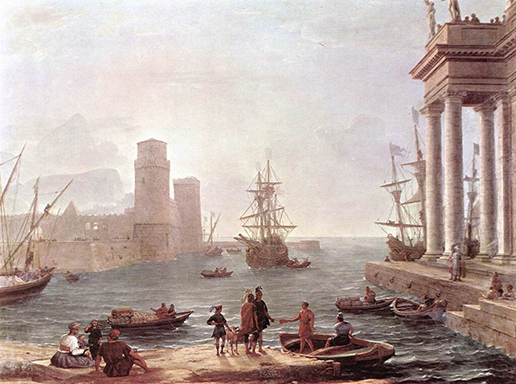
This painting by Claude Lorrain is very similar to another of his paintings which is sometimes attributed as a scene of the return of Briseis at the beginning of The Iliad. You can click here to see that painting and my comments about it.
Claude Lorrain was predominantly a landscape artist who specialised in seascapes by shorelines. Lorrain found a wider market for his landscapes by transforming them into historical scenes with the edition of figures who represented a famous moment. However, Lorrain’s figures and the historical moment remained subservient to the broader landscape in which they were depicted.
In this scene, attributed as a painting showing the departure of Odysseus from the Phaeacians, we see a figure standing in a row boat, presumably Odysseus, who is about to shake the hand of an official. A sail ship, which is entirely historically inaccurate, waits in the harbour.
Nor does Lorrain’s scene really capture the spirit of Homer’s text. We get a strong sense when reading Homer that there is a lot of activity around the ship that will return Odysseus home, as many bring gifts to stow in it. It feels like it is an event attended by numerous people. But here, Lorrain’s scene looks like the parting of a couple of friends, unremarkable to others, even those who sit on the shore nearby. Lorrain’s representation is more interested in the aesthetic possibilities of the scene, rather than representing a narrative moment.
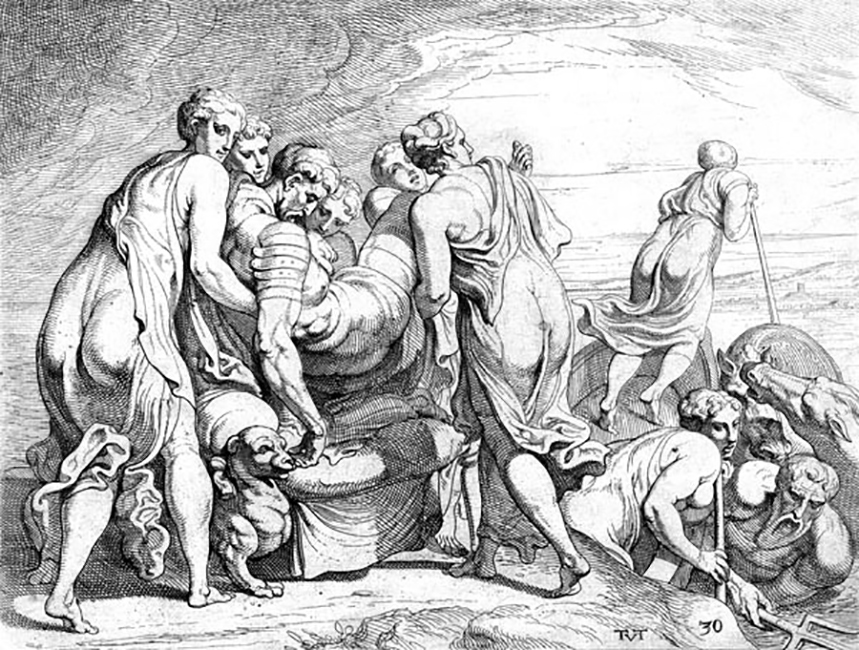
Theodoor van Thulden created a celebrated series of 58 etchings titled The Labors of Ulysses (original French title: Les Travaux d'Ulysse), published around 1633 to 1640. These prints are based on the frescoes by Francesco Primaticcio and Niccolò dell'Abate which were originally in the Gallery of Ulysses at the Palace of Fontainebleau, France. King Louis XV gave ordered for the gallery to be demolished in 1738 to make way for grander apartments. As a result, van Thulden’s etchings are a record of the frescoes.
As for many works of art, there is more than one name attributed to this particular etching, which is the thirtieth in the series of 58. It is known as ‘The Phaeacians Carry the Sleeping Ulysses to Ithaca’ (by the Fine Arts Museum of San Franciso for instance). It also bears the name ‘Faiaks bring the sleeping Odysseus to Ithaca’ on some sites (on Vecteezy for instance).
The reference to Phaeacians makes sense, since it is King Alcinous’ Phaeacian sailors who return the sleeping Odysseus to Ithaca. The reference to ‘Faiaks’ is more curious. The Phaeacians, according to legend, were named after Phaiax (or Phaeax) who was a son of the sea god, Poseidon. So ‘Faiaks’ is a variation on Phaiax (or Phaeax). This means that the Phaeacians were meant to be descendants of Poseidon, which helps to explain their extraordinary seafaring skills and the good will they normally enjoy from Poseidon as they traverse the seas.
In this image Phaeacian women (presumably) carry Odysseus (Ulysses in Latin) to shore to lay him on a couch or bed. In the small boat to the right of the image we see Poseidon clasping his trident. He may also be asleep.
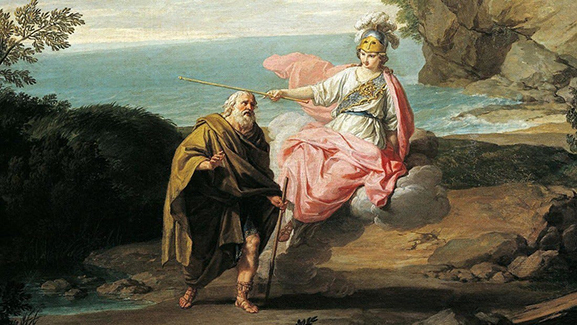
This painting by Giusseppe Bottani represents the moment Athena transforms Odysseus into an old beggar at the end of Book 13. The setting is a coastline, as you would expect, and the scene is a fairly close representation of the moment Homer describes, except for details of Odysseus’ disguise. Homer describes the look achieved by the transformation:
Bottani has Athena waving her wand and provides Odysseus with the staff, but his representation, on the whole, conforms more to principles of classical representation – the flowing, rich robes Odysseus wears, for instance – rather than the squalid image Homer suggests in the filth of his clothes and their rustic character.