
Best viewed on a wide computer screen
In this book Odysseus finally leads the attack against the suitors and retakes his home.
Odysseus pours his arrows at his own feet, readying himself to attack the suitors. He shoots Antinous first, hitting him in the throat as he is drinking. The rest of the suitors react. They look for shields or spears about the hall, but realise there are none to be found. They shout threateningly at Odysseus, but their hope lies in believing that the killing was an accident. For the moment they are helpless. But Odysseus reveals his true identity to them and says that their fates are sealed.
Eurymachus tries to reason with Odysseus. He portrays Antinous as a ringleader who did not represent the feelings of their group: that he forced them into crime. He asks Odysseus to consider the matter settled with the death of Antinous, and he promises to raise taxes and make reparations for the financial hardship Odysseus’ house has suffered during their stay. But Odysseus refuses this offer. He says he will not be swayed by the offer of any amount of money. He declares that he intends to kill all the suitors.
Seeing that his plea is hopeless, Eurymachus next turns to his fellow suitors and encourages them to fight, otherwise Odysseus will have the advantage over them with his bow. Eurymachus tries to lead an attack but Odysseus shoots him with an arrow that lodges in his liver.
Amphinomus tries to attack Odysseus, but Telemachus stabs him from behind with a spear, sending it right through his body. Telemachus swiftly swerves aside in case he, himself, is attacked from behind, and then runs to his father. He offers to fetch shields, armour and weapons from the room where they have been stored, for themselves as well as Eumaeus and Philoetius, Odysseus’ loyal cowherd. Odysseus urges him to hurry while he still has arrows left. Telemachus retrieves the armour and weapons and returns to Odysseus. Telemachus puts on armour, himself, and when Odysseus has run out of arrows, he does the same. Next, he instructs Eumaeus to guard a side door in the hall to prevent any suitors escaping.
Agelaus calls for someone to climb out of the hatch to sound the alarm outside. But Melanthius says it would be too dangerous to attempt. Instead, he offers to fetch armour and weapons for the suitors, guessing that they have been placed in the storeroom. He returns with weapons and armour and distributes them. Odysseus realises that the situation may have turned against him. He wonders if one of Penelope’s women has betrayed him. But Telemachus takes the blame, saying that he had left the door of the storeroom open. Odysseus orders Eumaeus to shut the storeroom door. When Malanthius tries to access the storeroom again Eumaeus spots him and calls for Odysseus to tell him what to do. Odysseus instructs Eumaeus and Philoetius to capture Melanthius and to tie him up to a plank and hoist him into the ceiling’s rafters. They wait outside the storeroom door and catch Melanthius as he is leaving. They tie him to the plank and hoist him up as Odysseus commanded, and then Eumaeus mocks Melanthius, suggesting that he is standing guard where he has been hung.
Eumaeus and Philoetius leave Melanthius and rejoin Odysseus. Odysseus and his companions are outnumbered. But now Athena, once again disguised as Mentor, appears. Odysseus calls upon ‘Mentor’ to rescue them, though he knows it is really Athena. But the suitors do not know this. They threaten ‘Mentor’, saying that if he helps Odysseus they will not only kill him, but they will take his lands along with Odysseus’ and deny his sons their birthright.
Athena chastises Odysseus for showing too little courage. She suggests he is not the same man who fought bravely at Troy. She chooses not to join the fight at this moment to test Odysseus’ mettle. Instead, she flies up to the hall’s central roofbeam.
Now, Agelaus calls upon, Eurynomous, Demoptolemus, Amphimedon, Pisander and Polybius to support him in a coordinated attack upon Odysseus in the hope that if they kill the others will put up no further resistance. All six of them hurl their spears at Odysseus but Athena makes the spears fly wide of their target. Next, Odysseus calls for a counterstrike. He and his men throw their spears. Odysseus kills Demoptolemus, Telemachus kills Euryades, the swineherd Elatus and Philoetius the cowherd kill Pisander, leaving only three suitors opposing them from this original grouping. The remaining suitors again throw their spears and Athena again deflects them. Only Telemachus receives a minor scratch on the wrist. Cteisippus, who appears to have joined the fight, sends a spear over Eumaeus’ head. Odysseus and his crew throw again. Odysseus strikes Eurydamus, Telemachus hits Amphimedon, Eumaeus kills Polybus and the cowherd stabs Ctessipus, who mockingly thrusts the spear into him.
Next, Odysseus stabs Agelaus through his body with a lance. Telemachus spears Leocritus in his groin, and Athena terrifies the remaining suitors by looming over them from the rafters and brandishing her shield. The suitors flee down the hall, terrified. Odysseus and his group chase them down like birds of prey. They kill the suitors.
Leodes, the seer, however, remains alive. He clutches Odysseus’ knees and begs to be spared. He says he tried to stop the suitors but they wouldn’t listen to him. But Odysseus doesn’t trust him, and so kills him by cutting off his head.
Phemius, the bard, still clutches his lyre, and debates with himself what to do: to flee or beg for mercy? He decides to beg for mercy, too. He says that if he is spared, he will sing songs that will glorify Odysseus. He says he only ever performed for the suitors against his will. Telemachus intercedes and asks Odysseus to spare Phemius. He also speaks on behalf of Medon, the herald. Medon rushes to Telemachus, clutches his knees and begs for mercy. Odysseus agrees to spare the two men. He tells them to wait outside while he finishes what he has started inside. The two men leave.
Now the suitors all lie dead in a bloody mess on the floor, reminiscent of a haul of dead fish lying in netting on the seashore. Odysseus asks Telemachus to summon the nurse, Eurycleia. When she arrives she finds Odysseus amongst the corpses, covered with blood and gore. She is happy at the fate of the suitors, but Odysseus tells her that it is wrong for her to openly take joy at the fate of the slaughtered men. He has asked to see her because he wants a report on the loyalty of the women who serve under her. There are fifty women serving in the house and she says that there is about a dozen who have been with the suitors. She offers to go wake Penelope to let her know what has happened in the hall. But Odysseus stops her. Instead, he wants Eurycleia to direct the dozen women she has nominated to come to him. When they arrive, he tells Telemachus to get the women to help him to start clearing away the bodies and to clean the furniture of blood. Once that is done Telemachus’ order is to kill the women with his sword.
The women are distressed as they carry out their work, either anticipating their own fate, or they upset at the deaths of their lovers, or both. After the furniture is cleaned Telemachus and the herdsmen scrape the floor, made from packed earth, clean. After all that, the women are taken outside. Telemachus declares that none of them will have a clean death, meaning they will not die by his sword. Instead, he sets up a ship cable between the roundhouse and the top of a column. Then the women’s heads are placed in nooses and they are hanged from the cable.
Next, Melanthius is brought out from where he had been hoisted in the storeroom. His nose, ears and genitals are cut off. After that, the house is fumigated with sulphur, and a fire is used to purify the house with smoke.
The women who have remained loyal to Odysseus and his household are then brought down by Eurycleia and they welcome Odysseus home.
In Book 22 Odysseus finally takes action against the suitors, supported by his son Telemachus, his swineherd Eumaeus, and Philoetius, his loyal cowherd. With the support of the goddess Athena these four men are able to subdue and finally kill all the suitors. However, the suitors are not the only ones whose life hangs in the balance with the return of Odysseus. Twelve serving women are nominated by Eurycleia, Odysseus’ old nurse, as traitorous, while a further three men beg for their lives, and Melanthius is subjected to a horrific death. This is a summary of their fates and a reminder of why Odysseus and Telemachus make the decisions they do about showing mercy or killing them.
In Book 21 Leodes is the first of the suitors to attempt to string Odysseus’ bow and fail. However, Homer allows his audience to feel a measure for sympathy for Leodes. We are told that he is a seer and that he sits well back, suggesting he is not as actively engaged with the other suitors actions. Also, Homer tells us that he was, “the one man in the group who loathed their reckless ways / appalled by all their outrage.” Unfortunately for Leodes, his sense of outrage is not demonstrated in his actions. He remains part of the group, pressing Penelope for her hand in marriage.
After he attempts to string Odysseus’ bow, he makes the prophetic observation that, “Here is the bow to rob our best of life and breath.” It is a remark that angers Antinous. Leodes also begins to see that their campaign to win Penelope may be hopeless, and that they might be better off pursuing other women
After the terrible slaughter of suitors Leodes is the first to beg for his life. He denies ever harassing any woman from Odysseus’ household, and he says that the other suitors would not listen to him when he spoke against them interfering with the women. He claims,
However, Odysseus dismisses his plea. He understands that the key factor in Leodes’ continuing presence in his house was the hope that he might eventually be the one to win Penelope’s hand in marriage, and coupled with that had to be a hope that Odysseus would never return:
Odysseus hacks off his head with a sword that is lying nearby.
We have to go all the way back to Book 1 to recall Phemius’ circumstances. We first encounter him less than two hundred lines into The Odyssey. He is a bard, a singer of songs that tell stories, much like Homer and men like him must have been during the period that the Epic Cycle was being constructed. Though it may only be fanciful, it is therefore easy to imagine Homer inserting himself into the epic with the character of Phemius, much like a director of films appearing briefly in their films. It is made clear that Phemius unwillingly performs for the suitors:
Attention is again focused on Phemius later in Book 1 when he performs a song that tells the story of The Achaeans’ Journey Home from Troy. Since Odysseus has not returned, Penelope is upset by the song and asks Phemius to stop singing. Telemachus defends Phemius’ choice of subject to his mother. First, he says that bards are inspired by Zeus in their choice of subject matter. Second, he says that it is always the latest song that is the most impactful for an audience and receives the most praise. Penelope is still upset and leaves. But we see that Telemachus is sympathetic to Phemius’ situation.
Telemachus’ sympathy proves crucial for Phemius. Phemius at first considers fleeing when he sees the slaughter in the hall, but then he decides to stay and plead for mercy, even though Leodes was granted none. Phemius makes two appeals to Odysseus as he clings to his knees. The first is an appeal to vanity. He suggests that if Odysseus spares his life, he will be able to establish his reputation in song for generations to come. His second appeal is for Odysseus to listen to his son, Telemachus, whom he believes will confirm he was not a willing performer for the suitors. Telemachus declares Phemius innocent and tells Odysseus not to kill him.
We encounter Medon in Book 4. He overhears the suitors plotting to ambush and kill Telemachus as he returns to Ithaca from the Peloponnese. He reports the plan to Penelope who was not aware that Telemachus had gone. Medon is described as “the soul of thoughtfulness” (4:801).
Telemachus vouches for Medon to Odysseus when he is asking Odysseus to spare Phemius. He does not even know if Medon has survived the battle, but upon hearing Telemachus’ words Medon reappears from under a chair where he has been cowering.
He and Phemius are told to wait outside the palace while the palace is cleaned up.
Homer has already set Melanthius up as a villain in Books 17 and 20, and his mean-minded and cruel treatment of Odysseus is clearly repaid with moralistic punishments that are meant to humiliate and emasculate him.
In Book 17, Melanthius meets Odysseus and Eumaeus on the road as he is herding his goats. Unprovoked, he immediately breaks into an abusive tirade:
In Book 20 Melanthius is called upon by Antinous to try to soften the wood of Odysseus’ bow after Leodes fails to bend it. Melanthius again confronts Odysseus in Book 20 as the feast is being prepared. He asks, “Still hounding your betters?” He asks Odysseus “Why don’t you cart yourself away?” He tells him to leave and threatens that he will physically harm Odysseus. He shows contempt for Odysseus because he believes him to be a beggar.
In Book 22 Melanthius shows that he is not merely a nasty man, but that he actively supports the suitors. He guesses where the weapons and armour have been stowed and he retrieves it for the suitors to give them a fighting chance against Odysseus’ group. He is captured by Eumaeus and Philoetius when he again enters the storeroom where the arms have been hidden. They bind him hand and foot and then hoist him with a rope high up near the ceiling and leave him to wait while the suitors are defeated.
Homer does not record whether Melanthius begs for his life or not. He is the last to be killed, after the traitorous women, and while his death is horrible, it also seems like a mere footnote to the carnage that has preceded it:
Eurycleia identifies around a dozen women out of a retinue of about fifty in the house who have been sleeping with the suitors and therefore can no longer be deemed loyal:
The situation with these women has been well established already. The issues around Penelope’s maids and Melantho in Books 18 and 19 are covered more completely in the page for Books 19 on this website under the title ‘Anticipating the Killing of the Maids’. Click here to see that page.
At the beginning of Book 20 we are given a further insight into Odysseus’ feelings about the unfaithful women. He lies awake at night and he hears the women slipping outside the house to go sleep with their lovers: “should he up and rush them, kill them one and all / or let them ruth with their lovers one last time?” (20:13-14)
Eurycleia is asked to identify the women who have been allied with the suitors and to send them to the hall where the slaughter has taken place. Odysseus orders Telemachus to make them clear away the bodies of the suitors and then kill them with a sword. The twelve women weep as they perform this task: first, we must assume, for their dead lovers; and second, because they must be anticipating their own deaths. Only the unfaithful women have been selected for this task.
Telemachus does not kill them with a sword since he believes this will be too merciful (“No clean death for the like of them . . .” (22:488). He is angered at the personal abuse he and his mother have received from the women who have obviously become arrogant. Instead, he chooses to hang them from a cable, which is a slower death.
Margaret Atwood focuses on this execution in her novel, The Penelopiad, which will be reviewed on this website during June 2026.
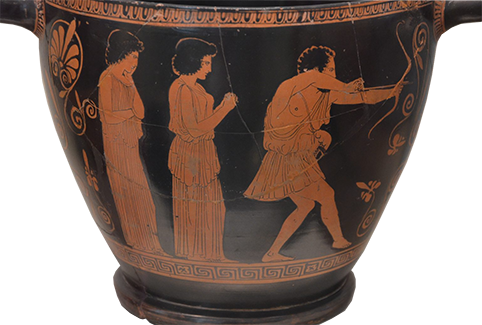
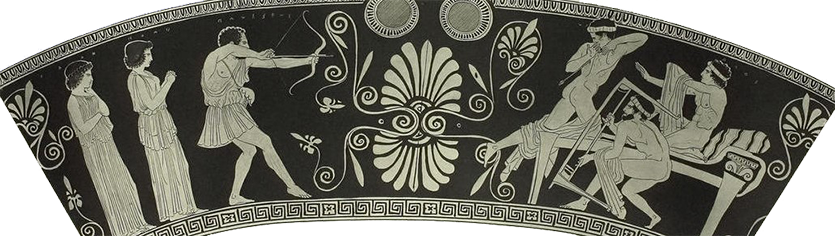
The above attic red figure skphos features a scene of Odysseus shooting arrows at the suitors. The black and white scan beneath the image shows the complete scene. Odysseus draws his bow to shoot on the left of the image with two female servants standing behind him. The right side of the image features three suitors, one of whom tries to hide behind a table for protection. Another, seated on a lounge, holds his hands up defensively, while the third has already been struck by an arrow.
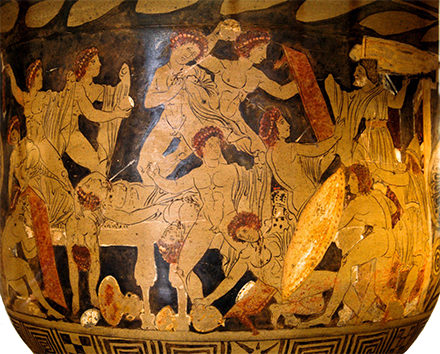
This red-figure bell-krater depicts the slaughter of the suitors, but its representation is far more chaotic than the scene on the skphos by the Penelope Painter, and illustrates the battle more graphically. To understand the scene, it is easiest to divide it in a 2:1 ratio. On the left two thirds of the image we can see the suitors attempting to defend themselves against Odysseus, Eumaeus and Telemachus. These three attackers can be seen on the right third of the image, facing the defenders. At the top we see Eumaeus. We see Odysseus in a peaked cap below him, the left-most figure in the image, who appears to be crouching to draw his bow. In the foreground at the bottom we see the young Telemachus, holding a large shield and advancing on the suitors.
Behind the defending suitors we see several men who have already been killed. Another, just before Telemachus, seems to be stumbling, succumbing to the fierce onslaught of the attack.
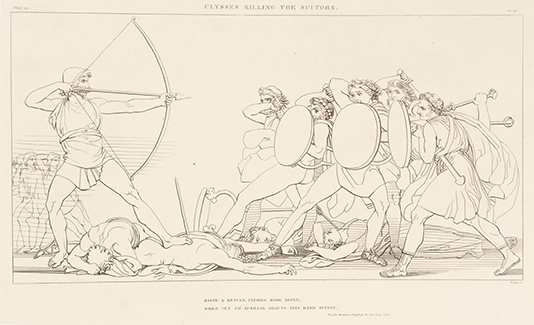
John Flaxman, a British sculptor, was commissioned to produce illustrations for The Iliad and The Odyssey with the intention that they would be engraved and published. Flaxman produced line drawings without colour that became highly popular in the 19th century.
His images are often adapted by other artists or by companies to sell as merchandise.
The paintings below would appear to be influenced by Flaxman’s representation of the scene in which the suitors attempt to defend themselves against Odysseus’s attack.
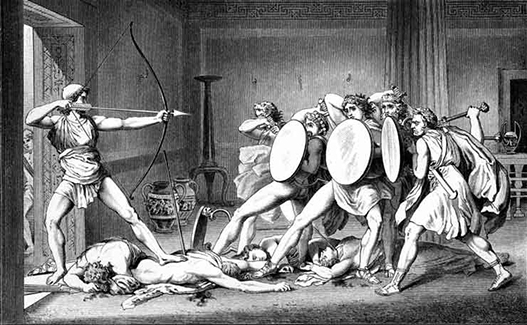
Gustave Schwab originally created this illustration for his book Die schönsten Sagen des klassischen Altertums (Legends of Classical Antiquity) in the early 1880s. The debt he owes to John Flaxman is undeniable. Except for some of the background details, the figures in the engraving follow Flaxman’s original exactly. Odysseus’ left foot is placed upon the body of a suitor, possibly Amphinomus who was impaled with a spear through the back by Telemachus. Five suitors cluster together holding furniture to protect themselves, four of whom also seem to brandish swords above their heads. In Homer’s Odyssey six suitors, Agelaus, Eurynomus, Demoptolemus, Amphimedon, Pisander and Polybus band together to attempt to make a charge against Odysseus.
Flaxman’s original image is accompanied by a quote from Alexander Pope’s translation of The Odyssey at the bottom. It reads:
Fagles’ translation of the same moment reads:
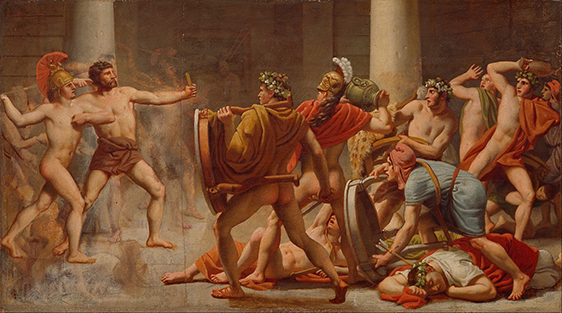
This version of the same scene has a similar layout to John Flaxman’s original sketch, but the representation is more original. The grouped suitors look less aggressive than in Schwab and Flaxman’s works. They are also not as unified in action. Apart from the two front suitors, who hold a table and an urn, the rest of the suitors are either dead or leaning back defensively.
A peculiar feature of this painting is the ‘ghostly’ figures that appear around Odysseus and Telemachus on the left. I do not know if these are the result of reworking or later attempts to block out figures. I have found no explanation of it except for an AI bot that wanted to suggest they represented Athena’s divine intervention. However, this seems unlikely. For a start, none of the figures could be identified as Athena.
The style of the painting is neoclassical, but the execution is less formal than what we might expect. Though painted in 1814, its brushwork, in places, vaguely resembles the broad hatching strokes of Paul Cézanne.
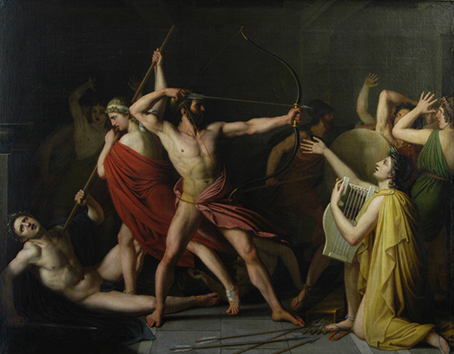
Thomas Degeorge was a French neoclassical painter who studied under Jacques-Louis David, the neoclassicist painter who was a supporter of the French Revolution. This painting reflects some of the same formal composition that we might expects from David, as in his ‘Oath of Horatio’ (1784), in which the stance of figures is static and sculptural.
This title of this painting translates in English to ‘Ulysses and Telemachus slaughtering Penelope's suitors’, yet it is interesting to consider what comprises the composition. Like David’s ‘Oath of Horatio’ the canvas is divided. The figure of Odysseus dominates the picture, drawing his bow. Behind him on the left of the picture we see Telemachus impaling a suitor with his spear. In Homer Telemachus impales Amphinomus, but he stabs him from behind.
To Odysseus’ right we see a somewhat different scene. In the background we see another figure, presumably Eumaeus, on the attack. In the foreground we see a young man on his knees, holding a lyre, presumably Phemius, who will be spared at Telemachus’ request. However, it is difficult to identify suitors behind him where Odysseus’ arrow is aimed. There appears a woman in a green dress and another in a red or brown dress. It is unclear whether the face of another background figure appearing between them is male or female, but they look feminine.
It appears this painting is possibly a montage scene or narrative painting depicting different moments from Book 22. Odysseus does not shoot the women in Homer’s version. They are hanged by Telemachus. The figures appearing as they do in this painting do not make sense, otherwise.
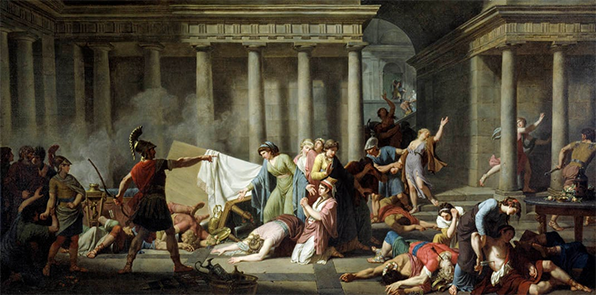
The website, matthiesengallery.com, identifies the woman in green at the centre of this painting as Penelope. I think that is an uncertain attribution since Penelope does not appear in Book 22 of The Odyssey. Odysseus tells Eurycleia not to wake her until the palace has been cleaned.
However, the group of women at the centre of this painting differ to other women who appear in it. One is on her knees, praying, another genuflects, while women at the back of the group turn their heads aside or look heavenward. If Penelope were to appear in this scene, it would have to be among this group. They are all dressed modestly and seem to act with propriety, unlike the woman to the right in purple being led by a man, her breast exposed, or others who appear to flee in terror or are manhandled in the background.
Women on the right of the painting attempt to move the bodies of the dead suitors, thus identifying them as part of the group who will later be executed by Telemachus.
Odysseus is portrayed to the left of centre, his right arm pointing commandingly, his bow held in his left hand. He appears to be pointing to the woman fleeing on the right of the painting, seen behind a column. She is being pursued by the man placed behind the table on the right.
More dead suitors lay on the ground behind Odysseus.
The painting is neoclassical in style and seems to represent different moments of the story. For that reason, while the centre group of women might be interpreted as being aligned with Penelope, they also might represent a different moment from the women on the right who move the bodies. They might also be begging for their lives. The women who are chased or manhandled may represent the moment when they are rounded up for execution.
The group of men to the far left, seen in shadow, possibly represent Telemachus (with a helmet) as well as Eumaeus and Philoetius who have fought with Odysseus. The figure kneeling in supplication possibly represents one of the pleas made for mercy after the battle, possibly Medon, who specifically targeted Telemachus for clemency.