
Best viewed on a wide computer screen
In this book Eumaeus tells Odysseus his own story of enslavement and Telemachus returns to Ithaca at Athena’s urging.
Athena returns to Sparta to encourage Telemachus to go back to Ithaca to protect his home and possessions from the suitors. Penelope is under pressure from her father and brothers to marry Eurymachus, the most generous of the suitors. Athena warns Telemachus that women can easily succumb and when they do, they will support their new husbands rather than their old family. She advises him to turn over his goods to his most trusted serving woman. Athena also warns Telemachus about the ambush that Antinous and Eurymachus planned for him that is described in Book 4. She suggests he finds another route home to avoid the attack, and then spend the first night with Eumaeus, the swineherd, upon his return to Ithaca.
In his enthusiasm to obey Athena, Telemachus wakes Pisistratus, his friend and Nestor’s son, but Pisistratus advises they wait until morning. The next morning Telemachus tells Menelaus he wants to return home. Menelaus says he would not detain him but asks to wait until they can find gifts for him. He even suggests taking Telemachus on a tour through mainland Greece, which would win him more treasures from other kings. But Telemachus insists he must go. Menelaus orders a meal be prepared, and then goes to a storeroom with Helen and his son Megapenthes, where they choose gifts for Telemachus: a mixing bowl made by Hephaestus, robes woven by Helen and a two-eared cup. Telemachus is presented the gifts and Pisistratus stows them in the chariot. They are then served the meal.
After they have eaten Menelaus bids them goodbye. As they are leaving, he asks them to give his greetings to Nestor, Pisistratus’ father. Telemachus promises to do so. At this moment an eagle flies past, clutching a goose. Pisistratus asks Menelaus its import. But Helen interjects to give her own interpretation. She says the eagle and goose are a sign that Odysseus will return home and have revenge upon the suitors.
Telemachus and Pisistratus leave the city and head through the countryside until they reach Phera, where they stay in Diocles’ halls for the night. The next day they continue their journey, but when they approach Pylos, Telemachus asks Pesistratus not to take him to see Nestor. He fears Nestor will delay him too long. So Pisistratus decides to take Telemachus to his ship immediately, and warns him to set sail without delay, so that he might be at sea by the time Pisistratus returns home to his father. Otherwise, Nestor might even come to the harbour to find Telemachus. Telemachus agrees. But before they set sail a man – a foreigner – approaches them. He is from a long line of seers, descended from Melampus, he says. He explains his lineage to Telemachus. He wants to be allowed aboard because he has killed a man from his own country whose brothers now seek revenge. Telemachus decides he will protect the man whose name is Theoclymenus. He allows him on board and they set sail for Ithaca, aided by a wind from Athena.
The narrative returns to Odysseus and Eumaeus. Odysseus again decides to test the swineherd: to test his hospitality by seeing if he will offer him a place to stay for a longer period. He begins by considering aloud what his options are once he leaves Eumaeus. He says that he might beg on the streets, or that he might seek out Penelope, or he might even try to ingratiate himself with her suitors. Eumaeus is shocked to hear he is considering going to the suitors. He warns Odysseus that even their servants will consider themselves his social superior. He insists that Odysseus stay with him. In fact, he even insists Odysseus awaits Odysseus’ return, a possibility that he denied to be possible only a short while ago. Odysseus asks about the parents of Odysseus. Eumaeus says that King Laertes still lives, but is miserable and desires death, and that his mother died from grief when Odysseus didn’t return. Eumaeus was fond of Anticlea, Odysseus’ mother, because she raised him alongside Odysseus’ sister, and she gave him his position as swineherd when he was old enough. Eumaeus reflects that Penelope’s current situation does not allow her opportunities to show such kindness to servants and slaves, which is important for their morale.
Odysseus asks how Eumaeus came to be a slave.
Eumaeus says he came from the island of Syrie, a kind of Utopian place where suffering and sickness seemed absent. His father ruled two cities there. One day some Phoenicians landed and were attracted by a Phoenician slave held by his father. She explained to the men how she was taken from a wealthy family by pirates and sold to Ormenus, Eumaeus’ father. The Phoenician woman made a bargain with the Phoenicians: that they should avoid revealing they knew her, but when they were ready to leave they would send her a signal, and she would escape with gold and the king’s son and join them.
A year passed and the Phoenicians had filled the hold of their ship with trade. They sent a signal to the woman. She stole three goblets and took the young Eumaeus with her and joined the Phoenicians on their ship. But after a week into the voyage the god Artemis shot and killed the woman, leaving Eumaeus alone with the Phoenician crew. They brought him to Ithaca where they sold him to Laertes.
Despite this sad story, Odysseus encourages Eumaeus to reflect on how lucky his life has been: that he was bought and raised by a kind family. He also says Eumaeus’ life has been better than his own.
Telemachus and his crew land back in Ithaca. They have a feast and then Telemachus says he will head off to see his swineherd, Eumaeus. Before he leaves Theoclymenus asks where he should go. Telemachus says that normally he would host Theoclymenus himself. He suggests Theoclymenus might go see Eurymachus, the lead suitor for Penelope’s hand in marriage. At that point, there is another omen. A hawk flies past with a dove in its claws. Theoclymenus says he is a seer and offers to interpret. He says that Telemachus’ line will reign as kings forever in Ithaca. Telemachus is heartened by this and now turns to his trusted friend, Piraeus, whom he asks to shelter Theoclumenus. Piraeus and Theoclymenus set sail. Meanwhile, Telemachus leaves to see Eumaeus, the swineherd, as he has been directed to do by Athena.
In this book Telemachus is joined by Theoclymenus. Theoclymenus is now a fugitive because he killed another man from his own tribe. The man had many brothers, he tells Telemachus, and those brothers now seek revenge. Theoclymenus has accepted that he must now wander the world to avoid retribution and asks to be taken aboard Telemachus’ ship.
But before he is taken aboard, he outlines his family lineage, starting with a prophet, Melampus, his great grandfather. The outline of his family’s structure and history can be found in lines 250 – 285 of Robert Fagles’ translation. The following diagram has been created from those lines:
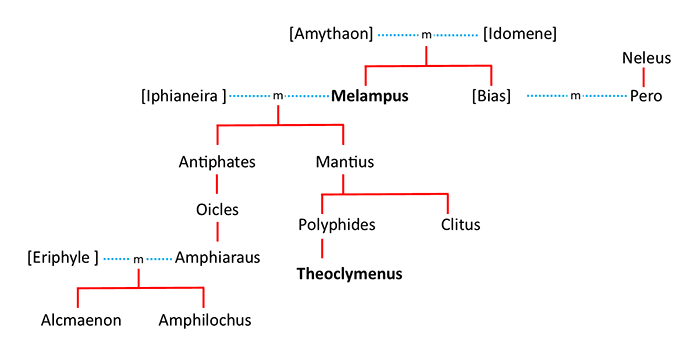
Characters in this diagram appearing in [square brackets] are not named by Homer. Their names have been taken from other sources.
By retracing Theoclymenus family tree back to Melampus Homer is establishing his bona fides as a seer. Melampus was a famous seer and other men in the family line also had this gift. Theoclymenus’ gifts as a seer are demonstrated later in this book and they will be important in later moments of the narrative.
The family history Homer relates is patchy. There are a number of vague allusions that are difficult to follow in Homer’s tale, and may actually lead to misinterpretation of one kind or another, depending on which translation is used. The vagueness of the detail may possibly be attributed to Homer’s audience being highly familiar with the stories already, and so they only needed perfunctory reference.
There are other legends concerning the people mentioned in Theoclymenus’ family history (for example, one legend concerning Melampus is that he was given the gift of speaking to animals by two snakes he protected; another that he introduced the worship of Dionysus to Greece). I will only focus on filling out and clarifying details, or explaining the most salient aspects for which a character is known. I have attempted to reconcile details from various sources where ever I give details beyond what Homer tells us, but the variety of versions of these stories means they are only a version or approximation.
What Homer tells us:
Melampus lives in Pylos and is rich but he is forced to flee the island when Neleus takes over his estate by force. Homer says that he was forced to go abroad to escape the “hot-blooded Neleus” but does not say exactly why: whether the acquisition of his estate is the reason, or if that happens afterwards. It sounds like a dispute between them, but other stories (outlined below) suggest Melampus had another purpose for leaving. After that, Melampus had been held prisoner by Phylacus for a year. Robert Fagles’ wording – that Melampus “suffered agonies – for Neleus’ daughter Pero” – is ambiguous. It might suggest his desire for her, but Fagles is referring to the agonies of his imprisonment. The reference to Pero is explained below.
We are told that while captive Melampus has a murderous desire for revenge. Homer’s account does not say why nor how Melampus is released. He somehow gets free and drives Phylacus’ cattle back to Pylos, and takes revenge on Neleus, but Homer isn’t clear what the revenge is. Melampus then gives Pero to his brother as a wife. After, he moves to Argos where he becomes ruler, marries, builds a house and has two sons, Antiphates and Mantius.
Details of the story of Melampus compiled from other sources:
Melampus was driven out of Pylos over a dispute with Neleus, which resulted in Neleus taking over his estate for the year Melampus was absent. As a response to this, Melampus decided to help his brother gain the hand of Neleus’ daughter, Pero, in marriage. To discourage suitors, Neleus had decreed that for any suitor to win his daughter’s hand, they had to steal the cattle of Phylacus, the King of Phylace. He did not expect his terms would ever be satisfied. Melampus was caught trying to steal the cattle on his brother’s behalf and was held prisoner by Phylacus. In another story about Melampus we find that he was gifted the power to understand the language of beasts by two serpents he protected. This becomes important in this story. While imprisoned Melampus could hear the worms in the woodwork of the house where he was being held. From this he understood the building would soon collapse and he asked to be moved. When the house collapsed soon after that, Phylacus offered the cattle to Melampus he had been imprisoned for trying to steal if he could cure his son, Iphiclus, of impotence. By listening to the speech of birds, Melampus was able to determine that the boy became impotent upon seeing animals castrated by a knife, and that if he took the rust from the knife for ten days he would be cured. It worked and Melampus was released with the cattle he needed. Once he had the cattle, he drove them back to Pylos to meet the marriage conditions on his brother’s behalf. His revenge was to overcome the strict conditions set for Pero’s hand, and thereby humiliate Neleus, who had driven him out of the city.
There are other versions of this story and other legends about Melampus, but these details accord with the information given in Homer.
What Homer tells us:
He fathered Oicles.
Other details about Antiphates:
This Antiphates is not to be confused with the king of the Laestrygones, Book 10 of The Odyssey, the tribe of gigantic cannibals who attack and kill most of Odysseus’ men. Homer offers us no story about Antiphates other than that he father Oicles.
What Homer tells us:
He fathered Amphiaraus.
Other details about Oicles:
Homer really tells us nothing about Oicles, but there are other details to give him context outside of what Homer has to say. In other tales he accompanied Heracles and Telamon to Troy to attack King Laomedon. One version of his story is that he was killed at Troy, protecting the ships against an attack by King Laomedon.
This story is not to be confused with the expedition against Troy which is the subject of Homer’s Iliad. This expedition was before that. King Laomedon had refused to pay Heracles for killing a sea monster that had threatened the city. Heracles quickly overcame the city with only a few ships. The city that features in The Iliad was a better fortified, built after Heracles’ expedition.
In some versions of Oicles’ story he survives the expedition to Troy and returns to live in Arcadia.
What Homer tells us:
He was a warrior whom Homer describes as a “driver of armies”, but he died in Thebes as a result of a bribe his wife took. He had two sons, Alcmaenon and Amphilochus.
More details about Amphiaraus
Unrelated to Homer’s story is that Amphiaraus was present at the hunting of the Calydonian Boar and was also an Argonaut on the voyage with Jason. You can read more about the Calydonian Boar hunt on our page about Book 9 of The Iliad by clicking here. It appears there under the subheading ‘Meleager and The Calydonian Boar’.
Of relevance to the story Homer is telling is that Amphiaraus also had the family gift for foreseeing the future. This becomes relevant in the story of the seven heroes who make war against Thebes. It is a famous war in Greek mythology in the generation before the Trojan War, but was considered a significant event of the period. The war is dramatized in several plays, but most notably in Aeschylus’ play, Seven Against Thebes.
The ‘seven’ were seven champions who made war on Thebes. Adrastus, the king of Argos, made war against Thebes to restore Oedipus' son, Polynices, to the Theban throne. Amphiaraus was one of the seven heroes. They failed to take the city and all but one were killed, including Amphiaraus.
The relevant detail mentioned by Homer is that he was “undone by a bribe his wife accepted”. The bribe was the necklace of Harmonia, the daughter of Aphrodite, which is said to have brought misfortune to all its wearers. It was given to Eriphyle, Amphiaraus’ wife, by Polynices, Oedipus’ son in exchange for her persuading her husband to take part in the war. She persuaded Amphiaraus. He agreed to go reluctantly because he had foreseen the expedition against Thebes was doomed. He asked his sons to avenge him if he failed to return from the war by killing their mother. He also forewarned the other warriors that they would fail against Thebes, to no avail.
During the campaign an eagle snatched Amphiaraus’ speer and dropped it. It transformed into a laurel tree where it dropped. During the battle Zeus threw a thunderbolt to save Amphiaraus from an attack, opening up the earth where the laurel tree stood, and Amphiaraus and his chariot were swallowed by the earth and after that resided in the underworld.
What Homer tells us:
He was a son of Amphiaraus.
Other details:
Alcmaenon was one of the ‘Epigoni’, a term for the sons of the seven heroes who originally failed in their military campaign against Thebes. He was made the leader of a new campaign against Thebes, a decade after the first. This time, Thebes was defeated and King Laodamus was killed.
Different versions reconcile this story with Alcmaenon’s killing of his mother in different ways. One presumption is that he killed his mother, Eriphyle, after he returned from the campaign. He did this as a promise to his father, Amphiaraus, who failed to return from the campaign against Thebes after Eriphyle persuaded him to go.
Alcmaenon was pursued by the Furies across Greece for this crime. There are different versions of how Alcmaenon escaped their pursuit. In one version he is purified of his crime by King Phegeus in Psophis, to whom he gives the robe and necklace of Harmonia in gratitude. Eriphyle had persuaded Alcmaenon (as she had persuaded his father) to take part in the campaign against Thebes after Thersander, another of the Epigoni, used the robe to gain her support.
In another version, Alcmaenon is told by an oracle that he could avoid the fate of the Furies if he managed to stand on land that did not exist when he killed his mother. He does this by finding a newly formed delta at the Achelous River. There, the river god, Alchelous, promises his daughter’s hand in marriage to Alcmaenon, if he would retrieve the necklace of Harmonia, given her by Polynices, and the robe of Harmonia, for his daughter.
Now the two versions of the story become one. Alcmaenon returns to King Phegeus to ask for the robe and necklace back, saying he needs it for purification. Discovering the truth, Phegeus has Alcmaenon killed. There are different versions of the story.
What Homer tells us:
He was the son of Amphiarus.
Other information:
In some versions of the family history he is said to have helped his brother, Alcmaenon, kill their mother, Eriphyle, at their father’s request.
He was also one of the ‘Epigoni’, the sons of the original heroes who attacked Thebes who finally took the city ten years later.
He was the King of Argos and a suitor for the hand of Helen. He fought in the Trojan War and returned to Greece afterwards.
He is also said to have been a seer.
Accounts of his death vary. In one account, he is killed by Apollo. In another he is killed by his half-brother, Mopsus.
What Homer tells us:
He had two sons, Polyphides and Clitus.
What Homer tells us:
Clitus was a beautiful young man who attracted the goddess of Dawn, Eos. She kidnapped him and he then lived with the gods.
What Homer tells us:
Apollo made Polyphides a prophet, the greatest on earth. After a feud with his father, Mantius, he went to Hyperesia to live. His son was Theoclymenus.
Book 15 of The Odyssey is a ‘quieter’ moment in the narrative for which there is little art available. It falls between some of the most famous moments of The Odyssey like the story about Polyphemus, the Cyclops, and the Sirens, which have inspired a great deal of art, and the final sections of the narrative when Odysseus returns to take back his house from the Suitors.
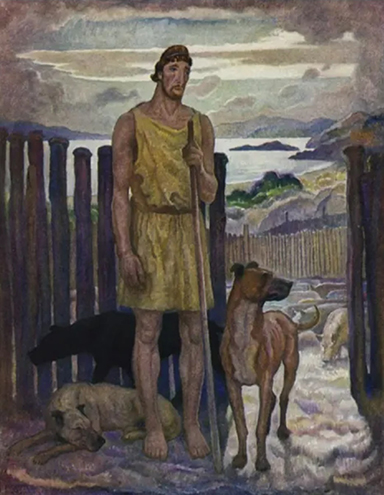
Newell Convers Wyeth was a famous American painter and book illustrator. He illustrated an edition of George Herbert Palmer’s translation of The Odyssey in 1929. Here, Wyeth portrays Eumaeus as a simple farmer. He stands with three of his four dogs against the stockade fence he built from oak trees, we are told, at the beginning of Book 14. His appears tall and powerful, but his quiet and humble demeanour belie the role he will later play in helping Odysseus to kill the suitors.
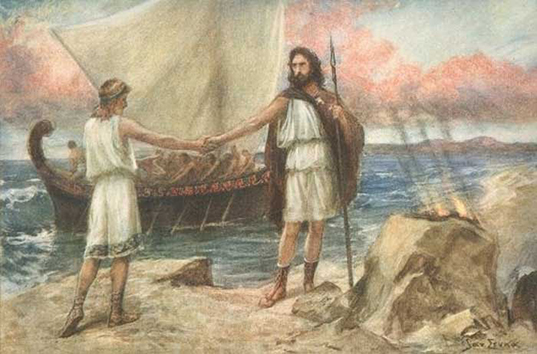
Jan Styka created a series of over 80 illustrations for Homer’s Odyssey over a 22-year period between 1901 and 1923. The works were completed in a variety of mediums. In this painting we see the moment when Telemachus agrees to take Theoclymenus on board. Theoclymenus is fleeing retribution for killing a family member. He has the power to interpret omens and foresee events, and so he will now have some part to play in the coming books. He will predict the return of Odysseus and the defeat of the suitors, but his warnings will go unheeded.