
Best viewed on a wide computer screen
In this book Odysseus, in disguise and unrecognised, is hosted by his old swineherd, Eumaeus, who demonstrates his loyalty.
Odysseus arrives at the swineherd’s place, a farmstead made by Eumaeus’ own hands. His farmstead includes twelve sties, each of which can house fifty sows. The boars sleep outside, but their numbers have been diminished – only 360 remain – by the suitors. Eumaeus has four men who help him with the pigs. Three are tending pigs when Odysseus arrives while a fourth is taking a boar for the suitor’s next feast.
When Eumaues’ dogs see Odysseus approach they charge him threateningly. Eumaeus calls them off. He quickly turns to the subject of Odysseus, long missing, and his own longing for his king. Eumaeus is a loyal servant. After many years’ absence and Odysseus’ disguise, Eumaeus doesn’t recognise him. Yet he invites Odysseus into his dwelling. He reveals that he believes in the laws of hospitality. Of Odysseus, he believes he has been waylaid by the gods, and he laments that he would have been well rewarded by Odysseus, had he returned. He speaks bitterly of Helen, on whose account he believes Odysseus has died.
Eumaeus kills two pigs to cook for himself and Odysseus. He tells Odysseus that these are not the best pigs. They are scrawny and would normally be served to slaves and servants. Meanwhile the suitors eat the best fatted hogs and drink Odysseus’ wine. They believe Odysseus is dead and so there is nothing to restrain their behaviour, now. They fear no retribution.
Eumaeus says that Odysseus was wealthy: one of the wealthiest kings. And he lists Odysseus’ livestock holdings both in Ithaca and abroad. But everyday his stock is being diminished by the suitors.
Odysseus asks to be told about himself by Eumaeus, pretending not to know the name of Eumaeus’ owner, and offers any news he might know of his master from his travels. But Eumaeus says it is unlikely there will be any real news. Drifters who want meals and accommodation and seek them by offering news of Odysseus in the palace are common, and Eumaeus does not trust them. He believes Odysseus is dead. He expresses his genuine grief at this loss, and says that he calls Odysseus both Master and Brother. But Odysseus assures Eumaeus that Odysseus is coming back to Ithaca, and tries to make him believe the truth of it by saying that he will refuse to benefit from this information unless Odysseus actually does return. But Eumaeus still refuses to believe the news. Instead, he places his hope in the return of Telemachus. He knows of the trap set by the suitors for Telemachus near Same, but he hopes the gods will protect him.
Eumaeus asks for Odysseus’ story. Odysseus indicates it is a long one.
Odysseus, pretending that he is someone other than himself, says he is the son of a rich man, but was born to his father’s slave, and so did not receive an equal inheritance with his brothers when his father died. He describes how he won himself a wife and developed a reputation for being a good soldier. When the Trojan War broke out he was obligated to go. After the fall of Troy, Odysseus says he returned home, but soon felt the urge for a new campaign. He set out with a force against Egypt.
But he was undermined by his crew who plundered the Egyptian farms, provoking the Egyptians to strike back. His men were overcome and slaughtered, while Odysseus threw himself at the mercy of the king, who also feared to cross Zeus by denying a guest. He stayed in Egypt for seven years and grew wealthy, until he was persuaded by a Phoenician to leave. They returned to the Phoenician’s house where Odysseus was delayed a year. The Phoenician then planned to take Odysseus to Libya, where Odysseus realised, he would be sold as a slave. But Zeus sent a storm against the ship along with lightning and the ship foundered. Odysseus was saved by the floating mast of the ship. After ten days Odysseus was washed upon the shores of Thesprotia, where he was found by King Phidon’s son and introduced into the king’s house. This is where, Odysseus disguised as the beggar says, he heard news of Odysseus. He heard that Odysseus had amassed a great deal of wealth. He was currently visiting Dodona, a temple with an oracle connected to Zeus, seeking for advice on how to return home.
But Odysseus, the beggar in this story, was shipped off on a Thespotian boat before Odysseus’ return. The crew betrayed him. They took what valuables he had and dressed him in the beggar’s garb he currently wears. They tied him up when they left the boat, but he slipped the knots and escaped to shore. He says the gods hid him and then brought him to Eumaeus.
Despite this tale, Eumaeus still refuses to believe that Odysseus is alive. In fact, he thinks Odysseus is like other men who have come and lied for their own gain. In fact, Eumaeus says he now avoids the court, sickened by these men who come to take advantage of Penelope. Eumaeus has been sceptical ever since he was first fooled by an Aetolian who claimed to have news of Odysseus’ survival. Eumaeus says Odysseus cannot win his respect or kindness with lies. He receives it out of respect for the laws of hospitality and out of pity.
Even so, Odysseus urges Eumaeus to trust him. He suggests, again, that he will only take benefit from the news of Odysseus’ survival when Odysseus returns. But if Odysseus fails to return, Eumaeus and his men can execute him. Eumaeus points out that he would be a poor host to execute a man he had taken in as a guest.
Eumaeus’ herdsmen return and he orders a quality fatted hog be slaughtered (better than the poor quality pigs he previously provided Odysseus). A hog is slaughtered, with due observance paid to the gods, and Odysseus is given the best cut. Eumaeus pours a libation and hands it to Odysseus. They are served by Mesaulius, a slave whom Eumaeus has been able to buy for himself.
As they eat Odysseus decides to tell a story to test the hospitality of the swineherd. He will try to get Eumaeus to give him his cloak. Odysseus tells him of a planned attack against Troy which required the Greek forces to hide beneath the city’s walls. He says that he forgot to bring a cloak with him, and began to freeze when a north wind struck. He says that he whispered to Odysseus that he needed a cloak and that he might die. Odysseus, he said, was concerned one of their fighters would hear this evidence of weakness, and so he sent a runner back to the ships to ask for reinforcements. When the runner took off his cloak Odysseus was able to take it. Odysseus now asks that Eumaeus has one of his swineherds give him a cloak so that he might be warm and hide the filthy beggar rags he currently wears. Eumaeus replies he will want for nothing while he stays with them, but he will have to return to beggar’s clothes exclusively once he leaves because they have no spare clothes to give. He says things will be better when Telemachus returns. Eumaeus provides Odysseus a bed and gives him his own winter cloak. Odysseus and the swineherds fall asleep while Eumaeus goes outside to sleep where he will be able to keep an eye on the pigs and protect them.
In Homer’s two epic poems possessions and war prizes confer status and power. The status gained from possessions and war prizes are at the heart of the conflict between Agamemnon and Achilles in The Iliad, as well as a stated cause of the war, since Paris’ leaving with Helen is not only the abduction or seduction of Menelaus’ wife, but perceived as a power move. It’s easier to understand this if it is read as a precursor for Agamemnon claiming Briseis from Achilles. The sense of power and wealth, so often suggested by possessions (and slave women were possessions for the soldiers in Agamemnon’s army) are often conferred in Homer’s poems through lists, which can also include the famous roll call of ships and heroes in Book 2 of The Iliad, or the long family genealogies that sometimes interrupt the action so that a character might establish his status.
In Book 14 of The Odyssey, a list is used by Eumaeus to confer a sense of Odysseus’ wealth and status in the Greek world:
Yet, Homer’s narration gives us a different account of Odysseus’ wealth prior to this, just before Odysseus arrives and sets the dogs barking at him. We learn that Eumaeus has built his farm with his own hands and the narration contains an account of its capacity and holdings which are very specific. Within a stockade he has built 12 sties, each holding 50 brooding sows, for a total of 600 sows. The boars sleep outside and their number has been reduced to 360 by the profligate suitors. There are 4 dogs guarding the boars and 4 men who assist Eumaeus in his work. While the list is indicative of wealth – the reference to the suitors diminishing the stock of boars indicates this specifically – it is also a picture of the world Eumaeus has built “with his own hands”.
Apart from this information conferring a sense of Odysseus’ wealth, studies have identified a cosmological significance within some of the details of Homer’s work: that the poems also contain allusions to some of the scientific understanding of the world from Homer’s time. I am taking this from studies published by husband-and-wife academics, Kenneth and Florence Wood, who published Homer's Secret Iliad: The Epic of the Night Skies Decoded (1999), and Homer's Secret Odyssey: The Secret of the Ancient Greek Myth and Calendar (2011). The first book argues that The Iliad contains embedded within it knowledge of astronomical cycles, while the latter book also argues Homer’s poems demonstrate knowledge of calendar making and cycles of the sun, as well as the moon and Venus within its narrative.
The following breakdown of the account of Eumaeus’ holdings comes from Kenneth and Florence Wood’s research. It reflects an analysis of numbers in conjunction with celestial knowledge, as well as an analysis of numbers and their frequent symbolic associations.
These numbers reflect the Lunar and Solar calendars. The Solar calendar is comprised of twelve months, represented by the 12 sties. Modern Lunar calendars calculate a Lunar year at 354 days, but ancient calendars, based on a system of 12 lots of 30 days, calculated it at 360 days.
The significance of the numbers, it is suggested, is that Eumaeus’ farm represents a microcosm of the wider world, in which social order and stability is maintained despite the pressures now placed on the system by the suitors.
Four dogs guard the farm and four swineherds assist Eumaeus. Kenneth and Florence Woods have identified the number four as symbolising stability – the number four being associated with the four cardinal directions.
Apart from an account of Eumaeus’ holdings, Woods also identifies that Odysseus’ stay with Eumaeus corresponds with a dark period of the Lunar cycle, that time of the month we call a ‘New Moon’. During the period Odysseus spends with Eumaeus he is disguised and in hiding. The natural phases of the moon therefore suggest the inevitable return of Odysseus, when his true identity is once again revealed.
Unlike the significance of numerological symbols, it does not take a scholar to understand that the false account given by Odysseus to Eumaeus of his wanderings differ in some respects to the account he gave of his travels to the Phaeacians, but that there are broad similarities between the two accounts. Odysseus is drawing on his experience to create is false account.
His false account begins by saying that he was the illegitimate son of a rich man. Odysseus was in fact the legitimate son of King Laertes and his wife, Anticlea. Later, Sophocles would attribute Sisyphus as Odysseus’ father in his play Philoctetes, a tradition also followed by Euripides in his play Cyclops, where Odysseus is called “one of Sisyphus's shrewd offspring”. However, in Homer he is the legitimate son of Laertes and therefore a legitimate king.
However, after this, there are more identifiable parallels in the two stories. In his false narrative, Odysseus says that he felt obligated to go to the Trojan War. Other details from his account to the Phaeacians also appear, somewhat different in details or the order in which they are told, but identifiable.
For instance, Odysseus states that he was undermined by his crew when they stole from Egyptian farms. The Egyptians retaliated. This is reminiscent of stories like the killing of the sun god’s cattle, who urged Zeus to kill Odysseus’ men in retaliation.
Odysseus also speaks of the seven years he spent in Egypt as a slave, reminiscent of the seven years he spent trapped by Calypso, and then a further year in the Phoenician’s house, much like the year he spent with Circe. Odysseus is being careful to account for the time between the end of the Trojan War and the present.
The storm sent by Zeus against the Phoenician ship and Odysseus’ survival by clinging to the mast is much like the story of the storm sent by Poseidon that shipwrecks him on the shores of the Phaeacians. He is found by King Phidon’s son, just as he was found by King Alcinous’ daughter, Nausicaa. At this point Odysseus says he heard news of himself at Dodona, a temple, which reflects his own voyage to the Underworld, seeking the same information: how to return home.
Odysseus’ final details in his false account may also reflect the truth the way he sees it. In reality King Alcinous’ crew abandoned Odysseus on the shores of Ithaca while he still slept. Now, Odysseus transforms that detail into a betrayal. Upon his escape, he says, the gods hid him, which is accurate, because in reality Athena intervened to hide him and gave him advice to seek out Eumaeus.
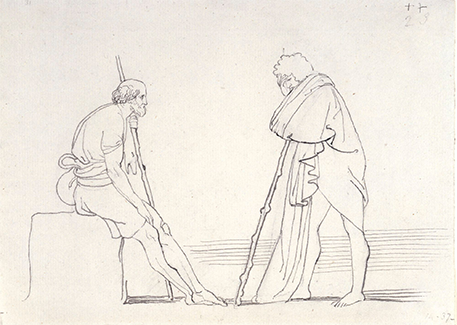
John Flaxman, a British sculptor, was commissioned to produce illustrations for The Iliad and The Odyssey with the intention that they would be engraved and published. Flaxman produced line drawings without colour that became highly popular in the 19th century. His stated intention as he completed his commission, was to eventually produce the drawings as a series of bas-reliefs in the style of the ancients, which accounts for the two-dimensional style of the drawings. However, Flaxman only ever produced a series of drawings for Homer’s two poems. His work became popular in the 19th century and it has often been adapted or copied by other artists. This simple image shows Eumaeus speaking with Odysseus.
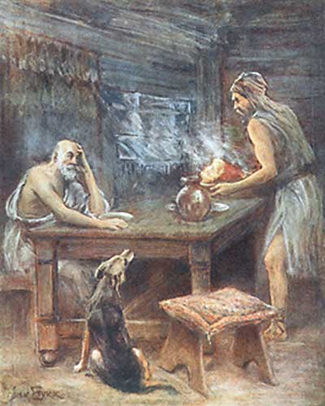
Jan Styka created a series of over 80 illustrations for Homer’s Odyssey over a 22-year period between 1901 and 1923. The works were completed in a variety of mediums. Many of the works depicted key scenes from The Odyssey and are sometimes dramatic. This painting, however, depicts the quiet moment between Odysseus and Eumaeus. Eumaeus is serving Odysseus, observing the custom of xenia or ‘hospitality’ due to strangers and friends alike. At this point Eumaeus does not know the beggar he is serving is, in fact, Odysseus, the master whose return he has long desired.
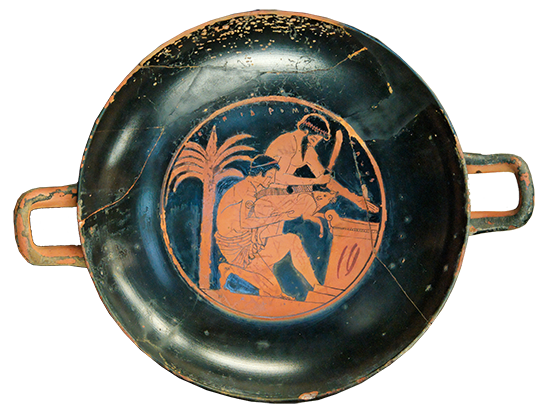
This 6th century kylix – a shallow drinking cup – depicts the sacrifice of a small pig. The slaughter of animals was an integral part of Greek religion and hospitality. Offerings of meat and blood were made to the gods from the slaughtered animal before the animal was consumed. Book 14 of The Odyssey has two ritual killings. Eumaeus slaughters the first hog before Odysseus has told his story. By Eumaeus’ own admission, this is not one of the best animals available: “It’s all we slaves have got, / scrawny pork, while the suitors eat the fatted hogs.” Clearly, if Eumaeus knew who Odysseus was at this point, he would be offered the best fatted hog.
Later, after Odysseus has related his story to Eumaeus and Eumaeus’ men return from the fields he orders the “fattest hog” slaughtered for their own consumption. His justification once again hints at the level of his anger for the suitors: