
Best viewed on a wide computer screen
In this book Odysseus wins his way into the palace, Penelope tricks the suitors into giving her gifts and Telemachus is forced to confront the suitors to stop things getting out of hand.
A tramp called Arnaeus, but generally known as Irus (after the goddess Iris) because he is willing to run messages, appears at the palace, having heard that another beggar is there. When he finds Odysseus he tells him to leave. Odysseus objects, saying Irus has no reason or standing to remove him. Odysseus threatens to beat him if Irus does not leave him alone. But Irus is not deterred. He becomes boastful. He says how easily he could beat Odysseus and challenges him to a fight. Antinous is amused by the prospect of this and encourages the other suitors to come and watch. He proposes that the winner of the fight will get the choice of any food available and will be given the right to eat with the suitors thereafter, while the loser will be banished from the palace forever. Odysseus plays to the suitors’ prejudices. He claims to be an old man and asks that he be accorded some deference: that no one should intervene in the fight to help Irus. The suitors swear an oath to this. Telemachus speaks next and assures Irus that no one will interfere in the fight against him, either.
The two men prepare to fight. Athena, unseen by the suitors, fleshes out Odysseus’ limbs, making him look strong and powerful, for the suitors to see. They are amazed what his ragged clothes have been hiding and their opinion now turns against Irus. Irus, too, has realised he has made a mistake and trembles with fear. Antinous makes it worse by threatening Irus. He says that if he loses, he will be sent across the sea to King Echetus, who will torture him mercilessly. Meanwhile, Odysseus merely wonders how much he should reveal of his own strength and skill to the suitors.
When the fight begins Odysseus immediately smashes the bones in Irus’ neck. Irus falls, crying in pain. Odysseus hauls him to the outer gate of the palace and tells him to stay there. He will no longer be allowed to play the beggar-king. Antinous calls for Irus to be sent to King Echetus.
The suitors now welcome Odysseus into the dining hall. He is given food and drink as promised. Amphinomous personally congratulates him. Odysseus warns him that what power men have is only granted by the gods and is eventually taken away. Men should not do wrong in their lives, but just accept what peace and happiness are offered by the gods. He then speaks generally to the suitors. He criticises them for abusing the hospitality of Penelope, and he warns them that they should leave the palace because Odysseus will soon return, and then blood will flow. Even so, the narrator tells us, Amphinomous’ death is already fated. He will be killed by Telemachus.
Athena inspires Penelope to appear before the suitors. Penelope tells Eurynome she intends to do this. Eurynome advises Penelope to tell Telemachus and to wash before she goes. But Penelope says that whatever beauty she once had was gone when Odysseus left for Troy. As Eurynome makes preparations Athena comes to Penelope once more and puts her to sleep. While Penelope sleeps Athena uses an unguent to clean her cheeks, makes her taller, gives her a more curvaceous figure and lightens her skin. She then releases Penelope from sleep. Penelope feels refreshed and wishes that her death will be just as gentle and peaceful.
Penelope appears before the suitors and they are all overcome with desire for her. As she stands there, she chides Telemachus for allowing a guest to be ill-treated. Telemachus argues it is difficult to observe good customs when their world is so overturned by the imposition of the suitors. He says he is no longer a boy and he wishes that the kind of beating Irus just received would also be administered to the suitors.
Eurymachus steps forward to praise Penelope and her beauty, but Penelope again says that her beauty was diminished when Odysseus left for Troy. She recalls the day he left and the advice he gave her. She says he realistically told her that not all would return from Troy and that possibility included him. He asked her to look after his parents, and he said that if Telemachus was old enough to grow a beard and he had not returned, then she should remarry. She makes it clear she is mortified by this prospect. Further, she wonders why the suitors eat her food when the normal thing would be for suitors to shower their beloved with gifts. Odysseus smiles at the cunning of his wife.
Antinous immediately asks Penelope to accept whatever gifts are brought to her, but says the suitors will not go back to their own estates until Penelope has married one of them. So, the suitors send their servants away to bring back gifts for Penelope. Eurymachus’ man brings back a necklace, Eurydamus’ men bring earrings, and Pisander’s servant brings a choker.
Once all the gifts are presented the suitors turn to singing and dancing once again, and braziers are lit to see them through the night. Maids are left to keep the braziers going, but Odysseus tells them to go back to Penelope, saying he will ensure the torches are kept alight. The maids are delighted, except Melantho, who turns on Odysseus. Melantho was raised by Penelope, but she is secretly Eurymachus’ lover. She questions why Odysseus is in the palace and why he doesn’t go somewhere else for the night. She says some other better man will beat him up and he will be carted away, bloodied. Odysseus threatens to tell Telemachus what she has said. The women depart, afraid of his angry response.
Athena decides to make the suitors insult Odysseus further so as to further inflame his anger against them. Eurymachus jokingly says to the other suitors that Odysseus must be divinely sent because the light in the room seems to come from his shiny bald head. He then suggests Odysseus come to work for him, but then repeats the accusation, as though he has only just remembered it, that Odysseus is lazy and will not work. Odysseus replies that he would easily match or better Eurymachus in any work in the fields, such as ploughing or harvesting. He then says that any of the suitors would turn into cowards if Odysseus returned and stood where he is currently standing. This enrages Eurymachus, who suggests Odysseus’ caution has been affected by too much wine. Eurymachus picks up a stool and throws it, intending to hit Odysseus, just as Antinous did in Book 17. But Odysseus dodges the stool and it hits a wine steward, instead.
The suitors are angered by this. They believe their good times are being ruined. Telemachus address the suitors. He is both commanding as well as deferential. He says they should go home but makes it clear he is not commanding them, thereby showing a level of respect to defuse the situation. The suitors are surprised that Telemachus had the courage to speak to them in this way. Amphinomus says that it is a fair enough request. He suggests they drink libations and then go home to their beds. Mulius mixes wine for the suitors. They drink the wine and then leave for the night.
This book of The Odyssey continues to build tension as the plot moves towards the expulsion of the suitors from the palace. But for now, the final denouement is anticipated by smaller incidents.
To this end Homer introduces the character Arnaeus, otherwise known as Irus, a beggar who wins no sympathy from Homer’s audience because he sides with the suitors against Odysseus. It is clear that he enjoys access to them, since his shortened name, Irus, suggests the function he performs for them: he runs messages for the suitors, meaning he is a convenience for them and tolerated. His given name, ‘Irus’, a masculine derivation of ‘Iris’, the name of the goddess who acts as a messenger for the gods. Irus’ taunting and challenging of Odysseus appear to be a means to further ingratiate himself with the suitors who have already shown disrespect to Odysseus. But the ploy is evidently a miscalculation as soon as Antinous and the other suitors see that Odysseus is not a weakened old man who will easily be bested.
The ease with which Odysseus dispatches Irus, with one obliterating blow to the neck, foreshadows the fate of the suitors, as well as anticipating Odysseus’ return to his throne. Odysseus refers to Irus as “the beggar-king”, and so a logical outcome of Irus’ defeat is that Odysseus takes his place. Indeed, he does. He is welcomed and feted by the suitors.
Odyssey makes two significant references to his belly in the previous book, thus characterising both the desires that motivate great kings as well as the simplest needs like food that shape and direct even the lowliest of men.
He makes one more reference to his belly in this book (line 61). Here Odysseus, speaking to the suitors, characterises his desire to fight Irus as a character flaw likely to bring him trouble:
Of course, this is a tactic, a typical ploy of a man famous for his schemes and tricks. Odysseus characterises himself to the suitors as a simple man who gets himself into trouble, even though he is sure to lose. His reference to his belly suggests he is a man entirely guided by need and desire, who never thinks through the implications of his own actions to begin with. Such a man would be easily manipulated and defeated. He is lulling the suitors to be overconfident so that he might negotiate the best terms he can: that he not be treated unfairly in the fight.
Antinous raises the spectre of King Echetus to Irus before the fight when it becomes clear to him that Irus is likely to lose.
There are two schools of thought about King Echetus. He was either a fabricated character used to scare young children, much like the modern bogey man, or he was a real king on mainland Greece. He is sometimes characterised as being deformed (reminiscent of Shakespeare’s Richard III) and even a cannibal.
Echetus is supposed to have blinded Metope, his own daughter, with a bronze needle and imprisoned her in a tower when he discovered she had a lover, Aechmodicus. Echetus is supposed to have then ‘mutilated’ the Aechmodicus, which most likely means he was castrated. This would appear to be the reference Antinous makes when he threatens to rip out Irus’ privates by the roots.
Metope is said to have been given iron barleycorns while imprisoned, and Echetus told her she could have her sight restored if she ground them into flour. This seems to have been a cruel taunt, since neither was possible.
That Antinous should choose to reference King Achetus as a threat helps us to characterise him further. Antinous, by association, is a needlessly cruel man who delights in bullying and dominating others. Of course, his cruel threats only heighten our sense of justice in the revenge Odysseus and Telemachus will soon take, in much the same way that Athena’s desire that Eurymachus should insult Odysseus will only embolden Odysseus when the time comes to act.
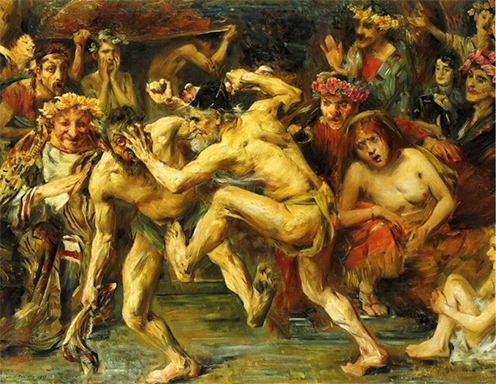
Lovis Cornith’s depiction of the fight between Odysseus and Irus was painted at the beginning of last century, and it exhibits the influence of Impressionism and other modern artistic movements. The brush strokes are large and impressionistic, abandoning the classical perfection favoured by Salon artists only the century before. The artist’s characterisation of the fight also abandons classical perfection, and instead opts for a stark realism devoid of nobility. Irus has a bloodied eye and his mouth gapes open in surprise at the ferocity of Odysseus’ attack. Odysseus’ beard is grizzled, his figure is wiry, and he attacks with everything at his disposal. His left foot kicks Irus in the genitals, his left hand rakes Irus’ face, while in his right hand he holds a large bone with which to bludgeon Irus. Irus is off balance, which is suggested not only by the distribution of his weight as he falls to the left, but by the dominance of Odysseus in the centre of the picture.
The onlookers are also interesting to look at. A cooked boar is carried into scene at the left back of the picture, in keeping with the revels and feasting the suitors engaged in nightly. The figure to the left of Irus wears clothes reminiscent of a Roman toga and is crowned with a flower wreath upon his head, as are other male figures in the crowd. This look suggests the licentious debauchery widely attributed to Roman feasts in the Roman Empire, an impression supported by the presence of a bare-breasted woman on the right of the painting.
While this is a scene full of energy and action, is does not quite square with the action of Homer’s story. In Homer’s account, Odysseus is cautious not to reveal too much of his skill and capacity too soon. He only punches Irus once, which is enough to crush the bones in his neck and incapacitate him.
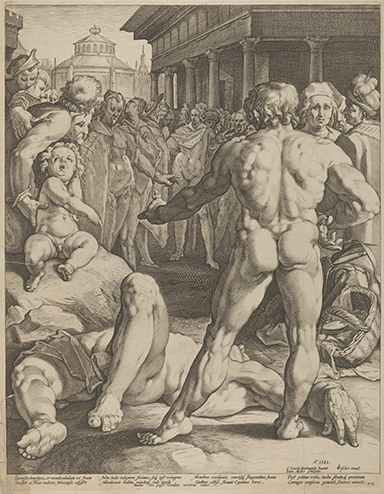
This engraving was made by Jan Muller, a Dutch artist who learned his trade working for his father, who was a book printer, engraver and publisher. Muller adapted this image from a panel painted in oils by Carnelis van Haarlem, an important figure in Northern Mannerism. His work was characterised by dramatic mythological and religious scenes featuring muscular nude figures.
This scene is an entirely different representation of this fight from Lovis Corninth’s modern painting. In the painting there is an almost comical energy to the fight. Here, however, the image is static. The fight has already occurred. Irus lies beaten at Odysseus’ feet. The style appears classical, especially given the architecture in the background, but it does not have the classical formality of composition we might expect of High Renaissance art. Odysseus is placed to the right of the picture with his back to us. It is clear that the real subject here is the musculature of the subjects, especially the powerful muscles depicted in Odysseus’ back. Whereas Corninth stripped the scene of any nobility, Muller has imbued the scene with nobility and power. Odysseus’ gesture to the fallen Irus, mirrored by the same gesture by the infant sitting on the rock, suggests this is a staged moment, in keeping with the reverence for the source text and the significance attributed to this moment in Odysseus’ return to his throne.
The crowd in this picture is also entirely different. Their clothes, their manner and stance all shows them to be more dignified. It is hard to gauge what they think about the outcome of this fight. If the figures of Odysseus and the fallen Irus were removed from the frame, the picture might just as easily be that of merchants or politicians in various discussions. Only their arrangement in a circular formation around what would have been the site for the fight connects them with the action that has just taken place.
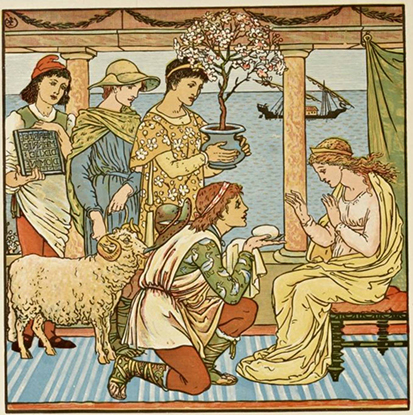
Walter Crane was a nineteenth century English artist and book illustrator (he died in 1915). His work included children’s books and illustrations of popular nursery rhymes, including The Baby’s Opera, a book of rhymes and music.
The Gifts is a watercolour illustration Crane published in his 1898 book The Work of Walter Crane. It illustrates the scene in which Penelope has tricked the suitors into bringing gifts to her in order to woo her properly. They do this because she has suggested to them that she is on the verge of selecting one of them as her new husband.
In this illustration Penelope is presented with what is presumably a precious egg, a potted plant, a sheep and a book. Homer does not list the gifts of all the suitors, so we can accept this as a good representation of what she receives beyond what is in the text. The gifts Homer lists are a necklace from Eurymachus, earrings from Eurydamus, and a choker from Pisander.
The use of water colours gives the picture a warm, intimate atmosphere. And the suitors are feminised either by floral emblems on their clothing (as well as ducks) which are worn or tied in a manner distinctly feminine to modern tastes also by their feminine builds and their youthful appearances, and even longer hair. As well as this their ordered queueing and the deferential kneeling of the first suitor is in stark contrast to the rude and unruly men who inhabit Penelope’s house in Homer Odyssey, but this change may be attributed to their expectation of a resolution to their waiting, and might be supported by Homer’s line which suggests their orderly approach to Penelope: “And so each suitor in turn laid on a handsome gift.” (line 338)