
Best viewed on a wide computer screen
In this book, Odysseus progresses his plans to slaughter the suitors and is recognised by his old nurse.
After the suitors have left to go to bed Odysseus tells Telemachus that they must store their weapons where they can’t access them. He instructs Telemachus that if he is asked, he must say this was done to protect their weapons from damage from their fires, as well as to prevent them hurting each other when they are drunk. Telemachus instructs the old nurse, Eurycleia, to lock the women in their quarters while he does this. She asks who will carry his torch. Telemachus responds that the beggar – Odysseus – will. Odysseus and Telemachus, with Athena walking before them, collect the weapons, and Telemachus senses a god’s presence. Once the weapons are stowed Odysseus orders Telemachus to go to bed. Meanwhile, he will test the women, including Penelope. Telemachus goes to his bedroom to sleep.
Penelope emerges from her bedroom. She sits before the fire in her favourite chair. Meanwhile, Melantho lashes out at Odysseus once more. She questions why he is in the house and says he should go. Odysseus warns her that he once lived in a good house too, and that his fortunes changed. He suggests hers may, too: that Odysseus may return or Telemachus may take up his cause. Penelope hears this exchange and she turns on Melantho to support Odysseus. She threatens Melantho’s life.
Penelope then orders a comfortable chair be brought for Odysseus so that they can talk together. She asks him who he is and where he is from. Odysseus responds with hyperbolic praise of Penelope, but asks not to have to reveal his identity or his past. He says he has suffered many sorrows and does not wish to be scolded by a maid for speaking long about them.
Penelope says that whatever beauty she once had was gone after Odysseus left. She says her life is a torment. She describes how she is courted against her will and the trick she played on the suitors for three years: that she promised to choose a suitor to marry once she had weaved her father’s death shroud. She would weave throughout the day and each night she would unravel her work so it was never finished, and this went on until her maids betrayed her to the suitors. This story is first told in book 2 of The Odyssey. Now she is trapped, unwilling to remarry yet unable to escape that fate. Penelope again asks where Odysseus comes from.
Odysseus replies with a story that is partly true, with details changed to hide his identity. He says he is from Cnossos, that his father was Deucalion and that his own name is Aethon. He claims to have met Odysseus in Cnossos, whom, he says, was searching for Idomeneus (who would be Odysseus’ fictional brother, both being sons of Deucalion). In this tale the Odysseus ‘Aethon’ meets lies, claiming to be Idomeneus’ brother. ‘Aethon’ informs Odysseus that Idomeneus sailed for Troy ten or eleven days before. He says he took Odysseus back to his own house where he stayed for twelve days before sailing for Troy on the thirteenth day.
Penelope is moved to tears by this story. Even so, when she gains her composure, she decides to test the veracity of the story. She asks him to describe Odysseus’ clothing and the kind of man he was. Odysseus describes a purple cape and a golden brooch that depicted a hound killing a fawn. He says he also gave Odysseus a cloak and sword to take with him. He adds that Odysseus also had a herald, Eurybates. Penelope recognises from this description the clothes and brooch she gave her husband before he departed for Troy. She now trusts Odysseus/beggar, and says he will be her honoured guest. She says she rues the day Odysseus left for “that cursed city” which she calls ‘Destroy’ – a play on Troy’s name. In the Emily Wilson translation, it is “Evilium”, a play on Troy’s Greek name ‘Ilium’, from which The Iliad gets its name. In the E.V. Rieu translation it is merely referred to as ‘evil Ilium’.
Penelope is distraught and in tears. To calm her Odysseus promises to tell the whole truth. He claims that Odysseus is on his way home to set things right, along with a hoard of treasure, though he has lost his crew. He then refers to incidents in his own story to fill out the narrative. He tells of the loss of his crew after they ate the cattle of the sun god, Helios, and how he was saved by the Phaeacians. He says Odysseus has been delayed only to recoup treasure that was lost to him. He says the treasure is so vast it would last ten generations. He says Odysseus is now seeking advice from Zeus on how to return home. He assures Penelope that Odysseus is close at hand and all will be well. But Penelope has difficulty believing these assurances. She has lost hope.
Penelope orders her maids to bathe Odysseus the beggar, so that he can sit next to Telemachus in the hall to eat breakfast the following morning. She says that he could not consider her a wise and prudent woman if she allowed him to appear in the hall looking like a beggar. She says that men’s reputations are served by their actions in life. Odysseus rejects the idea of a comfortable bed, saying he is used to sleeping rough, and refuses a foot bath from any of her women, unless it is a trusted old retainer.
Penelope offers him the services of Eurycleia, the old nurse. Eurycleia is moved to be given this duty. She is mindful that Odysseus the beggar has rejected the services of the other women who have mocked him, and she is upset to think that Odysseus might be treated as badly by women in some foreign hall. She also notes how much he looks like her old master, Odysseus. Odysseus tries to deflect this observation by saying that others had noted the similarity, but as soon as Eurycleia starts washing his feet she knows he is Odysseus. She recognises an old scar on his leg.
The narrative digresses to tell the story of how Odysseus received the scar. It begins with Odysseus’ grandfather, Autolycus, who travels from Parnassus to Ithaca after Odysseus’ birth and is asked to name him. He promises to give Odysseus great gifts when he comes of age. When Odysseus is old enough, he travels to Parnassus to receive his gifts. Autolycus prepares a feast to celebrate Odysseus’ visit. The next day they head out to go hunting. A boar charges from a dense thicket. Odysseus attacks it first but the boar gashes his leg above the knee. Even so, Odysseus manages to kill the boar. Autolycus heals Odysseus by binding his wound and chanting a spell. Odysseus then returns to Ithaca where he tells the tale of his exploits to his parents.
Eurycleia accidentally drops Odysseus’ foot in the basin of water when she recognises him. She insists to him that he is Odysseus. Odysseus grabs her by the throat and pulls her to him. He says if she reveals what she knows it will endanger him. He threatens to kill her if she does, along with the rest of the women in the house. Eurycleia assures him she will say nothing. Instead, she offers to tell him which women are still loyal to him and which are not. Odysseus says he will observe them himself. Eurycleia fetches more water and finishes bathing Odysseus.
Odysseus returns to Penelope after he has been bathed. He makes sure that he hides his scar. Penelope tells him of her misery and the difficulty she has sleeping. She is kept awake by her dilemma, whether to remarry or not: whether to maintain her husband’s estate and servants, or to move on and marry the best of the suitors. She believes Telemachus wants her to leave so as to preserve his own inheritance which is daily diminished by the suitors’ presence.
Penelope says that she has had a dream. In the dream there are twenty geese in the house, but an eagle swoops down and snaps all their necks. She cries in the dream but the eagle returns and tells her that the dream is “a happy waking vision”. The eagle explains that the geese represent the suitors and that he represents her husband, returned. Upon hearing this dream Odysseus agrees that the suitors’ destruction is near at hand. But Penelope is not sure. She says there are two types of dreams, each passing through a different gate. Those that pass through the ivory gate mean nothing. Those that pass through gates of polished horn are truthful portents. Penelope lacks hope and does not believe her dream. For this reason, she has devised a contest to select a suitor to marry. Odysseus used to shoot an arrow through twelve axes set in a line. She intends to make this the contest for the suitors. The man who can perform the task will be her new husband. Odysseus is enthusiastic about this idea. He urges her not to delay. He says that before the contest is over Odysseus will reappear. Penelope is still doubtful. She intends to return to bed to get some sleep and says Odysseus can sleep in the hall. Penelope returns to bed and falls asleep, weeping.
The premise for Margaret Atwood’s novel, The Penelopiad, lies in the questions, “What led to the hanging of the maids, and what was Penelope really up to?” This is in reference to the killing of Penelope’s twelve maids after the slaughter of the suitors in Book 22 of The Odyssey. Atwood’s novel has its own purposes. She tells us in her introduction that myths always had variant tellings, and that she will write her own story as an alternative version to the Odysseus myth which will serve the purposes of a modern audience.
But Homer’s story is written from the perspective of a different time and as we read, it becomes clear why Odysseus feels the maids he kills need to die, whether our modern sensibilities agree with him or not. By Book 19, Odysseus’ motivations for killing Penelope’s maids are already being established. It is clear the maids who are later killed have given reasons not to be trusted. Their loyalty has been turned against Penelope by the suitors and once the suitors are dead it might be dangerous to keep them in the palace.
This situation is initially suggested in Book 18 when Melantho, one of Penelope’s maids, mocks and abuses Odysseus whom she thinks is just a beggar. We are told at this point “the women burst into laughter” (Book 18, line 362) at Odysseus, showing that while we hear only what Melantho says, she speaks for other women in Penelope’s retinue. We are told explicitly at this point that Penelope had raised Melantho and treated her like her own child,
As a reminder, this is the same Eurymachus who is considered the prime contender to win Penelope’s hand in marriage. He is one of two leading suitors (the other being Antinous), both of whom throw stools at Odysseus in Books 17 and 18. There are further notes about Eurymachus for Book 16 of The Odyssey on this website.
Homer economically connects the idea of the maids’ sexual allegiance with the suitors and their potential disloyalty to Penelope here.
This situation is further developed in Book 19 and can be traced through specific moments.
Odysseus will test loyalty: As early as Book 16 Odysseus tells Telemachus “You and I alone will test the women’s mood” (Book 16, line 437), and while Telemachus feels that it will take too long to assess all the male servants, for now, who are typically more scattered across their holdings, he advises, “I do advise you to sound the women out: / who are disloyal to you, who are guiltless?”
This plan begins to be realised in Book 19. Odysseus tells Telemachus to go to bed while he stays behind to test the loyalty of the women. (lines 47 – 48) It is not clear how he will do this, but it is mentioned more than once. Later, when Eurycleia has recognised Odysseus, she offers to tell him which women in the house are loyal and which are not. Odysseus again says that he will judge each woman, himself (line 565).
Locking up the Maids: Odysseus and Telemachus plan to lock up the suitor’s weapons to limit their capability to fight back. Telemachus tells Eurycleia to lock the maids into their rooms while this is being done. Clearly, they do not want their actions witnessed by the maids and reported back to the suitors. (line 15 – 18) This shows they implicitly do not trust Penelope’s maids.
Melantho’s abuse: Homer has already established Melantho as disloyal in Book 18. This is reinforced in Book 19 when she again abuses Odysseus. But the situation now becomes more significant because Penelope hears the exchange and intervenes. She calls Melantho a “brazen, shameless bitch” and threatens “you will pay for it with your life, you will!” (lines 99 – 101) This remark foreshadows threats later made by Odysseus.
Penelope feels betrayed: Penelope tells Odysseus the story of how she held the suitors off by unravelling the weaving she was working on each night, as they had agreed to await its completion. In this instance she speaks of the maids collectively – “thanks to my maids – the shameless, reckless creatures” – who alerted the suitors as to what she was doing. This is evidence that the maids’ loyalty (those who will later be killed) lies with the suitors, and it is reasonable to assume that their loyalty is won because they have become the lovers of these men of higher status. (170 – 177)
Washing Odysseus’ feet: Odysseus tells Penelope that he will allow none of her women to wash his feet except “some old retainer, the soul of trust”. (lines 393 – 394) Eurycleia, Odysseus’ old nurse, is therefore chosen for the task. Eurycleia makes explicit what Odysseus has only implied: that he will not allow any of the other women to wash him because he sees that they are collectively untrustworthy (“these bitches, stranger, mock you here . . . you will not let them wash you” line 422 – 424). In this way we see again that Melantho has only given voice to what is presumed to be a wider disrespect.
Odysseus’ intentions made explicit: When Eurycleia recognises Odysseus he grabs her by the throat and threatens her because if she reveals his identity, he will be in danger. Eurycleia is totally loyal and asserts her loyalty, but before Odysseus is given this assurance, he threatens that if she betrays him, “I will not spare you . . . when I kill the other women in my house.” (lines 553 – 554) From this we see that Odysseus already has a plan for the maids as well as the suitors. Therefore it should be no surprise to us when they are later hanged.
While the killing of the maids may be shocking to modern sensibilities – it certainly inspired Margaret Atwood’s response – there is a logic to it: to remove disloyal and potentially dangerous women from the household who might even help others take revenge. Their killing also makes this a more domestic drama: that not only the war must be won but that the home and inner sanctum must again be secured.
When Eurycleia recognises Odysseus by the scar he has on his leg there is a long digression in Homer’s narrative to tell the story of Odysseus’ birth and his journey to see his uncle Autolycus when he was a young man, as well as the wound he received while they were hunting a boar.
This story has nothing to do with the story of the hunting of the Calydonian Boar, which appears in Book 10 of The Iliad. The following is a family tree to help in a reading of the story of Odysseus’ journey to Parnassus and his own boar hunt:
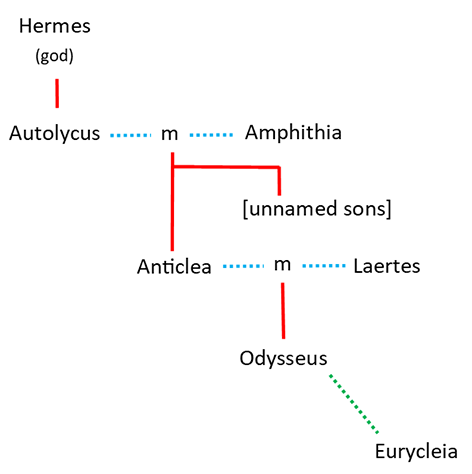
Autolycus is Odysseus’ grandfather. Homer’s description of him also makes it clear that he has a reputation as a thief and deceiver, aided by the god Hermes. However, there are variations to this aspect of the story. Pausanius says Daedalion was Autolycus’ father, while Ovid identifies Hermes as his father, in which case the son may have inherited the gods’ gifts for deception and thievery. There are even more versions told of his parentage by other authors.
Homer tells us “[Autolycus] excelled the world at thievery, that and subtle, shiny oaths” due to gifts bestowed by Hermes as a result of Autolycus’ many offerings in ritual.
The following are stories that helped gain Autolycus this reputation for thievery and deception:
Stealing from Sisyphus
Sisyphus is best known for the punishment he received from the gods, forever made to role a boulder up a hill in Hades. However, Autolycus is said to have been able to steal Sisyphus’ cattle because he had the power to change their appearance. However, as Sisyphus became aware of the thefts he began to mark the hoofs of his herd, which allowed him to track them. Sisyphus forced the return of his cattle, but as part of his revenge he is said to have seduced Antolycus’ daughter, Anticlea, Odysseus’ mother.
The story of Heracles
Autolycus also stole cattle (or horses, depending on the source) from King Eurytus of Euboea (or Thessaly, depending on the source), who is supposed to have taught Heracles how to use a bow. Heracles was accused of the theft by Eurytus. Eurytus had held an archery competition for the hand of his daughter, Iole, in marriage. When Heracles won, Eurytus refused him his daughter, possibly because Heracles had killed his previous wife, Megara, which was why he had been made to perform his twelve labours. Eurytus thought Heracles stole his animals in retaliation. Eurytus’ son, Iphitus, tried to help Heracles find the animals, but Heracles later killed him in a fit of rage or madness, possibly induced by Hera, for which he eventually served three years as a slave to atone.
Amyntor’s helmet
Amyntor was a ruler, possibly the king of the Dolopians in Thessaly. He owned a boar’s tusk helmet which is described by Homer in Book 10 of The Iliad. Autolycus stole the helmet from Amyntor’s house. Eventually, the helmet is given to Odysseus by Meriones during the Trojan war. Further details regarding this can be found in the account for Book 10 of The Iliad on this website by following this link.
As ‘Aethon’, Odysseus describes a brooch and clothes he says he saw Odysseus wearing when he saw him in Crete. This helps him win Penelope’s trust. It is for this reason that Penelope reveals to him the anguish she personally feels, and describes how she goes to bed each night, unhappy and in tears. She compares her feelings to the grief felt by “Pandareus’ daughter”. She says her grief is,
In this case it seems Homer would expect his contemporary audience to understand Penelope’s allusion. The unnamed daughter of Pandareus was Aëdon, sister-in-law to Niobe, of whom she was jealous. Niobe had many children while Aëdon had only one son, Itylus. Aëdon planned to murder Niobe’s eldest son, but in the confusion of the moment and darkness she accidentally killed Itylus, instead. Her grief was overpowering. Zeus transformed Aëdon into a nightingale to help ease her pain, and the sound of the nightingale’s song is meant to be an expression of Aëdon’s grief.
Odysseus’ return home is a slow process. First, he was delayed for ten years during his return to Ithaca, and once in Ithaca he must go disguised while he makes his preparations to overthrow the suitors. In Book 19 he is recognised by his old nurse, Eurycleia, which follows the recognition of Odysseus in Book 17 by his dog, Argos. The effect is that we feel Odysseus is drawing closer to his goal by degrees. The following artworks depict the moment that Eurycleia recognises Odysseus while washing his feet.
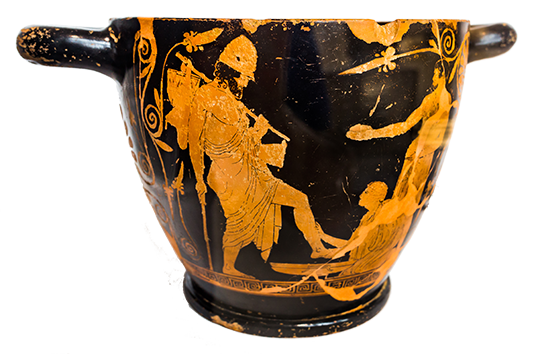
The figures in this red figure skyphos are identified as Odysseus, Antiphata and Eumaios. The last is a variation on the name Eumaeus, Odysseus’ loyal swineherd, who is seen here watching as Odysseus’ feet are washed, although he does not appear in this scene as it is described by Homer.
‘Antiphata’ is a name attributed to the nurse in different Greek versions of the story, either because Eurycleia was also known by that name, or different versions include a different person as the nurse.

This bas-relief was produced around the same period as the skyphos jar, above. However, its details are different. Eurycleia washes Odysseus’ feet, but the figures in the background are Telemachus and Penelope. In Homer’s narrative Telemachus goes to bed early in the book.


The subject of Eurycleia’s recognition of Odysseus was a popular subject during the mid-19th century. Evidence of this is that both Gustave Boulanger and Gustave Housez both painted the scene in 1849. Boulanger won the 1849 Prix de Rome prize for the painting. Boulanger’s and Housez’s treatment of the main figures is very similar, but Boulanger’s seems more dynamic, with Odysseus’ head turned, searching to see if anyone has heard his old nurse, mindful of his danger, while Housez has Odysseus focused entirely on quieting his nurse. In Housez, the figures of Penelope and a maid in the background, along with the exterior of the palace in the background, are distracting features which detract rather than contribute to the drama.
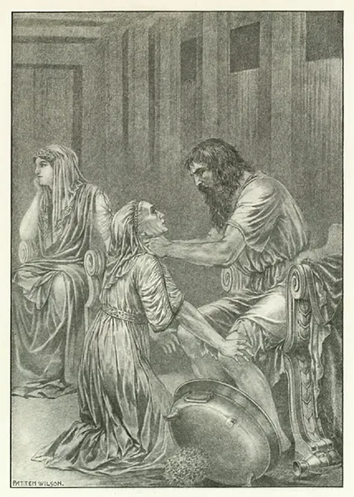
Of the various versions of this scene depicted in art on this page, Patten’s image most accurately depicts the scene described by Homer. Odysseus is heavily bearded and looks ragged. Penelope is in the background but she is evidently distracted. The basin used to wash Odysseus feet has been overturned when Eurycleia dropped Odysseus’ foot in surprise at recognising her old master. And Odysseus’ hands are placed threateningly around her neck. Here, his tone would not be imploring. His chokehold is serious, as it is in Homer’s version, and it is easy to imagine Odysseus speaking the threats he makes against Eurycleia: that he will kill her if she betrays what she knows to anyone.
For those who are interested in making comparisons, William Shakespeare’s Venus and Adonis provides an interesting contrast to the story of Odysseus hunting the boar in book 19 of The Odyssey. In Shakespeare the wound Adonis receives from the boar is symbolically a wound of love which proves fatal. For Odysseus, the backstory provides the means for the anagnorisis - the recognition scene – a common trope in fiction, famously achieved by the strawberry birthmark in The Castle of Otranto, and through a ridiculous culmination of proofs in The Importance of Being Ernest: a lost handbag, a three-volume novel, an Army List, and the confession of Ernest’s former governess. For Odysseus, the scar he receives from the boar will be the means by which Eurycleia recognises him.
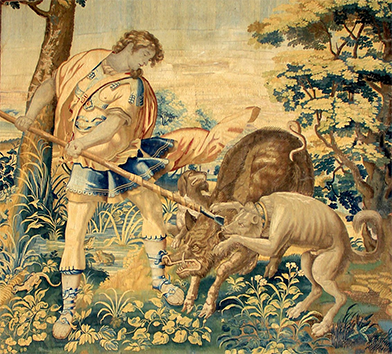
In this tapestry, produced in a Brussel’s workshop in the 17th century, the artist depicts the moment before Odysseus is wounded by the boar. Despite the fierce look of the boar and the evident action of the scene, the tapestry is quite static. The colours and decorative treatment of flora in the scene seems more appropriate for Shakespeare’s Adonis. The dense thicket in which the boar is said to have been hiding is not apparent, but the presence of the dogs is in keeping with the description Homer gives, since the dogs break away from the main group of hunters to pursue the boar.