
Best viewed on a wide computer screen
Book 20 of The Odyssey might be described as the calm before the gathering storm. The gods are prayed to and portents appear to foreshadow the violence to come.
Odysseus makes his bed in the entrance hall and lies awake plotting his revenge as the maids slip away to visit their suitor lovers. He is tempted to kill them immediately, but he knows that restraint is required for his plan to succeed. As he lies awake Athena comes to him. He tells her the thoughts of revenge and possible retribution against him running through his head. Athena chastises him for not having faith in his own abilities and hers. She reassures him he will not fail and then sends him to sleep.
At that moment Penelope awakes. She begins crying due to her stress. She prays to Artemis to take her life. She expresses her fear of having to remarry and she says that she finds no relief from her torment, even in sleep.
When dawn breaks Odysseus awakes and hears Penelope crying. He gathers up his bedding and then prays to Zeus, asking for signs: one being an expression from someone in the house that augers well; a second appearing outside from Zeus. Immediately Zeus sends a single roll of thunder from a cloudless sky, and a woman grinding grain in the house says a lucky word. She has heard the thunder and takes it as an omen, too, and prays that this new day will be the last day of the suitors in the house.
Telemachus awakes and asks Eurycleia how Odysseus has been treated. Eurycleia assures him that Penelope did all she could to make him welcome and comfortable, but Odysseus chose to sleep rough in the hall. Telemachus leaves to go to the meeting grounds and Eurycleia gives orders to her maids to clean everything thoroughly. Her orders are carried out while the serving men split wood. Eumaeus arrives with three more pigs for the next feast. He asks Odysseus if he has been shown respect by the suitors.
At that moment Melanthius, a goatherd, begins to abuse Odysseus. He says Odysseus should leave and threatens him with violence. Odysseus doesn’t respond. Next, Philoethius, the cowherd, speaks, but he is respectful. He asks Eumaeus about Odysseus background and greets Odysseus warmly. He says that seeing Odysseus (disguised as a beggar) reminded him of his master, Odysseus, and that he cried in remembrance of him. He expresses disapproval of the suitors. He is torn between his desire to leave and his desire to remain and await the return of Odysseus. Odysseus assures Philoethius that his master will return. Philoethius indicates he would fight on Odysseus’ side if he returned.
An eagle clutching a dove suddenly flies past. It is seen as an omen. Amphinomus interprets it as an indication that they will fail to kill Temelmachus, so they may as well just enjoy their feasting. So, the feast is prepared. Telemachus sits with Odysseus and makes sure he is given a proper share. And he upbraids the suitors, warning them not to be disrespectful. The suitors are surprised by Telemachus’ assertiveness. Eupithes mockingly says they should obey Telemachus.
Sacrificial animals are led through the streets for Apollo’s festal day while inside the animals are slaughtered and cooked. The feast is served out and Odysseus receives a fair share. But Athena, who wishes to keep Odysseus keen for revenge, is not pleased by this. So, it seems implied that Ctesippus’ action is influenced by her. He mocks Odysseus by saying that as a guest of Telemachus he should also receive a gift. He then picks up an ox hoof and throws it at Odysseus, who ducks to avoid being hit in the head. Telemachus says Ctesippus is lucky to have missed or he would have been killed with a spear. He tells the suitors not to commit any more offences since he is no longer a boy. Even though they could collectively kill him, he would rather that than put up with any more of their behaviour.
Agelaus stands to speak. He agrees that Telemachus and his household should be treated with respect. But he then focuses on the question of Penelope. He says that it is clear Odysseus will not return and that Penelope should be made to choose a husband and remarry so that Telemachus can take proper control of his father’s estate. Telemachus says he agrees, but adds that he will not force his mother to make a choice against her will. At this solemn moment Athena makes the suitors burst into uncontrollable laughter. Theoclymenus, the seer, however, sees a terrible vision of death and destruction. But his distress only makes the suitors laugh all the harder. Eurymachus makes fun of Theoclymenus, saying he needs to be taken outside to give him light, to relieve him of the darkness he experiences inside the house. Theoclymenus responds by making his vision more specific: saying that the suitors all face a terrible disaster; that none will escape their fate. Theoclymenus than leaves to walk to the home of Piraeus. The suitors turn back to Telemachus and mockingly suggest he is unlucky in his guests. They suggest he gets rid of his friends.
Telemachus does not respond. His attention is on Odysseus, waiting for a signal when to act.
Meanwhile, Penelope has placed her chair outside the hall so she can comfortably listen to all that is said. The narrative concludes with an ominous foreshadowing of the suitors’ deaths, described as a “groaning feast”.
In Book 19, Penelope speaks to Odysseus without recognising him. Even so, the details Odysseus is able to give her about his purported sighting of her husband convinces her to trust him, and so she unburdens herself by describing the grief that overwhelms her every day. In an attempt to characterise this grief, she recalls the story of Aëdon who accidently kills her son. The details of this story can be found at the bottom of our webpage for Book 19 under the title ‘Penelope’s Digression’ by following this link.
In this book Penelope’s grief is heightened to the point where she prays to Artemis to end her life. In an attempt to express her towering grief, she takes a further digression by recounting another story concerning Aëdon and her family. We might assume that Homer’s audience knew the story well, since she recalls the story to represent her grief rather than merely telling it for its own sake. However, Homer’s account is the only ancient source that remains of this story, so I’ve reproduced it here from Fagles’ translation in full:
There are variations in the names of the three daughters depending on source, but they are commonly known as Aëdon (or Aedon), Cleothera (or Cleodora) and Merope. Their story begins in tragedy – the death of their parents – but changes in tone when the gods take it upon themselves to raise the sisters and educate them. The reversal of fortune at the end of the tale is a common theme in Greek myth: that children pay for the sins of their parents. Penelope’s account does not explain what that sin is.
That story appears in other sources. Antonius Liberalis, an Ancient Greek mythographer working around the 2nd or 3rd century CE, wrote about Pandareus’ crime which eventually brought about his daughters’ terrible fate many years later. Liberalis’ account is short (like all 41 tales he recounts in his work) and so I have reproduced it in its entirety here from ToposText.Org, where you can find Liberalis’ entire work if you are interested:
§ 36 PANDAREUS: When Rhea, fearing Cronus, hid Zeus in the Cretan cavern, a goat offered her udder and gave him nourishment. By the will of Rhea a golden dog guarded the goat. After Zeus drove out the Titans and deprived Cronus of power, he changed the goat into an immortal. There is a representation of her among the stars to this day. He ordered the golden dog to guard this sacred spot in Crete. Pandareus son of Merops stole the dog and carried it off to Mount Sipylus. He gave it to Tantalus, son of Zeus and Pluto, to guard. After a time Pandareus went to Mount Sipylus and asked for the dog. Tantalus swore he had never received it. To punish him for the theft Zeus turned Pandareus into a rock where he stood. Tantalus, for going back on his oath, he struck down with a thunderbolt and set Mount Sipylus on top of his head.
Pandareus steals the golden dog that was meant to guard the goat that nourished Zeus, and he gives it to Tantalus. This is the crime for which Pandareus and his wife, Harmothoe, die, thus making their daughters orphans.
Nothing in the story of Pandareus or his daughters has a direct correlation with the situation faced by Penelope, but she clearly identifies with the tragedies of the family, first with Aëdon killing her own son (Book 19), and the sisters being delivered to the Furies after a promising upbringing with the gods.
But more broadly, both Penelope’s story and the story of the sisters is one in which they live a life of luxury, culture and privilege, only to see that stripped from them. In this, Penelope clearly feels a connection, and so she elevates her own suffering by recounting the story of Pandareus’ daughters.
However, there is a crucial difference between Penelope’s story and that of Pandareus’ daughters. Pandareus’ daughters had the sin of the father hanging over them, while Penelope has no such burden. While she digresses to tell this story to elevate her own grief, as an audience we are also aware that her relief is at hand. Penelope acts somewhat like Athena here. Athena constantly makes Odysseus suffer more abuse whenever the suitors look like they might act more reasonably so as to heighten Odysseus’ resolve for revenge. Likewise, Penelope intensifies her grief by recalling the story.
But we realise from this, knowing that as a woman it is not Penelope’s role in this story to act with anger or seek revenge, that her story also represents a different aspect of the world of The Odyssey. As a woman Penelope is subject to the power of men, and so her emotions are not outward facing, like anger and a desire for revenge, but turned inward in the form of grief. Penelope is powerless and her grief is an expression of that, just as anger is empowering. The only agency she possesses is either to choose another husband or to desire death. This desire may seem irrational or self-defeating in the eyes of some, but it is merely the diametric opposite set of feelings and responses available to her husband. So, we have the following dichotomies manifest within the text:
| Male | Female |
|---|---|
| Worldly | Private/Domestic |
| Anger | Grief |
| Harm Others | Harm Self |
Though we see Penelope heightening her own grief, thus allowing Homer’s audience to take greater pleasure in the anticipation of the redemption and revenge that is to come, it is also a response to the same set of circumstances her husband faces, that makes him vengeful while she is sad.
The following artworks represent two key aspects of the story of the daughters of Pandareus. First, is their benevolent treatment by the gods after their parents’ death. Second is their fate: to be captured by harpies and delivered to the Furies, thus ending the promising future they seemed destined for.
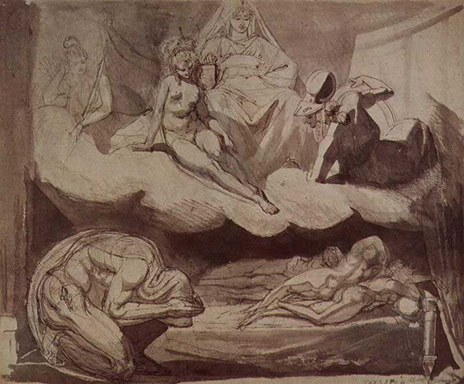
Henry Fuseli was a Swiss painter who spent most of his career in England. If you haven’t heard of him, you may be familiar with one of his most famous paintings, ‘The Nightmare’ (1781).
His work ‘The Daughters of Pandareus’, produced with India ink, tempera and watercolor on cardboard, we see the sisters of Pandareus asleep on their bed in the bottom right of the image. Four goddesses watch over them as they sleep. Their divine nature is signified by the cloud upon which they float, which separates the divine and mortal spheres. It is a trope widely used by the 17th century artist, Crispijn van de Passe, in his depictions of scenes from The Iliad in which the gods regularly intervene in the Trojan War.
Penelope mentions four goddesses in her story: Hera, Artemis, Athena and Aphrodite. We may presume that Hera is the goddess seated in the centre and at the greatest height. We may also presume Athena is seated to her right, from our perspective, given that she wears the helmet associated with Athena. To the left, background, is a figure only sketched in, but it is clear she has a bow and arrows, which identifies her as Artemis. That leaves the crowned figure to Hera’s left, the only goddess associated with sexuality in this image (due to her exposed breasts and reclining posture) to be Aphrodite, the goddess of love. Each goddess teaches the three sisters certain skills which are outlined in the extract I have included on this page.
A male figure is featured in the left foreground of the picture. He is distinguished by a muscular physique. Zeus is the only male god mentioned in Penelope’s story, so we might presume this figure to be Zeus. However, the figure is bowed and seems to be making a supplicating gesture, although it might be a gesture denoting grief, too. Penelope states that Zeus “knows all, all that’s fated, all not fated, for mortal man”, and so Zeus would also know the fate that eventually awaits the three sisters.
Alternately, the male figure could be Pandareus, himself, his face covered and bent in a gesture of grief for what he has done. I have found no explanation of the picture’s elements, so this is speculation.
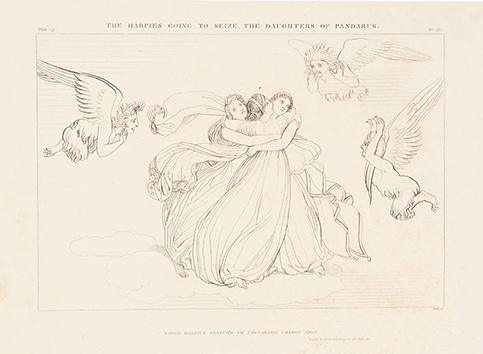
John Flaxman, a British sculptor, was commissioned to produce illustrations for The Iliad and The Odyssey with the intention that they would be engraved and published. Flaxman produced line drawings without colour that became highly popular in the 19th century.
His images are often adapted by other artists or by companies to sell as merchandise.
Flaxman’s drawing depicts the moment when the three sisters are beset by the harpies. They cling to each other, thereby adding a level of pathos to the scene. Their flowing robes suggests romantic, tragic figures, which also contrast to the unnatural fur and wings of the harpies, denoting them as monsters.