
Best viewed on a wide computer screen
In this book Odysseus returns to his house, disguised as a beggar, and is abused by Antonius when he begs food from the suitors.
The dawn breaks and Telemachus prepares to return home to allay his mother’s fears over his absence. Before he leaves he tells Eumaeus to take Odysseus into town where he can beg. Odysseus expresses his willingness at this proposal. Telemachus leaves and returns home to the palace. He leaves his spear outside. He is welcomed by Euricleia, his old nurse, and other servants, and then by Penelope, who is overcome with emotion and relief. She asks if he has news of his father but Telemachus declines to speak, saying he feels too upset, and tells his mother to go bathe and put on new clothes. He tells Penelope that he intends to go to the meeting grounds to find Piraeus and Theoclymenus, the seer. Penelope goes to bathe.
Telemachus leaves and Athena places a splendour on him to make others gaze in wonder at him. At the meeting ground he avoids the suitors and sits near Mentor, Antiphus and Halithernes, his father’s friends. Piraeus approaches with Theoclymenus. Piraeus offers to bring Menelaus’ gifts for Telemachus to his house, but Telemachus asks him to keep them until the situation with the suitors is resolved in case he is killed. If he is killed he wants Piraeus to have them, not the suitors. They return to the palace where they are washed by women and brought food. When Penelope sees Telemachus, she tells him she will go back to her bed and weep, but begs first to be told any news of Odysseus. Telemachus tells her that Nestor had no news of Odysseus and that Menelaus was outraged to hear of what the suitors were doing. He tells Penelope of the news of the Old Man of the Sea who claimed to have seen Odysseus on an island, held captive by Calypso and miserable.
Theoclymenus now interrupts to say that he has seen an omen that makes him believe that Odysseus is already back in Ithaca and that he will soon take revenge on the suitors. Penelope wishes it were true.
The suitors are outside playing sports and Medon calls them in for their meal.
As this has been happening Eumaeus and Odysseus have prepared to leave for town, as per Telemachus’ instructions, even though Eumaeus would prefer Odysseus to remain at the farm and help to guard it. Odysseus asks for a walking stick and Eumaeus gives him a staff. They head into town. Odysseus, is still in the disguise given him by Athena, looking like an old beggar.
As they enter the town they come to the fountain where Melanthus, who is out herding his own goats, sees them. Melanthus is rude and abusive. He refers to them as ‘scum’, belittles Eumaeus for being a swineherd, and suggests that Odysseus is a lazy bum. He says that if Odysseus approaches the palace, he will have footstools thrown at him and he will have to run a gauntlet of them to get back out. He then kicks Odysseus. Odysseus contains his temper and does not respond. Eumaeus prays, wishing that Odysseus could return and punish Melanthus whom he says is “cocksure”. Melanthus answers back, saying Eumaeus can’t do anything but speak, and says that Odysseus is lost “worlds away” and will never return. He then leaves to join with the other suitors for dinner.
Eumaeus and Odysseus approach the palace and Odysseus enthusiastically praises it, like one admiring it for the first time. Eumaeus advises him to stay outside while he first enters, and then follow him in.
An old dog is lying by them. It is Argos, Odysseus’ dog, now aged and neglected. But the dog recognises Odysseus, despite the disguise, and wags his tale, though he is too weak to move. Eumaeus recalls the dog’s speed and strength when he was younger, but laments that he is now old and neglected. It is over twenty years since the dog saw Odysseus. Eumaeus enters the palace. Meanwhile, Argos dies.
Eumaeus sits with Telemachus as the meal is served. Odysseus enters the hall by himself. Telemachus calls him over and gives him a generous portion of food, and then instructs him to go beg from all the suitors. Odysseus eats his meal as a bard sings for the group. Athena then appears to Odysseus and also urges him to beg food from the suitors , so as to “tell the innocent from the guilty”. Odysseus obeys and the suitors, on the whole, give him scraps of their food, until he is seen by Melenthus, who says he has seen this beggar before and that the Swineherd let him in.
Antinous objects to Odysseus being in the hall. Eumaeus responds, saying that Antinous would only welcome those with talents to benefit himself. Eumaeus says he is happy for a beggar to be present while ever it is Penelope and Telemachus’ house. Telemachus says he doesn’t mind feeding a beggar, and urges Antinous to do the same. Antinous is angered by Telemachus’ attitude and makes a threatening gesture with a stool.
The rest of the suitors fill Odysseus’ sack with handouts. When Odysseus comes to Antinous, he asks him for a handout, despite what Antinous has already said. Odysseus explains that he was once wealthy with an impressive house, but that he fell on hard times. He then tells a version of the story he told Eumaeus in Book 14, of the Egyptian expedition that brought disaster when his crew plundered the Egyptian countryside and brought upon themselves the wrath of the Egyptian people who killed his men and handed him over to Dmetor in Cyprus, from whence he was able to sail to Ithaca.
Despite this story, Antinous remains unmoved and threatens Odysseus if he will not back off. Odysseus responds by saying that Antinous has no sense or generosity. Antinous is furious at this and hurls a stool at Odysseus. It strikes Odysseus in the back. Odysseus wants to respond but restrains himself. He says Antinous struck him merely because he was hungry, and expresses a desire that Antinous will die before he is ever married. Antinous backs down. He tells Odysseus to eat and be quiet, lest his suitor companions turn against him.
But Antinous has not read the room. The other suitors speak against him. They see that his striking a beggar was wrong, and warn that the beggar could be a god in disguise, or that a god could be watching. Telemachus looks on and he, like his father, is filled with silent rage which he represses.
At this point Penelope intervenes. She has heard that Odysseus was struck by a stool. She is outraged, and expresses a desire that Apollo would take vengeance on Antinous. She says Antinous is the worst of all the suitors: “he’s the black death itself.” Penelope asks Eumaeus to bring the beggar to see her. She is also interested to know if the beggar has news of her husband. Eumaeus responds, telling Penelope of the beggar’s gifts for storytelling, and says that he has news of Odysseus in Thresprotia. Penelope expresses her exasperation with the suitors once again, as well as expressing a wish that Odysseus would return to take revenge with Telemachus at his side. She decides that she will give the beggar new clothes if she believes his story.
Eumaeus informs Odysseus of Penelope’s desire to speak to him. Odysseus agrees he will tell Penelope his tale, but he advises they must be cautious with the suitors around. He says Penelope should wait until after dark and when things have quietened down in the palace.
Penelope is impatient when she is told by Emaeus that she must wait but she accepts the need for caution.
Eumaeus returns to the hall where the suitors are feasting and tells Telemachus that he will leave to go back to the farm, and advises Telemachus to be cautious and not get himself killed. He promises to return early the following day.
The suitors continue to eat and enjoy songs and dancing as the day approaches sunset.
When Odysseus returns home in this book, he is unrecognised by anyone except his old dog, Argos. It is one of two moments in the book that stand out. The other is the violence with which Antinous treats Odysseus by throwing his stool at him. These two moments stand in stark contrast. Of the two, it is the poignant moment with Argos as the dog wags his tale in recognition and then dies, that is the most memorable:
Much is said of the loyalty of Argos here, which is in contrast to the unscrupulous suitors, or even Odysseus’ servants who have neglected the dog:
Book 17 would seem to be about loyalty, the kind we have grown accustomed to with dogs. For instance, Odysseus is first urged by his son, Telemachus, to beg at the suitors’ tables, but sits to eat the meal he has already been given, instead. It takes Athena’s brief intervention to make the point clear:
The test may seem pointless, given that all the suitors will eventually be slaughtered, but it does reveal a wider spectrum of morality amongst the suitors than we might suppose. When Antinous throws the stool at Odysseus, effectively beating him like a dog at the table, the other suitors turn against him. It is left to them to remind Antinous of the power of the gods, and implicitly of the rules of xenia or hospitality, since Antinous is acting like a host in another’s house.
It may be surprising to consider how much Odysseus is associated with dogs in this book, but Argos’ example has wider implications and shows us more than just loyalty. Homer is using Argos’ presence to make a point about Odysseus’ situation, the attitudes of the suitors and how they should really be understood. There is also the matter of the dignity of being a man in this book, and being able to transcend one’s basest desires or physical needs in order to act honourably.
To begin with, Odysseus acts like and is treated like a dog in this book. This point is initially made prior to us seeing Argos, when Eumaeus and Odysseus meet Melanthius, coming into town. Melanthius’ language is degrading from the start – “one scum nosing another scum along” – and he quickly equates Eumaeus with his pigs by calling him “pig-boy”. Of Odysseus, his language recalls the behaviour of dogs immediately: “this sickening beggar who licks at the pots at feast”. He also describes Odysseus’ type – beggars – as “Hanging round doorposts, rubbing his back / scavenging after scraps”. The dog imagery is soon applied to Eumaeus, too: “All bark and no bite from the vicious mutt!” Without status within the world of the palace, Emmaus and Odysseus are accorded no humanity whatsoever by Melanthius. When Odysseus enters the feasting hall and is called out by Melanthus, Antinous’ language then reflects the same kind of attitude: “disgusting beggars who lick the feasters’ plates”.
Clearly, the moment with Argos exists in this book not only because it is affecting or that it highlights the lack of respect and loyalty that exists in Odysseus’ home, but because Homer intends us to understand that there is a correlation to be made between Odysseus and Argos. Odysseus, himself, characterises two types of dogs when speaking to Eumaeus. The first is those with “the running speed to match his looks” (that is, useful dogs as Argos was in his prime, able to track and hunt), and the second “the sort that gentry spoil at table”. Both are kinds of dogs that would be owned by the rich, but in the masculine world in habituated by Odysseus, only the first can be admired.
On this first point, Melanthius accuses Odysseus of being lazy and useless; that he serves no purpose:
This idea of usefulness is also applied by Eumaeus in his response to Antinous who has shown contempt for Odysseus as a beggar at the feast. Eumaeus suggests that Antinous welcomes only those who are useful to him:
Eumaeus’ sarcasm reveals the reality of the situation. It is the suitors who impose upon Penelope with nothing to offer, bleeding her “household white”. In effect, they are the dogs spoiled at the table of the gentry, but they have lost the sense of their proper place. The whole point involving dogs is rather ironic.
The speech of the suitors and even Odysseus’ characterises dogs as being motivated by hunger. Melanthius refers to Odysseus’ “greedy gut”, and Odysseus, himself, refers to the “belly’s hungers” twice after that in this book.
In the first instance he states:
It is not unusual that in the guise of a beggar Odysseus should speak of his belly and hunger, but here it is clear that his language is encompassing more than a desire for food. His further explication, that sea voyages and war are the result of the “belly’s hunger”, signals to us that Odysseus is speaking more broadly of the desire for wealth, status or position that is the cause of wars. It may be that he is alluding to the expedition made against Troy which was said to be result of Paris’ desire – his hunger – for Helen. Odysseus’ speech potentially embodies all the wants and needs of humanity that inevitably draw men into conflict and danger, and away from the potential for higher goals that are freed from desire.
Odysseus’ second reference to the ‘belly’ occurs after he has been struck by Antinous with the stool. In this instance, he is more in the character of the beggar he pretends to be:
Here we have the difference between the rich and the poor. While both are driven by their desires, the rich may express them in deeds that change the world and even become the subject of great poems, as was the case for the Trojan War. The poor, on the other hand, are merely victims either to the basest of their needs, food, or further made victims by being punished for trying to attain it.
It is worth returning to the matter of dogs here. Dogs are characterised throughout as base animals driven by their desire for food, hence their association with poor beggars. But Argos is never associated with these needs in the poem. Instead, he possesses qualities that transcend physical need: his loyalty and faithfulness. This is not to say that he is not physically degraded. Argos, we are told, is neglected, “Infested with ticks”, and he lies on a mound of dung that he is too weak to move from. Yet his dying at the moment that he sees Odysseus is an apotheotic moment that elevates Argos in his death, much like Christian martyrs who wouldn’t exist for many more centuries yet. This makes Argos one of the noblest characters in The Odyssey: certainly the noblest in this particular book.
For book 16 I wrote: “Read broadly, The Odyssey has two basic plots: a return home and a coming-of-age story.” The coming-of-age story is Telemachus’. He must find courage and resolve to face the suitors. In book 17 we see further evidence that Telemachus is finding this resolve. In particular, Antinous treatment of Odysseus – throwing the stood at him – hardens Telemachus’ attitude against the suitors and brings him closer to Odysseus’ way of thinking. Homer projects this with two instances of thought that use repetition to show their thinking is simpatico. I will quote each. Here, Odysseus is struck by the stool:
And this is Telemachus’ reaction to Odysseus being hit:
By this stage, the repetition shows us, Odysseus and Telemachus are of like minds, and Telemachus is ready to take on the suitors.
The following are three different representations of the same scene in which Odysseus and Argos recognise each other. The scene is for its pathos and the loyalty and devotion that it characterises of dogs for their owners. More can be read about the significance of this scene in the second column of this page “Of Men and Beasts”.
In terms of the accuracy of their representations, all three artworks are fairly similar. None depict Argos in the truly terrible state we see him in Homer, lying immobile on a mound of dung. In each artwork Odysseus finds Argos on the ground and observes him with a bowed head, appearing to openly consider his old dog. In Homer he has to pretend not to known Argos, because he cannot reveal his true identity, not even to Eumaeus. In none of these representations do we find Eumaeus, who is present in the scene in Homer. In Jean-Joseph Espercieux’s statue Argos seems to have some limited means to actively seek Odysseus’ attention.
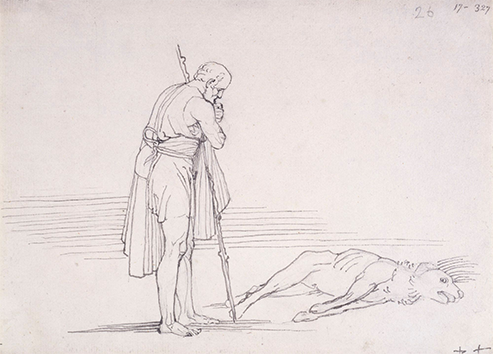
John Flaxman, a British sculptor, was commissioned to produce illustrations for The Iliad and The Odyssey with the intention that they would be engraved and published. Flaxman produced line drawings without colour that became highly popular in the 19th century.
His images are often adapted by other artists or by companies to sell as merchandise.
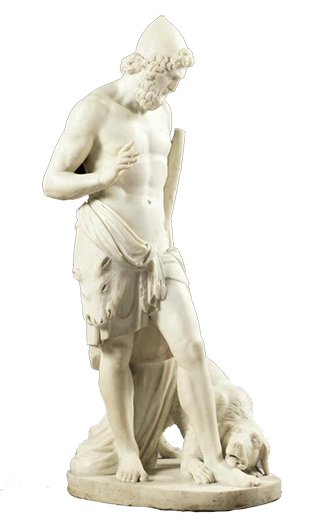
Jean-Joseph Espercieux was heavily influenced by Jacques-Louis David. Both were artists of the French Revolution. He exhibited regularly at the Paris Salon.
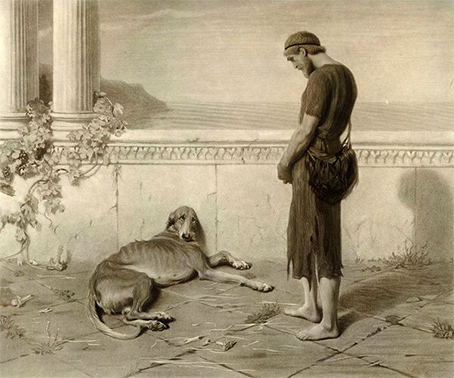
Briton Rivière painted many pictures with dogs and their loyalty as his subject. One of the most famous, Requiescat, can be viewed by clicking here.
He was a British artist and exhibited paintings at the Royal Academy, but most of his work was devoted to paintings of animals.