
Best viewed on a wide computer screen
In this book Odysseus and Telemachus are reunited while the suitors make further plans.
After breakfast Telemachus appears at Eumaeus’ place. Odysseus realises the visitor is known to Eumaeus’ dogs because they do not bark or make a fuss. Telemachus appears in the doorway and Eumaeus greets him with great emotion, like a father who has not seen his son for some time. Eumaeus says he thought he would no longer see Telemachus, now that he spends his time in town. Telemachus says he has come to find out whether his mother has yet married. Eumaeus expresses faith in Penelope’s fidelity.
Odysseus offers Telemachus his seat but Telemachus fetches another for himself and they sit while Eumaeus provides them a meal. When they finish Telemachus asks Eumaeus who Odysseus is. Eumaeus outlines the bare bones of the story Odysseus has given him, and says Odysseus needs shelter. But Telemachus cannot promise shelter, given his situation with the suitors and his wavering doubts about his mother’s fidelity. He promises to clothe Odysseus, but doesn’t want him near the suitors whom he fears would mock him, and so asks Eumaeus if he can provide shelter, instead.
Odysseus interrupts to give his opinion about the suitor situation. He believes it wrong that the suitors act as they do, and questions why Telemachus has done nothing against them. He believes that Telemachus should do something, even though the odds are against him; even if by asserting his rights the suitors kill him. Telemachus replies, saying he has no brothers to help him and any support he might usually have expected from near neighbours is out because they, too, are suitors. Meanwhile, his mother cannot bring herself to resolve the situation, and the suitors continue to eat his livestock and abuse their hospitality.
Telemachus turns to Eumaeus and asks him to go to Penelope with a message that he is back in Ithaca, but to tell no one else. Eumaeus asks whether Laertes, Odysseus’ old father, should also be told. He is in bad health since he has not eaten since Telemachus left for Sparta. But Telemachus does not wish to risk others knowing he is back, so he says Laertes cannot be told. He asks that Penelope send one of her servants back to him. Eumaeus leaves to deliver the message.
As Eumaeus leaves Athena appears at the door, visible only to Odysseus. Odysseus goes outside to speak with her. She commands him to tell Telemachus the truth about who he is. She wants them to start making plans against the suitors and says she is eager to support them. She removes the disguise from Odysseus, transforming him from his appearance as an old man back to his usual self, with new clothes. When Odysseus goes back inside, Telemachus is wonderstruck by the transformation and assumes that Odysseus must be a god. Odysseus assures him he is not: that instead, he is Telemachus’ father. Telemachus cannot credit it, but Odysseus assures him he is, returned after twenty years, and explains that his transformation was affected by Athena. Telemachus finally accepts the truth and they have an emotional reunion. Telemachus then asks how Odysseus got back, and Odysseus briefly tells him of the help he received from the Phaeacians, and of the gifts they gave which are currently stowed in the cave.
Odysseus asks for an account of the suitors so as to determine a likely course of action against them. Telemachus cannot believe Odysseus is contemplating action against them, since by the list he gives Odysseus, they tally around 108 men, including servants. Telemachus thinks it a suicide mission without further help. Odysseus says they have Zeus and Athena on their side, but Telemachus does not count on the gods whom he believes will have no cause to support them. But Odysseus assures him they will.
Odysseus says he will head back home, again disguised as the beggar, and Telemachus must not acknowledge him, even if the suitors treat him badly. He says that upon Athena’s signal Telemachus must gather up any weapons available to the suitors and hide them, and that if questioned he must say he put them away to avoid any deadly quarrels while the suitors were drinking. But Telemachus must put aside two swords, spears and bucklers – a small shield – for their own use. Odysseus says no one is to be told of their plan, but Odysseus wants to test the attitudes of the servants to access their loyalty. Telemachus advises him to only test the women, since the duties of the male servants usually have them scattered further afield, on farms like Eumaeus, and it will take too long. That can be done after their victory.
Meanwhile, the ship in which Telemachus sailed home is just pulling into port. The ship’s crew send a messenger to tell Penelope that Telemachus has returned. Eumaeus meets this messenger on the road as he, too, makes his way to Odysseus’ house. When they reach the house the messenger from the ship announces loudly that Telemachus has returned, while Eumaeus whispers to Penelope all he has been told to say.
The suitors are disturbed by the news. They realise that their plan to ambush and kill Telemachus has failed. Just as they speak about it, they see the ship they had sent for the ambush arrive back in port. They head down to the water to meet it. Eupithes expresses their dismay and disbelief, that Telemachus could have slipped by them despite their assiduous watch, day and night. He is concerned because popular opinion is turning against the suitors and he fears a popular revolt against them if Telemachus isn’t killed soon. He insists that Telemachus must be killed and his estates shared between them. And there must be a final concerted effort to pressure Penelope into marrying one of them.
Amphinomus, the suitor who has most consistently wooed Penelope and who is considered most likely to succeed, says he does not wish to kill Telemachus, and would only do so if the gods supported doing it. Amphinomus wins over some support for this position.
Penelope has heard all that the suitors have been saying – their plans to kill Telemachus – from her loyal servant, Medon, who has been forced to serve the suitors while they have occupied the house. She decides to confront the suitors, speaking directly to Antinous, one of the two main schemers against Telemachus in Book 4. She demands to know why he plots against her son, and she reminds him that his own father was once given refuge in their house when the people rose against him for helping pirates to attack Thesprotians, their allies; how Odysseus saved his father’s life. She demands he make the suitors end their campaign against her and her house.
Polybus responds on behalf of the suitors. He assures Penelope that no one wants to kill Telemachus; that he would kill any man who tried to harm her son. He recalls that Odysseus was kind to him as a child, and he feels great loyalty to him. Despite his words, Homer tells us that he is deceitful and fully intends to murder Telemachus.
Penelope returns to her room and weeps until she falls asleep.
Athena has transformed Odysseus back into an old man again, dressed in filthy rags, by the time Eumaeus returns. Odysseus asks him what he has seen. Eumaeus reports that he met up with the messenger from the ship who told Penelope the news of Telemachus’ return in front of everyone. He also tells Odysseus a ship loaded with armed men – the suitors who had set out to ambush Telemachus – has pulled into harbour. Eumaeus says he believes they might be the men they’re after. Telemachus gives Odysseus a knowing smile without explaining to Eumaeus the significance of what he said.
They eat and then fall asleep.
Read broadly, The Odyssey has two basic plots: a return home and a coming-of-age story.
Odysseus’ story details how he overcomes Poseidon’s wrath and the obstacles set against him to return to his family in Ithaca. The Greek word nostoi, meaning ‘returns’, is the title given to a now lost book from the Greek Epic Cycle, commonly placed before The Odyssey in the sequence, which detailed the return of Greek warriors to their homes from the Trojan War, ending with the return of Agamemnon and Menelaus.
The second aspect of the plot, a coming-of-age story, is the story of Telemachus maturing from a capable but cautious youth into a heroic warrior against the suitors, under the direction of his father, Odysseus. In Book 1, Athena tells Telemachus:
Later, when Telemachus teams with his father to kill the suitors, he will achieve this desired transition from boyhood to manhood, as he has been enjoined by Athena, because he will then embody the desired qualities of masculinity in this culture and time.
However, at this moment in Book 16, Telemachus is not yet there. When Odysseus insists that they must kill the suitors, Telemachus responds, “How on earth could two men fight so many and so strong?” (Book 16, line 275)
Book 16 is a transitional moment in The Odyssey when the objectives of each plot merges – the need for Odysseus to make his return compete, and the need for Telemachus to make his transition into manhood.
The suitors, the antagonists of this story, have been absent from the plot since Book 4 when we see them plan an ambush for Telemachus as he returns from mainland Greece, intending to kill him. Telemachus gives Odysseus a breakdown of the numbers of suitors when Odysseus proposes attacking them:
By Telemachus’ reckoning there are 108 suitors and servants to be dealt with: a formidable number. The suitors will soon feature prominently in the final books of The Odyssey, but until now Homer has limited our exposure to individual suitors. The following is a recap of the ringleaders and others who have been mentioned so far.
Eurymachus and Antinous have already been established as the ringleaders in earlier books of The Odyssey. What follows is an outline of their appearances so far, up to and including Book 16.
Antinous is easily the most arrogant and possibly most aggressive of the suitors. Here is a summation of his appearances up to and including Book 16:
Book 1: Telemachus is emboldened by Athena to tell the suitors to leave, even though he has no means or real will to enforce his demand. Antinous is the first to speak against him. He dismisses Telemachus, suggesting his courage has come only from the gods, and that he does not deserve to be king, even though he is the legal heir to the throne. Later, he tries to placate Telemachus, saying that if he wishes to leave to look for Odysseus, he will happily provide a ship and crew. (Book 1 lines 330 – 342)
Book 2: Telemachus makes an impassioned plea for the suitors to leave, but this time he foregrounds his weakness and helplessness rather than trying to project strength (“All we do is / parade our wretched weakness. A boy inept in battle.” – Lines 65 – 66) He tries to appeal to their better natures, suggesting that they should feel shame for what they are doing: that the only justification for their actions would be if his father had done the Achaeans harm at Troy. Here, of course, he is reminding them of his father’s courage and the moral debt owed him.
Antinous again responds to Telemachus when no others have the heart to do it.
Antinous’ response is to blame Penelope for the situation. He uses words like ‘cunning’ and ‘guile’ to describe her, and portrays the suitors as her victims. He describes how she has delayed a decision by saying she must finish a death shroud for Laertes first, yet unpicks her work at night to delay its completion. He suggests Penelope’s capacity for intrigue exceeds anyone else’s, and this justifies the actions of the suitors.
Book 4: Homer names Antinous, along with Eurymachus, as ringleaders of the suitors in this book:
Also, in this book, Phronius, son of Noëmon, informs the suitors that Telemachus has left Ithaca for mainland Greece. The suitors are entirely surprised by this news. The suitors sit to discuss this development and Antinous is the first to speak. He is angry, showing that his offer to provide a ship for Telemachus in Book 1 was disingenuous. He immediately proposes ambushing Telemachus at sea as he returns. It is entirely his idea. Later, when some of the younger suitors begin to openly brag that they intend to kill Telemachus, Antinous angrily quietens them: “Stupid fools! Muzzle your bragging now” (Book 4, line 872). He does not want his plot revealed.
Book 16: Upon hearing the news that Telemachus has returned, Antinous immediately warns the other suitors that his return could turn the people against them. They are losing support for their cause. He advocates that they kill Telemachus before he can return home and seize all his estates, except his palace, which his mother, along with any suitor who marries her, can keep. His approach is always brash; never as subtle and conniving as Eurymachus, his fellow leader.
Penelope confronts the suitors over their plan to kill her son. She speaks of Antinous’ personal debt to her family due to the protection Odysseus provided his father in his time of need (see the note on Eupithes, below).
Eurymachus is early identified as a ringleader with Antinous. He is manipulative, charismatic and deceptive. Here is a summation of his appearances up to and including Book 16:
Book 1: Eurymachus responds to Telemachus’ demand that the suitors leave after Antinous blames Penelope for the whole trouble. He adopts a more reasonable tone to deflect Telemachus’ aggression by suggesting that it is in the hands of the gods whom Penelope will marry and make king of Ithaca. He is basically asking Telemachus in reasonable tones to accept being supplanted. He then turns his focus on Athena, who is disguised as Mentes. He wishes to know who ‘he’ is. He is instinctively checking the threat of Odysseus’ return: “Did he bring some news of your father, his return?” (Book 1, line 465) He is more thoughtful than Antinous, since he has the sense to fear Mentes might be Odysseus.
Book 2: Here, Eurymachus speaks against the interpretation of an omen sent by Zeus. Telemachus calls for Zeus to exact vengeance on the suitors and Zeus sends two eagles that swoop down and fight above their heads. Halitherses, an old warrior, interprets the omen as a sign that Odysseus is returning and that disaster awaits the suitors as a result. Eurymachus, aware that this portent could embolden opposition against the suitors, dismisses Haltherses’ interpretation, saying not all birds that fly mean something. He says Odysseus is dead and will not return. He threatens to punish Telemachus if Halitherses continues to speak, and will impose a crushing fine upon Halitherses, himself. This is how Eurymachus acts to quell any threat against the suitors’ intentions.
Book 5: In Book 5 Homer openly acknowledges Eurymachus as a ringleader of the suitors, along with Antinous. See the quote under Antinous, above.
Book 16: Eurymachus is revealed to be deceptive and conniving. When Penelope confronts the suitors about the plot to kill her son, Eurymachus denies any desire to do so. He says he would defend Telemachus against any man who tried to harm him. He also recalls his as a child with Odysseus to persuade Penelope that he has only good intentions towards her family. (This speech is Book 16, lines 482 – 496 in Fagles’ translation) But Homer concludes this exchange with an insight for his audience:
Eurymachus’ level of treachery and his more subtle approach to the conflict over his fellow suitor, Antinous, makes him one of the most dangerous of the suitors.
Amphinomos (son of Nisus, King Aretias’ grandson) is usually portrayed as one of the more reasonable suitors. In a future book Odysseus will recognise his decency and try to warn him to leave the palace.
In Book 16 he is the suitor who spots the ship sailed by those who had planned to ambush Telemachus returning to harbour. He opposes killing Telemachus but his opposition is qualified. He says he will kill Telemachus himself if it is shown to be the will of the gods (Book 16, lines 494 – 499).
Phronius (son of Noëmon) tells Antinous news that Telemachus has left Ithaca page (Book 4, lines 711 – 716)
Leiocritus (son of Evenor) is the last to speak in the assembly called by Telemachus in Book 2. During this assembly Mentor warns of the dangers the suitors face if they persist. He warns them of Odysseus’ return. Leiocritus responds abusively, saying that Mentor is only stirring trouble, and that even if Odysseus returned, he would “meet a humiliating end” if he tried to oppose the suitors. He calls Mentor and Halitherses Odysseus’ “doddering friends”.
Eurynomus (son of Aegyptius) is mentioned early in Book 2 as one of the sons of the loyal servant, Aegyptus.
Eupithes (father on Antinous): When Penelope confronts the suitors about their plot to kill Telemachus she employs shame as a strategy. Antinous owes a moral debt to the family of Odysseus since Odysseus saved his father, Eupithes, from death years before. There had been a popular uprising against Eupithes because he had joined pirates who were attacking their allies, the Threspotians. The people wished to strip him of his wealth in retribution. Odysseus protected Eupithes from the mob.
Polybus (father of Eurymachus): This Polybus is not to be confused with the Polybus of Egypt from Book 4 of The Odyssey who presents Menelaus with gifts (Book 4, lines 141 – 145 in the Fagles translation)
The reunion of Odysseus and Telemachus is an emotional scene. Telemachus finally accepts that Odysseus is not supernatural, but his father, returned home for the first time since he was an infant. It is also a pivotal point in The Odyssey because after this, Odysseus and his son are working together to oust the suitors. It also marks a crucial moment in Telemarchus’ maturation, since under Odysseus’ encouragement he will now undertake his masculine duties to his family and home, whereas before he merely felt helpless.
The three artworks below portray the moment when Odysseus and Telemarchus are reunited, inspired by the following lines from Homer:
The imagery of the birds of prey crying at the loss of their eggs is an attempt to capture the emotional intensity of the scene, although it is a strange comparison, since Odysseus and Telemarchus are reunited, not separated; the moment joyous, not tragic.
It seems a strange coincidence that the representations of this scene are so similar across the three paintings, and that all were produced in 1880. Athena features in two of the paintings, but the arrangement of the two men, Odysseus sitting, and Telemachus on his knees hugging him, is almost identical across the three paintings. Even the peasant cap worn by Odysseus is repeated in each picture. In Henri-Lucien Doucet and Lionel Royer’s paintings, Telemachus’ gender is ambiguous, suggesting romantic passion absent the context of the story.
However, the similarities between the paintings is not so mysterious. All three painters were salon painters committed to traditional art subjects and technical methods that were being challenged by artistic movements like Impressionism during this period. The salon academies had strict requirements and standards for admission, so the style and quality of each piece would therefore be similar.
In addition to this, each of these paintings was produced for the French Prix de Rome competition, 1880. Winning the competition meant an artist had greater security and opportunity. Henri-Lucien Doucet won the prize in 1880 with the first painting pictured, below. Winning gave him a sponsored scholarship to study at the Académie de France at the Villa Medici in Rome, to study classical, Renaissance, and academic art. Lionel Royer, who painted the second of the three paintings below, won the competition in 1882.
The reunion between Odysseus and Telemachus was an assigned subject in 1880. Artists were required to produce a painting of this exact moment in the hut of Eumaeus. Each artist was sequestered in a small studio for 72 days to complete their works, meaning they could not see what each other was doing, but clearly the circumstances of the competition produced some similar results.
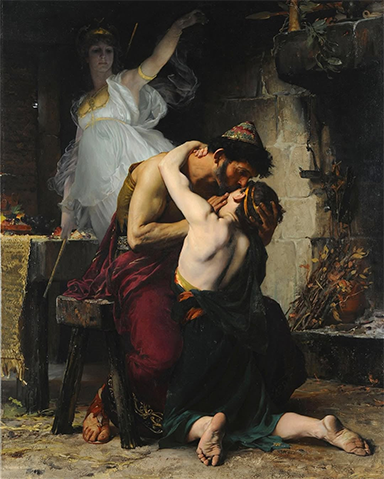
This is the painting that won the French Prix de Rome competition, 1880. It is beautifully detailed and the arrangement of the two figures suggests their overwhelming feelings. The stone fireplace shows Eumaeus to have been a fine builder and living well as a servant of Odysseus. Athena stands in the background, her arm raised above the two men, her fingers spread as though she is manipulating them, like a puppet master in control of their fates. It is also a reminder about the part Athena has played in this reunion. She has transformed Odysseus back to his former self and instructed him to reveal the truth to his son.
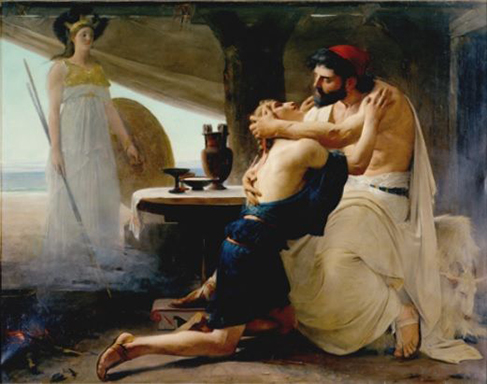
Lionel Royer’s painting arranges the father and son almost exactly the same, except from a different angle. In this painting Telemachus’ face is also seen, but his gender remains ambiguous for a viewer unaware of the subject.
Athena also stands in the background of this painting, too, but her role here is different. Unlike Doucet’s Athena, who seems invested in the emotion of the reunion, Royer’s Athena stands back impassively, as though this moment has little interest for her, emotionally. Her interest lies with the spears and shield she holds. She seems to be waiting for all this to be over, so that the real work of fighting the suitors can be started, recalling her words to Odysseus just before this scene: “I’m blazing for battle!” (Book 16, line 193)
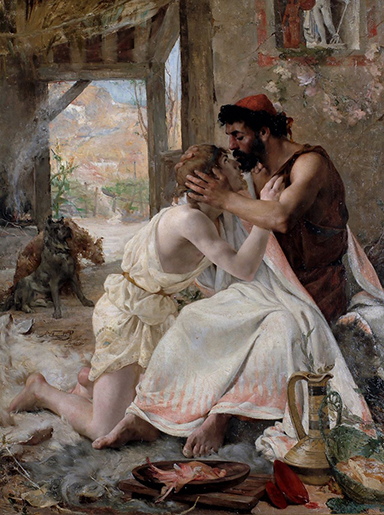
This third painting, attributed to Georges Trauffaut, represents a less classical, more bucolic rendition of the reunion between Odysseus and Telemachus. The dwelling is cruder in its construction, Eumaeus’ dogs appear in the scene and Athena is absent, while the remains of their food appear in the picture’s foreground. A niche in the top right corner of the painting contains the likeness of two gods, but the scene is otherwise removed from the wider context of the story. One of the gods in the niche may be Poseidon, given that he bears a trident.
The emotion between the two men feels less intense. Telemachus’ right arm is not flung about Odysseus. Rather, it seems to edge towards him while his eyes, looking up into his father’s face, seem searching, less certain.
There is a detail in this painting that has made me question the common attribution to Georges Trauffaut as the artist. On the ground, below the dogs, the painting is signed ‘A. Valenzuela P.’ It appears to refer to a Chilean painter, Alfredo Valenzuela Puelma. I have included the detail of the signature from the painting below:
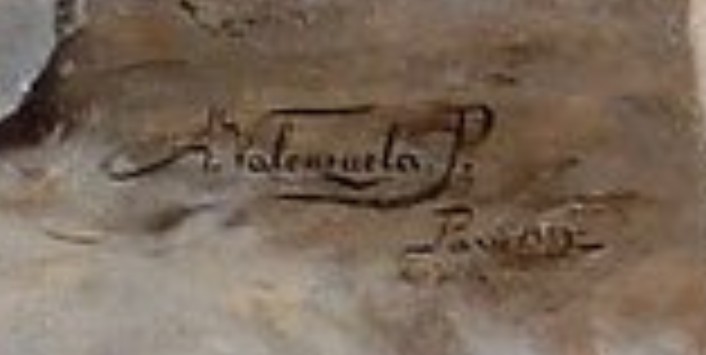
Alfredo Valenzuela Puelma (1856–1909) was a renowned Chilean realist painter who trained in both Santiago and Paris. He was awarded a scholarship to study in Paris. As part of his training he is known to have copied masters from the Louvre, as many artists did. Either the painting is mis-attributed, a mistake that has been compounded across websites on the internet, or this may be a copy of the original which Puelma has signed.
Puelma is considered one of the great Chilean artists of this period.
I have no way to resolve the question of the picture’s artist.