James Bond #4
- Category:Spy Thriller, Now A Major Motion Picture
- Date Read:6 May 2026
- Year Published:1956
- Pages:192


We’re at the fourth outing for Britain’s most famous secret agent (a contradiction in terms), James Bond, and if I had a nickel for every time a mission was primarily based in America, I’d have two nickels. Which isn’t a lot, but it’s weird how often that happens.
The Spangled Mob’s diamond smuggling operation falls under the watchful eye of MI6, and Bond is tasked with following the pipeline from the British mid-way point after Sierra Leone, all the way down to the American end. Overseeing the operation are the elusive Jack and Seraffimo Spang, American brothers who operate legitimate business through the Tiara Hotel in Las Vegas, but utilise proxies to organise and direct smugglers. Bond’s contact is Tiffany Case, who begrudgingly builds a rapport with the new diamond mule.
Despite lamenting the prospect of a long, drawn-out infiltration effort, Bond and his old friend Felix Leiter (who now works as a Private Investigator for Pinkertons) attempt to fast-track Bond’s ascension in the ranks by sabotaging the Spangled Mob’s operations at every turn. But as Bond’s journey takes him into the gambling heartland of America, his good luck begins to change.
Diamonds Are Forever is a somewhat better take on the infiltration / investigation plot of his previous outing. If Moonraker was a little plodding and overstuffed with exposition, Diamonds cuts the clutter down to a neat slice of facts, filled with interesting action and good pacing. Bond’s impatience helps to sell the sudden shifts and quick leaps, and it’s not without its drawbacks, from a cause-and-effect perspective. He causes so much noise that it brings the heat down on him, but Bond still manages to accomplish his mission simply by virtue of being captured.
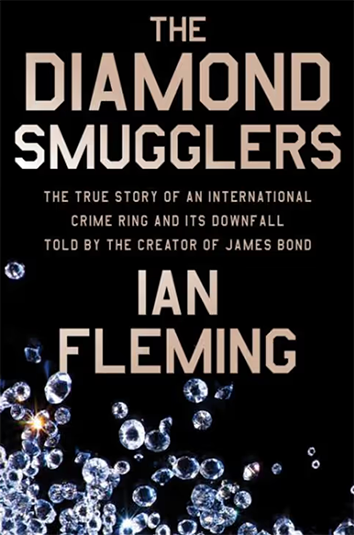
The structure, inner workings, and methodology of the whole diamond smuggling operation, too, is very believable and likely it is how many criminal syndicates do or have run their business. The deeper we get, the more fascinating it becomes, especially when we learn how the group legitimises the handling of money from business vendors to smugglers for their dangerous work. It’s when we reach the top and discover the true location of the Spangled Mob’s hideout of Spectreville (a private holiday town for the Spangs) that we truly enter the realm of whacky that James Bond is known for. Not in a bad way, mind you.
The return of our favourite former CIA Agent Felix Leiter is a bitter-sweet affair. It is a pleasure to have him back, but the toll has quite clearly been taken and a slight strain on the relationship between him and Bond looms over every scene they share. Now handicapped due to his missing several limbs, Leiter seems to be making up for his disability without complaint in what appears to be some kind of proving effort to win his worth in the eyes of James. Meanwhile, Bond struggles to keep his guilt and pity for his P.I. best friend out of his mind, despite noticing the signs of debilitation across their time together.
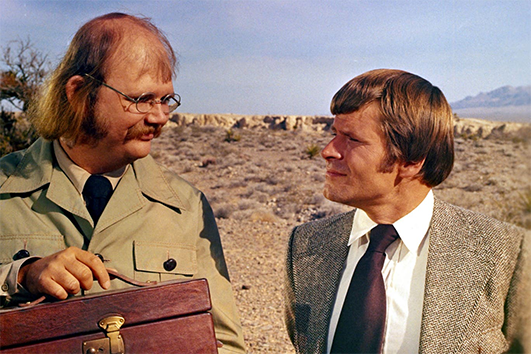
The standout villains of the piece are hitmen Wint and Kidd, synonymous as well amongst fans of the Diamonds Are Forever film adaptation. Both are just as ruthless and unusual as their movie counterparts, and the same representation is present in regards to their relationship. It is clear why they are a few of the surviving original characters to make the translation across mediums: Tiffany Case being the other, whose character has far more depth here than the later adaptation. She features far more intelligence and emotional depth in the novelisation, making her a standout to most other “Bond Girls” thus far.
For the most part, Diamonds Are Forever is best when it comes to the bit parts and memorable sequences: limo driver and snitch Ernie Cureo, Shady Tree, Seraffimo Spang in his cowboy getup and rigging the rigged horse race, the mud baths, Bond causing trouble at the casino, the car and train chases, Spectreville, and the events aboard The Queen Mary, all make for the kind of spectacle you need in a Bond adventure. Its only flaws come at times from the blasé manner in which the narrative conveys some of the hijinks. But allow yourself to be carried away and it is only a mild dulling of the impact.
The film version of Diamonds Are Forever is remembered fondly by most. Although it is, perhaps, one of the campier films from that time, which is especially notable from our perspective since we know the series was approaching the Roger Moore era. As such, the plot-line is given over to the pursuit of Spectre’s head, Ernst Stavro Blofeld, after killing Bond’s wife at the end of On Her Majesty’s Secret Service. Both character and story have yet to occur in the chronology of the novels, thereby making the movie mostly an original piece of fiction. It’s difficult to make a comparison between the book and the film with such stark contrasts and points of establishment, only to say that Diamonds Are Forever, the book, has its focus and interest squarely on the very real issue of diamond smuggling from the era of the 1950s, almost as if Fleming had a vested interest in the subject. The film, on the other hand, had its focus on . . . well, quite a lot of things that make for a bit of a jumble of a plot, but it is at least an entertaining romp.
This felt truly like a bit if a return to form for Bond with a much more solid adventure and a remembrance from Fleming that, in order to keep your readers glued to the page, the best exploration of a topic is best done through the eyes of your protagonist rather than chapters of straight exposition.
Our next adventure comes to us From Russia, With Love.
The James Bond Series
Greyed-out covers indicate a review is yet to be pubished for that book on this site









The Movie
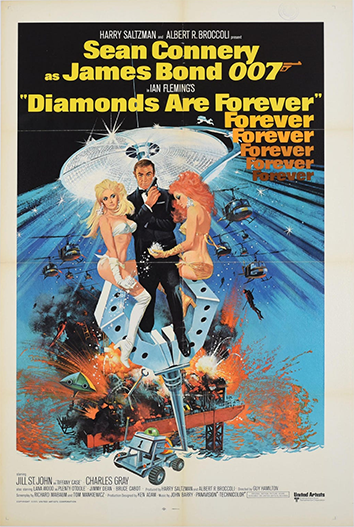
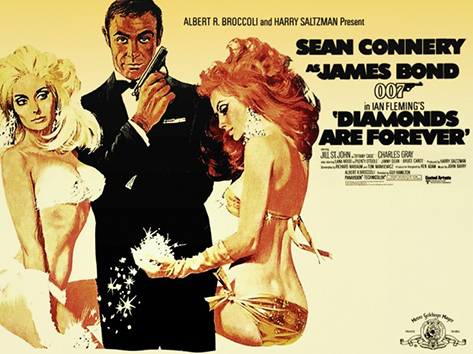
Diamonds are Forever was Sean Connery’s sixth appearance as James Bond. He had retired from the role after the 1967 film You Only Live Twice. George Lazenby appeared next in the 1969 film On Her Majesty’s Secret Service. Bond’s wife is murdered by Blofeld at the end of that movie, and so Diamonds are Forever continues that story thread.
Connery was paid $1.25 million to return as Bond. His contract also included a percentage of the film’s gross profits, earning him a total of about $6.7 million dollars in 1970s money. It was a world record payment for an actor at the time.
Fleming's Other Diamond Book