James Bond #3
- Category:Spy Thriller, Now A Major Motion Picture
- Date Read:23 March 2026
- Year Published:1955
- Pages:190


I was surprised to learn Moonraker was the third title chronologically in the James Bond novel series, but nowhere near as shocked as when I read it and found out just how different it was to its film adaptation. But just how different is it? And are these changes for better or worse? That depends. But first, our scheduled summary.
A frustrated Bond completes menial tasks at MI6 between missions, awaiting word on the successful returns of two fellow agents out in the field. Suddenly, he is called into M’s office on something of a personal request. M has been approached by the head of his gentlemen’s club, Blades, who suspects the multi-millionaire and national hero Hugo Drax has been cheating at cards on a regular basis. With the scandal potentially damaging both to Drax and to the government if word got out to the public that the man engineering the British-backed Moonraker project was scamming people out of their money, M tasks Bond with figuring out if these suspicions are valid and how, and to deal with it in a discreet manner.
That same evening, Bond meets Drax at the card table and confirms that the millionaire is indeed cheating, and beats him at his own game in a suitably humiliating fashion. Feeling off about a vague threat made by Drax over his £15,000 loss, Bond looks into his background to discover that, prior to heading up Moonraker’s development as Britain’s first viable nuclear missile system for the Cold War, Drax had been a scarred soldier of WWII who had lost his memory, and built up his immense wealth by controlling the monopoly on a rare metal called Columbite, which is now being used to build the Moonraker itself. Once again, M requests Bond’s help concerning Drax, but with far more serious circumstances. The Head of Security for the Moonraker facility is shot dead after reporting suspicions of sabotage of the project, but had been assassinated by a rogue guard (who also committed suicide) before he could give any details as to why. M, at the behest of the government, has assigned Bond as the new Head of Security for the Moonraker Project.
Special Branch’s mole, Gala Brand, links up with Bond, and the pair attempt to discover the identity of any potential saboteur. Attempts on their lives expand the possible list of suspects, and it becomes clear that intentions for the Moonraker missile are far grander than anyone but the illustrious Drax is aware of.
Unlike the first two Bond novels, Moonraker is divided into several parts, although this structure adds nothing to the flow of the narrative. However, its first third and last third are by far the strongest and more interesting segments, with the middle falling flat with what should be the bread and butter of any spy-thriller: the espionage. Moonraker is unique in that it is the first of the Bond books to actually be set in the United Kingdom instead of featuring purely as a flashback to fill in contextual holes via briefings. Instead, the whole plot spans the distance between London to Dover and back again. While it is by no means the most stationary outing for the titular agent (that honour thus far would have to go to Casino Royale), the plot grinds to a halt upon his arrival at the Moonraker base. While Bond searches for clues as to why the Head of Security was killed in the first place, obvious red flags jump out immediately, to which Bond’s own inner monologue hardly reacts at all. It makes the developments of this section of the novel (which includes a prime suspect getting into an altercation with Bond and nothing being done to reprimand him) feel underwhelming and somewhat out of character for Bond to excuse. The explanations provided may work as a dissection of British mentalities of the time, but we are of course talking about an MI6 operative and not the general public.
Aside from that lull in the middle, the rest of Moonraker is quite frankly the best Bond has had to offer thus far. It is far and away better structured than what we’ve seen prior, with the first few chapters being my favourite. Starting Moonraker off with an innocuous side-story of Bond and M teaching Drax a lesson about cheating at the gentlemen’s club is just a lovely bit of cheeky fun. It’s nice to see some development of the relationship between M and Bond with their levels of friendship being broadened beyond the office setting. It says a lot for someone as secretive and high-strung as M to approach Bond on what is essentially a personal matter, and Bond’s subdued reverence for M speaks volumes about him too. Mostly, it sets up Drax as a character so very nicely: a villain who appears so early on and is established to be incredibly intelligent and petulant through present actions more than hearsay or dialogue is always a win in my book (no pun intended). Plus, his comeuppance is just wryly satisfying. Even by today’s standards, Drax is a fairly relevant interpretation of today’s idealised tech-hero who becomes popularised due to a false image of a regular-joe-self-made-millionaire, but as a person is quite childish and is merely the rich facilitator of many talented individuals beneath him. Take ten guesses who that description embodies today, and you’d be right about all ten.
The final third of the novel is where the bulk of the action takes place - the players moving across the board, and the final countdown leading to the launch of the Moonraker. The explosive finale is nice and nail-bitey to the point where prospective readers may wonder if Bond will get away with it this time . . . at least, perhaps, if you didn’t know about the near-dozen books after this one. Of course, he wouldn’t have been able to get out of this one alive if it weren’t for Gala Brand who, in a first for the saga, curbs the Bond Girl trope by not reciprocating affections for her offsider. Despite his best efforts in flirtation, Gala never beds the bachelor spy, instead remaining friends with him by novel’s end and resulting in quite a sad farewell for Bond. She plays quite the integral role in the whole affair, a step-up from prior female love interests. Gala’s presence to Bond does not marry with that of her own perception, and he learns this the hard way. Where Moonraker is at its best, it is exemplifying its characters’ traits, or adding layers to them.
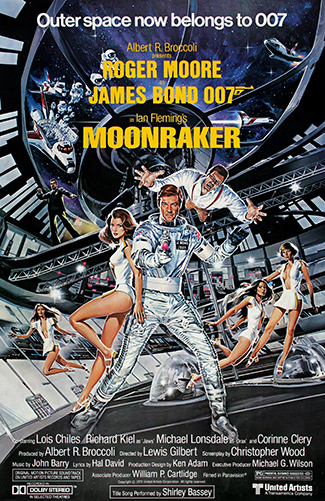
Now, I know the question on everyone’s mind is: how good was the space laser battle in the book compared to the movie? The answer is: better. Much better. They didn’t have a space laser battle, but its absence was something of a blessing. Clearly, there’s no space station to have a space laser battle over, and we never at any point set foot into the vacuum of space. Moonraker is purely a terrestrial tale about the race to nuclear deterrence (or destruction) during the outset of the Cold War. It’s intriguing just how much Moonraker looks back at the events of World War II to juxtapose Britain’s smiling patriotism and almost-calm at the idea of hosting its own nuclear missile platform, blind to the idea that it could potentially be used against them by a rogue element, even from within. While the film boasts metal-toothed henchmen, a eugenic apocalypse plot, and a freaking laser battle, it does quite lack a self-awareness in its commentary and simply exists to play on the cool of the day. It’s clear Fleming was very passionate in his research and creation of Moonraker, and even if the first half had to be “grafted on”, in his own words, it makes for a hell of an opening to what is, at worst, a very reflective look on British ideals of the time.
Though Moonraker had a few hitches along the journey between, its launch and eventual landing were near perfection. And speaking of perfection, we’ll see soon whether Diamonds Are Forever makes the cut.
The James Bond Series
Greyed-out covers indicate a review is yet to be pubished for that book on this site