Two Reviews of this book by bikerbuddy and Toriaz
The Book of Dust #2
- Category:Children’s Fiction, Fantasy Fiction
- Date Read:25 January 2026
- Pages:687
- Published:2019


The Secret Commonwealth is the second book in The Book of Dust trilogy. Lyra, the protagonist, is now a young woman studying at Jordan College where she has mostly grown up after the disappearance of her mother and father at the end of His Dark Materials. If you are unfamiliar with these books, it is essential to know that in this world a person’s soul outwardly manifests as a ‘dæmon’ in the form of some kind of animal which accompanies their person everywhere and is able to communicate with them. The act of separation, which is possible, can only be undertaken with extreme anguish and physical pain. Lyra’s dæmon is Pan, a pine martin. In The Amber Spyglass, the last book in His Dark Materials trilogy, Pan and Lyra separate so that Lyra can travel to the world of the dead. Since then, we find, they have become increasingly estranged. Pan has trouble psychologically accepting his abandonment, and since he can now freely separate from Lyra, he has taken to sneaking out at night. Except, this night, as the book begins, Pan witnesses a murder. As the man, Anthony Hassall, lies dying, his dæmon begs Pan to take his wallet. What they find in the wallet will be the beginning of an adventure that will take Lyra and Pan far into the East, ostensibly to search for the fabled roses that produce oil that allows greater insight into the nature of Dust, that mysterious phenomenon that is the basis of existence.
One might presume the properties of the oil produced by the roses is a MacGuffin. The desire to control the oil and the search for the land in which the roses grow is the motivating factor for both Marcele Delamare, the Secretary General of La Maison Juste, an organisation based in Geneva associated with the Magisterium. And Lyra’s personal journey is intertwined with Karamakan, where Hassall’s research has pointed her. But it is also a metaphor for the difficulties of insight and knowledge. Oliver Bonneville, the son of the Bonneville of the first novel, has discovered the painful side effects caused by reading the aliethiometer in a new way as he attempts to track Lyra and Pan. Likewise, the side effects of placing the rose oil into one’s eye to perceive Dust is also searingly painful.
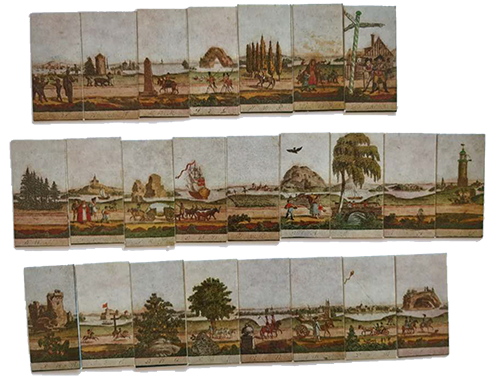
This is a novel about self-discovery and widening one’s perception. Much further into the novel, when Lyra is well into her journey, she meets an elderly man on a train who is attempting to keep a young child amused. He produces a pack of cards which have various illustrated scenes. The cards can be placed in any order and they will form a continuing picture which can be interpreted as a narrative: a Myriorama. The elderly gentleman uses the cards to tell stories to the child and he later leaves the deck for Lyra while she sleeps, along with a note warning her to be careful: “These are difficult times”. His warning suggests a link between his simple diversion and the wider realities of Lyra’s world.
For Lyra, as a college student, has been intellectually swayed by popular books she is currently reading; by intellectual fashions which Pan believes are dangerous. Pan feels Lyra is becoming too rational, is lacking in imagination and is dismissive of some of the very tenets of their shared reality. She has been reading two books in particular. The Constant Deceiver by Simon Talbot posits that there is no basis for truth or any reality. Gottfried Brande’s The Hyperchorasmians values reason above all else and its tenets can be encapsulated in the phrase, “Nothing is any more than what it is”. In other words, there is no reality beyond what is physical and evident. Brande dismisses dæmons as nothing more than a mass delusion. Pan is horrified that these ideas are having an influence on the impressionable Lyra.
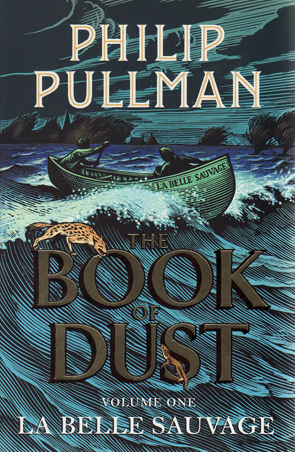
In a conversation with Talbot, Malcom Polestead (who, as a boy in La Belle Sauvage, helped save the baby Lyra, and is now a professor of Jordan College at Oxford) suggests that Talbot’s views stem from the arbitrary nature of language. From this we might infer that Pullman is taking aim at the theoretical spawn of post-structuralism in our own world, like Deconstruction theory, which takes the uncertain significations of language as its basis, or Postmodernism, which flattens history, meaning and tradition until no assumed objective truth, tradition or formerly dominant cultural narrative maintains a privileged position. Instead, each are revealed as forms of power and interpretation, only. There is no edifice, only positions. In short, ‘truth’ gives way to relativism. It is very much like the intellectual sugar that now feeds Lyra.
But as Lyra plays with the cards, she senses a correlation between her own journey and its goals, step by step, and what the cards shows her. “I could choose to believe in the secret commonwealth,” she thinks, “I don’t have to be sceptical about it.” The secret commonwealth is a world that exists through the agency of stories, dreams and imagination. Giorgio Brabandt, who helps hide Lyra from the Magisterium, says of the secret commonwealth,
. . . if you want to think about them it don’t do no good making lists and classifying and analysing. You’ll just get a lot of dead rubbish what means nothing. The way to think about the secret commonwealth is with stories. Only stories’ll do.
This is the significance of the Myriorama. The secret commonwealth is the world of fairies and night-ghasts and jacky lanterns, none of them explainable by science or logic, but having a tenable hold upon our inner world if we allow it. In despair, Pan leaves Lyra to look for her imagination. After all, the very tenets of her emerging thinking would reason him out of existence. Without him, Lyra cannot be whole.
Of course, the scene with the Myriorama is a piece of metafiction. Pullman, like the elderly gentleman, reveals the secret world of imagination to us through his own story. But the cards presumably also presage events of the final volume of The Book of Dust. Also, we understand a shift in Lyra’s thinking as she meditates upon the cards, a kind of low-tech aliethiometer. Narratively, the cards reveal a ruined tower, weary soldiers and a gigantic bird so large that it can carry away horses. This detail should spark readers’ attention. Earlier, a merchant has described the road to the East to Marcele Delamare, who is looking to exploit the properties of oil extracted from roses, grown only in one place, far enough away to be exotic and mysterious and require a serious journey by our protagonist. The merchant tells Delamare of the terrifying birds called oghâb-gorgs. Later, again, we learn that a fanatical group, generally known as by the vague sobriquet “men from the mountain” (religious zealots who fear the rose oil will blaspheme their religion) undertook the destruction of a research station but were “forced to flee by a monstrous bird”.
The birds play no role in The Secret Commonwealth, so we might presume their presence will be felt in The Rose Field, the final volume of The Book of Dust. Their presumed reality, like the mysterious Myriorama that foreshadows them, would have previously been dismissed by Lyra. Lyra is older now. Twenty years have passed since we last saw her as a six-month-old baby in La Belle Sauvage. (Chronologically, this book follows The Amber Spyglass from His Dark Materials. But there is no need to slavishly read the books in chronological order. Maybe don’t.) While the first and second volumes of The Book of Dust bookend His Dark Materials, they are their own thing. In fact, it is arguable that Pullman writes in response to his own earlier work. His Dark Materials, broadly, is a response to the power and influence of organised religion and its absolutist tenets. In those books the Magisterium – broadly a representation of the Catholic church – experiments with children, cutting them from their dæmons in an attempt to sever them from the original Biblical Fall – a knowledge of Sin – we know from the story of Adam and Eve. Now, Pullman seems to pull back from the extremes of rationalism. It is one thing to reject an organised religion bent upon domination, but rationalism, taken to an extreme, also risks one leading an incomplete life; of being an incomplete person.
This is evident in the sheer number of characters we meet in this volume who have, for one reason or another, lost their dæmons. Cornelius van Dongen, otherwise known as the ‘Furnace Man’, lives a life of torment and pain since his father gave his dæmon to a magician. He gives off tremendous heat and he cannot live in comfort. “I am all fire and she is all water”, he tells Lyra, and begs for help to be reunited with his dæmon so that he can live in peace once again. There is also the Princess Cantacazino whose dæmon left her for another woman. The Princess had tried to pretend to love this woman, also, to be with her dæmon, but her life is a sad emptiness.
The link between the loss of dæmons and the rational/irrational is most pronounced with Lyra and Pan, who explicitly argue about this issue. But the issue is also related to one’s humanity. To be less than whole is to be less than human, and Pullman reifies this argument in the sinking of a ferry full of refugees. The novel seems to take its context from the European refugee crisis that began in 2015. That crisis was characterised by unusually large numbers of refugees moving from Middle Eastern countries and trying to enter Europe, caused by several factors, including the Syrian Civil War. Lyra is on the ferry that sinks a refugee boat, and the event is a part of the intellectual and emotional tapestry which is beginning to change her sense of self. Lyra passes through some of the temporary refugee camps on her way east, and upon seeing their living conditions she reflects, “they had no homes; they were like people without dæmons, people missing something essential.”
The Secret Commonwealth is a richly layered narrative, filled with fascinating characters and situations, and it enhances Pullman’s reputation as a writer who tackles big ideas. As a reading experience, it is immersive, yet there is a strange sense that while it is more cohesive and unified than La Belle Sauvage, at the same time it lacks the sense of a satisfying ending. A destination is reached, but we’re left with a feeling of expectation. I was glad I had decided to wait for the whole trilogy was published before I started to read it. La Belle Sauvage could have stood alone as a single novel. The Secret Commonwealth can’t. As readers of both His Dark Materials and The Book of Dust, we are also aware that Pullman is doing something different with his world, now. His Dark Materials was large, cosmic, on an epic scale. The Book of Dust, so far, is more personal. A personal journey. A meditation on what makes us who we are.
“You won’t understand anything about the imagination until you realise that it’s not about making things up, it’s about perception.”
The Secret Commonwealth is the second in The Book of Dust trilogy, but the first and second books are separated in time by the original His Dark Materials trilogy. The sequence goes:
- La Belle Sauvage - The Book of Dust #1 - Lyra is a baby, under a year old
- His Dark Materials trilogy - Lyra ages from around 11 to 13 over the course of the trilogy
- Lyra’s Oxford - a standalone novella - Lyra is 15
- The Secret Commonwealth - Lyra is 20
- The Rose Field
While La Belle Sauvage could be read as a standalone story, The Secret Commonwealth has an abrupt ending which (hopefully) leads directly to the final book. At this time, there is no estimated publication date and the expected title has not been revealed. Given that Pullman made people wait 3 years between the second and third books of the His Dark Materials, I may have made a serious mistake in reading this book at the moment. Because there is a lot going on in The Secret Commonwealth and I really want to know what will come next and how Pullman will resolve a fairly complex plot.
There is so much happening in this book, it will be interesting to see what Pullman intends to do and how he will tie the story all up neatly. The overall background is the increasing power of the church and of their control over all aspects of life. Universities are no longer truly independent places of study, but dependent on the goodwill of the church for survival. There is a disruption in the trade of an important commodity (rose oil), and economic repercussions are being felt in the west. The disruption in the rose trade is a result of terrorism, from the activities of a small band of religious fanatics who dictate that God is offended by the stench of roses. There is also an increasing refugee crisis. It doesn’t appear to have reached England at the start of the book, but is referenced more and more as our main characters travel from England to Europe and towards the Middle East. And against all of this background, a powerful member of the church is seeking Lyra for unspecified reasons.
The refugee experience is introduced subtly. At first there are just a few references, such as an overheard conversation between two sailors about their ship’s captain selling a batch of desperate travellers into slavery. But the references become more frequent and more graphic as we head east. A ferry Lyra is travelling on collides with a smaller boat, overcrowded and sailing without a light, and destroys it, with many of the passengers drowning. As Lyra travels further, she sees desperate families trying to find shelter and food. Pullman illustrates the desperate life of refugees, the abuses they can suffer at the hands of unscrupulous men (being sold as slaves is fairly minor compared to something which happens later), and the way families can be torn apart, but does this as part of the background to his story, rather than making it the focus of the story.
There are obvious parallels between the world of The Secret Commonwealth and our world. Apart from a few remaining aspects of fantasy, the story could easily be set in our world, with turmoil in the Middle East and increasing right wing extremism in the West. The steampunkish world Pullman created for His Dark Materials seems to have faded into a much more mundane world. I noticed this in La Belle Sauvage as well. I think part of this is that Lyra was a child in the first trilogy and saw the world through a child’s eye. She is no longer a child in this book, and her world view is a bit more sophisticated. She has lost her ability to feel wonder at many aspects of her world and because of this, the world of the book is a much more mundane one for the reader, also.
At the opening of this book, Lyra has become too rational, at least in the eyes of Pantalaimon (her dæmon), and this causes the two to be increasingly at odds with each other. The Secret Commonwealth is revealed to be the world beyond rationality, a world of imagination, of folklore and stories, a world which Lyra has lost. This was something I didn’t understand in La Belle Sauvage; why Pullman had included several interludes that seemed to be taken from fairytales amongst the horror of the floods Malcolm and Alice were subjected to with baby Lyra. While I still think those sections dragged a little and could possibly benefit from some editing, I now understand they served to reveal part of these wonders’ existence in our world, and that Lyra has forgotten them in her attempts to be a rational scholar. A major part of this book is Lyra’s realisation as to what she has lost and her attempts to take steps to get it back again. The journey is a hard one and very painful for Lyra, and it isn’t really resolved at the end of the novel. We can only wait, now, for the final book to see if Lyra is able to overcome the self-hatred which seems to overwhelm her in much of this book.
Overall, I enjoyed this book, but was disappointed to have nothing resolved, and therefore having to wait for the third book to start tying all the loose ends of this story together. I liked the acknowledgement that the heroine of the earlier trilogy has now grown up and has to face grown-up problems. I look forward to the third book and the conclusion of this story.
“She couldn’t get any further at that point. The sky full of stars seemed dead and cold, everything in it the result of the mechanical, indifferent interactions of molecules and particles that would continue for the rest of time whether Lyra lived or died, whether human beings were conscious or unconscious: a vast silent empty indifference, all quite meaningless.
Reason had brought her to this state. She had exalted reason over every other faculty. The result had been - was now - the deepest unhappiness she had ever felt.”
The Chronological Reading Order