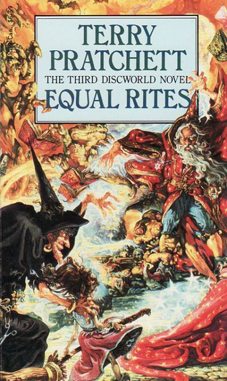
Two Reviews by: Skep | Toriaz
The Discworld Series #3
- Category:Fantasy Fiction, Humorous Fiction
- Date Read:17 February 2026
- Pages:264
- Published:1987

[Esk] found that life in the cottage wasn’t entirely straightforward. There was the matter of the goats’ names, for example.
“But they’ve got to have names!” she said. “Everything’s got a name.”
Granny looked at her around the pear-shaped flanks of the head nanny, while the milk squirted into the low pail.
“I daresay they’ve got names in Goat,” she said vaguely. “What do they want names in Human for?”
“Well,” said Esk, and stopped. She thought for a bit. “How do you make them do what you want, then?”
“They just do, and when they want me they holler.”
Esk gravely gave the head goat a wisp of hay. Granny watched her thoughtfully. Goats did have names for themselves, she well knew: there was “goat who is my kid,” “goat who is my mother,” “goat who is herd leader,” and half a dozen other names not least of which is “goat who is this goat.” They had a complicated herd system and four stomachs and a digestive system that sounded very busy on still nights, and Granny had always felt that calling all this names like Buttercup was an insult to a noble animal.
This being my first time reading the Discworld novels in order of release, I’m only now struck by how significant a departure Equal Rites is from Pratchett’s first two novels. On the face of it, it’s exactly what you would expect from what we’ve seen so far: an offbeat adventure through a fantasy world featuring humorous characters, improbable situations, and tongue-in-cheek commentary on human nature. But once you discount all that, you realize this is a far more scaled-down, grounded story compared to Rincewind’s whirlwind escapades. We’re no longer hopping from antic to antic, connected only by the loosest threads of continuity. Instead, we’ve graduated to a full-on “STORY!” with all the features you would commonly expect, such as intrinsic and clashing character motivations, overarching themes indicative of authorial intent, and a plot.
Factor in that Pratchett overtly and unabashedly published this entry as a commentary on gender roles, at a period of time where such a thing was not commonly done, in a genre where such a thing was possibly never done, and you can see why I’ve been putting off writing this review for so long. With so much I could possibly talk about, where do I even start? (this is me, currently writing this paragraph, stalling for time before I have to move to the next one and ostensibly take this review somewhere).
(okay, I’m going to do it now)
(hhrrrrgggh . . .)
I suppose it makes the most sense to begin with Pratchett’s focus on gender, as it is central to the basis of the plot (phew, I did it!). In Discworld tradition:
- Men practice wizardry, which focuses on big, flashy, bend-the-world-to-my-will magic, high-level academics, studies in the theoretical, and a severely unbalanced ratio of pomp and circumstance to actual spellcasting.
- Women practice witchcraft – a practical, domestic magic – which relies half on an intimate understanding of the natural world, and half on an intimate understanding of the placebo effect.
And never the twain shall meet . . . Until . . .
In a remote mountain town, a child is born under all the auspices that signify a wizard of talent, and is bequeathed powers that would make the boy a shoo-in for admittance into Unseen University, the foremost academic hub for such individuals. Except in this case, the child is female. Nobody really knows what to do about that, but they do at least know that women can’t be wizards. That’s just basic science right there.
Even without me saying anything else about the plot, you can probably take some educated guesses about who the protagonist is and what she ends up wanting to do and how other people might feel about such a thing. This kind of breaking-barriers, do-what-they-tell-you-you-can’t story is perfectly fine, though personally doesn’t really move me in the way that these things are typically meant to. On the other hand, I’m a privileged man, and the films I grew up watching were less “girls can’t play basketball” and more “dogs can’t play basketball”, so it’s a little bit possible my sensibilities are wildly misaligned. When it comes to emotional impact, you really should be putting more weight into Toriaz’s review here than mine (you shouldn’t be putting weight into any of my reviews to be honest, if Air Bud is the first piece of media I think of to compare this book to).
Credit to Pratchett, though, who sees modest success with the initial two entries in his goofy-ass fantasy spoof and decides the first thing he’s going to do with his new platform is tackle feminism. That’s a swing you have to respect.
Anyway, this book breaks down neatly into three acts:
- Eskarina Smith (aforementioned child) apprentices to Granny Weatherwax (local witch) because everyone supposes she should learn SOME sort of magic.
- Esk and Granny journey to Ankh-Morpork so that Esk can join the Unseen University and learn wizard magic instead.
- The university won’t accept Esk on the basis of genitalia, so she sneaks in as a servant. Also, the world almost ends, maybe.
Of these, Act 1 is by far the best. Pratchett’s version of witchcraft – which strikes me as a surprisingly respectful portrayal that doesn’t fall into the easy tropes – isn’t necessarily the most fun on the surface, but we have some really good conflict as Esk chafes against the rote memorization and boundaries witchcraft imposes. Magic is instinctive to her; why isn’t she allowed to just do it? Really, after two books of zany antics, Pratchett shows he can give us a more zoomed-in slice-of -life narrative (complete with actual stakes) while still bringing the jokes. And once again, we’re doing it with characters that would never be leading other fantasy novels. Truthfully, this is some of his best work.
Unfortunately, it can’t last. Act 2 isn’t bad, but at this point Esk starts to come into her own. By this I mean, although she doesn’t know much about the world outside her village, the wizard staff she inherited provides the magic needed to safeguard her, no matter what she faces. While this is amusing at times, between her and Granny, our two characters have become “naif who walks through every encounter with unearned confidence” and “bitter magic user who is in over their head trying to protect their companion from self-sabotage and who would rather have stayed home”. In other words, pretty much the same exact schtick as Rincewind and Twoflower. I mean, it’s a good schtick, I understand wanting to reuse it. It’s just not nearly as compelling as Act 1.
(It occurs to me after the fact that I have managed to work in the word “schtick” into all of these reviews so far. I’m sure this says something; I’m just not sure what yet.)
Then we get to Act 3, and . . . I have to say, this is an outright mess. Everything is fine up until the climax of the story, at which point I start to lose the plot through vague motivations and half-baked ideas.
Throughout the book, Pratchett has hinted at these dark beings at the edge of one’s vision who, I don’t know, have an attraction to magical minds or something (if you can understand anything about this then you are a smarter person than I). Well, late in Act 2, Esk meets an aspiring wizard named Simon, who is already studying magic in the same way Hawking studied theoretical physics.
(Side note, but Pratchett somehow manages to write even more obnoxious dialogue surrounding a character’s speech mannerisms than he did with Cohen the Barbarian’s missing teeth in The Light Fantastic. Here, Simon speaks with a nervous stutter; this is fine. What’s unforgivable is that a solid 80% of his sentences are completed by another character filling in whatever word he’s struggling with, meaning at times the flow of conversation is constantly being broken up every couple of words for no worthwhile reason. This doesn’t even seem like it was being played as a joke. Maybe he was trying to pad out the book? I can’t believe an editor OK’d this.)
Eventually, they attack Simon and steal his mind away after he gets knocked unconscious. Esk enlists Granny Weatherwax to tend to the young wizard, and Granny decides they need the help of the University’s archchancellor to restore him. But when they go to see him, the archchancellor is just upset that there are women in the Great Hall, and . . . he and Granny get into a wizard duel, and Granny the witch is suddenly casting all sorts of spells? This is one of those beats that sounds cool on paper but doesn’t actually make a lot of sense. We’ve clearly delineated these as two distinct types of magic, and anyway, Granny hasn’t cast spells prior to this point; yet suddenly she’s going toe-to-toe with the most powerful wizard in the city. Okay.
While this is going on, Esk has to go find Simon, and uses what she learned from Granny to astral project (actually Granny never taught her to do this) into some void (this is never explained) where the creatures are watching Simon play with entire worlds like a toddler would play with building blocks (it’s hard to say exactly if this is Simon in this moment or if the Things have taken him over, but neither case really explains this behaviour very well), threatening to break the Discworld (also not explained is why other worlds are present at all, other than that one of them is Earth and Pratchett can point at it and say “Look! Earth!”).
Esk then somehow intuits what is happening and makes a series of choices that somehow prevent total destruction; but all of this seems arbitrary and gives the sense that Pratchett had developed this climax on its own, really liked it, and wanted to slot it in to some book somewhere regardless of how well it actually fit. I could see Rincewind here just as easily.
Eventually, Granny and the archchancellor stop duelling and instead work together to find Esk’s staff, which she had pitched away in a fit of anger. These scenes are quite charming, and even – dare I say – pretty cute, though I would have liked if each of them had a chance to play to their strengths. Granny does most of the work here, and even then, it’s only because she knows what’s going on since she’s witnessed all the events in the book so far, whereas the archchancellor was introduced into the story quite recently and was in the middle of eating dinner when everything broke bad.
They find the staff and somehow send it to wherever Esk is, and as per usual in these books, it puts in all the effort required to save the day. Hooray.
As far as endings go, it really comes across as a confusing, disjointed mess; which is a shame, because the book started out SO GOOD. But it’s like none of the lessons and trials that took place in the front half of the book translated to the back half. The introduction clearly indicates to us that Esk is supposed to be both a magical anomaly and incredibly gifted – and, potentially, powerful – but then after the first act, that damn wizard’s staff does so much of the heavy lifting that it’s hard to say what Esk is actually capable of. By the time we get to the end, very few of the actions she takes feel like her own, and definitely don’t feel like they’re influenced by either her wizardy nature or witchy upbringing. We should be left with the distinct impression that Esk was the only person in the world who could have resolved the crisis, but we simply don’t have that, and the ending lacks any sort of payoff as a result.
I don’t say this often, but . . . this book needed to be longer, possibly even stretched across two entries. Esk spends next to no time at Unseen University before the climax ambushes us, and Simon’s whole deal is gestured at but never adequately explained. Plus, there was such little focus on the subject of female characters persevering in the face of male-dominated institutions, which is kind of what the book is positioning itself to be. The only time Esk really has to face any societal adversity is when she initially attempts to join Unseen University, and is rejected. Rather than fighting an uphill battle to prove herself, she instead gets a job as janitorial staff and sneaks lessons from the chalkboard for, like, two days before the finale kicks off. This really would have worked better as a slow burn, but unfortunately, it seems as though Pratchett was more interested in filling the midsection with gags than he was with developing the premise that had shown so much promise in the beginning.
Normally when I hand out three out of five stars to a piece of media, I do it as a sort of “meh” rating: a piece of work that wasn’t particularly offensive in any way, but that also didn’t do enough to grab my attention, either. On rarer occasions, though, I’m forced to employ it when I find that the highest highs are weighed down by the lowest lows. Such is the case here; a compelling introduction was maddeningly squandered; and though I am admittedly mostly here for the jokes, that doesn’t mean a good story should suffer for the sake of a laugh, either.

“Unseen University had never admitted women, muttering something about problems with the plumbing, but the real reason was an unspoken dread that if women were allowed to mess around with magic they would probably be embarrassingly good at it . . .”
― Terry Pratchett, The Light Fantastic (foreshadowing the plot of Equal Rites)
This was the first Discworld book I ever read. A friend at university gave me a copy, saying he thought I’d enjoy it. As one of only a few females studying Physics, it was a story I connected with instantly. Many of Pratchett’s later books have better storylines and character development, but this one still holds an important spot in my heart.
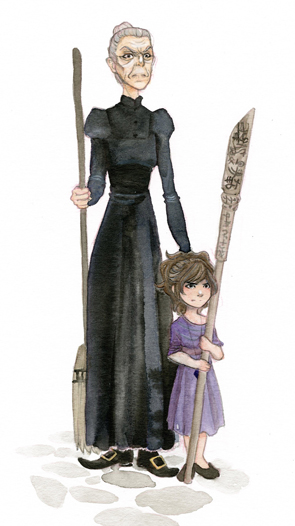
There are a number of sub-series in the Discworld novels, such as the Rincewind/Unseen University series (which the first two Discworld books fit into), the Death series, the City Watch series and the Witches series. Equal Rites is the first of the Witches books and introduces us to Granny Weatherwax. Later books introduce additional witches, such as the wonderful Nanny Ogg, but this book focusses on Granny and her protégé Eskarina Smith (usually known as Esk). Just as Equal Rites is special to me, I’ve always enjoyed the Witches book more than the other series. I think that has a lot to do with Granny Weatherwax.
Esk is the eighth child, and first daughter, of an eighth son. In the Discworld, the eighth son of an eighth son is a wizard, so the Wizard Drum Billet, sensing his approaching death, passes his staff on to the newborn Esk without bothering to check that she is, in fact, a boy. Gender roles are very clearly defined on the Disc: only males can become wizards, while females become witches. And unlike the world of Harry Potter, ‘wizard’ and ‘witch’ aren't just gender names for the same role. They are vastly different in the magic they do and in their sphere of influence. Granny, the local witch, is disturbed by what has happened, but initially hopes they can hide the staff (attempting to destroy it proved too dangerous) from Esk and raise her as a normal girl. However, as Esk grows it becomes apparent to both Esk’s father and Granny that the magic cannot be denied. So Granny takes Esk on as a trainee witch and hopes that will be enough for her. But the male magic continues to take hold of Esk, and Granny finally concedes that it can’t be contained. She takes Esk to Ankh-Morpork to seek entrance into the Unseen University, a place which considers the idea of a female wizard laughable. Once they leave their tiny village of Bad Ass, the story really gets moving. And of course, the jokes start flying.
This book shows Pratchett’s development as a writer. The Colour of Magic and The Light Fantastic were both very episodic, more a running collection of jokes with a fantasy background than a solid story. Equal Rites has a more traditional story structure, with a consistent plot running through it. The characters are better developed as well, and the competence of both Granny and Esk in magic is a nice contrast with the incompetent wizard Rincewind of the first two books. Granny, of course, will continue to develop into a much more complex character over the rest of the Witches series.
My main complaint with this book is that it wraps up too quickly. Apart from Esk’s struggles to be taken seriously as a potential student at Unseen University, the main conflict only comes out late in the book, and is wrapped up way too quickly. I understand that this problem of the dangers caused by Simon’s new magic is secondary to the main plot of equality and the triumph of Esk over the misogyny of the wizards, but it seems to be solved way too quickly once Granny persuades the Archchancellor that Esk should be allowed to join the hallowed ranks of trainee wizards. And even that more important struggle of the acceptance of Esk as a wizard seemed to be solved too quickly. Perhaps this was a sign that Pratchett still wasn’t confident with where he was going with the story, as he certainly doesn’t shy away from properly developing a problem then solving it appropriately in later books.
Despite the better story in this book, Pratchett continued with his traditional humour and his clever wordplays. As always, there are way too many hilarious lines to ever pick a favourite, although the quote I’ve included in the sidebar about the boundaries of ignorance would have to be a top contender. Maybe that’sjust because it has always captured how my fellow students and I felt every time we walked out of our advanced quantum lectures?
As always with the Discworld books, highly recommended.

Finally Cutangle spoke, very slowly and carefully.
‘I look at it like this,’ he said. ‘Before I heard him talk, I was like everyone else. You know what I mean? I was confused and uncertain about all the little details of life. But now,’ he brightened up, ‘while I’m still confused and uncertain, it’s on a much higher plane, d’you see, and at least I know I'm bewildered about the really fundamental and important facts of the universe.
Treatle nodded. ‘I hadn’t looked at it like that,’ he said, ‘but you’re absolutely right. He’s really pushed back the boundaries of ignorance. There’s so much about the universe we don’t know.’
They both savoured the strange warm glow of being much more ignorant than ordinary people, who were only ignorant of ordinary things.
