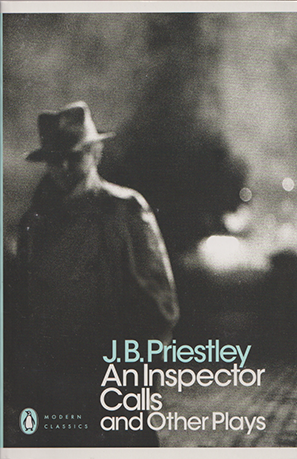
- Category:Crime Fiction, Play
- Date Read:24 May 2026
- Year Published:1947 (Debuted in Russia 1945. In England 1946)
- Pages:63


Imagine the scene: a wealthy middle-class family, the Birlings, have just finished dinner. It is 1912. There have been intimations of a coming war for some time but tonight that seems like a distant possibility. After all, they have just been celebrating the engagement of their daughter, Sheila, with Gerald Croft. The Crofts are an old wealthy aristocratic family and this is a good match. Because Arthur Birling, the family patriarch, wants more than success and wealth. He wants respectability. The prospect of receiving a knighthood, which has recently been hinted to him, is one means by which he hopes to achieve this. His daughter’s marriage will also help his family’s social standing, and will provide him a new business alliance. He just has to avoid any scandal in the coming months before the King’s honours list is announced.
But then a police inspector is announced at the door by the family maid, Edna. He is admitted into the dining room. He wants to question Birling about a young woman who has committed suicide that afternoon. Eva Smith was Birling’s employee and Birling fired her almost two years ago. Birling feels he is being unfairly blamed. But the inspector seems to know much more than he is letting on. In the course of the evening, he will implicate every member of the family in the death of Eva Smith in one way or another.
Such is the situation that opens J.B. Priestley’s play, An Inspector Calls. In a way, it is an unusual play, since it draws upon the tropes of crime fiction, but it is not concerned with a traditional crime – murder is most usual – nor does it implicate a traditional culprit, a murderer. Also, the investigative phase of the story is staged as what would normally be the denouement or summation scene: the end of a crime story in which the suspects are gathered and the explanation given, culminating in an accusation. In fact, one can imagine the whole play as an example of an extended summation scene. Commonly (but not always, of course, but for the purposes of making a point) the plot deals with a murder and a single culprit. However, in An Inspector Calls, not only is there more than one culprit, but Eva Smith is more than one victim. She has been known by a variety of names to the family in different and separate situations, so that near the end of the play it is difficult for the Birling family to believe that the inspector hasn’t been conflating several women into one fictional character for his own nefarious purposes. If they can rationalise the case this way (at least the older members of the family hope to) they can deflect the enormity of their moral guilt and maintain the status quo that was characterised that night with a celebration. But Eva Smith is more than a mere menagerie of stories cobbled together. By the end of the play the audience should realise that Eva Smith is an ‘everyman’, or an ‘everywoman’. Either is a clumsy appellation in contemporary society but the masculine term comes from a medieval morality play, and that is what An Inspector Calls essentially is. In Priestley’s world the poor are crushed by social pressures and economic realities that the rich are reluctant to take responsibility for.
Some Background Context
Because the political message of An Inspector Calls is so starkly made, it is worth considering the play in a broader context. Priestley had lived through two world wars (he had actually fought in World War I and been seriously wounded) and he had a reputation as a left-leaning intellectual.
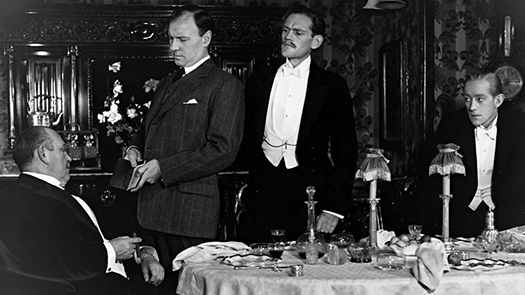
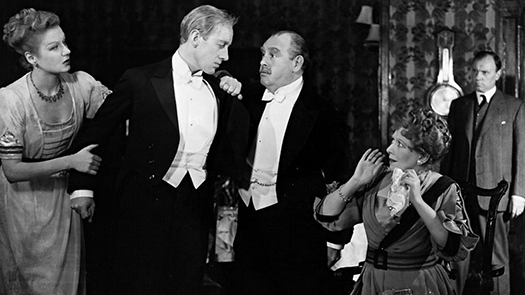
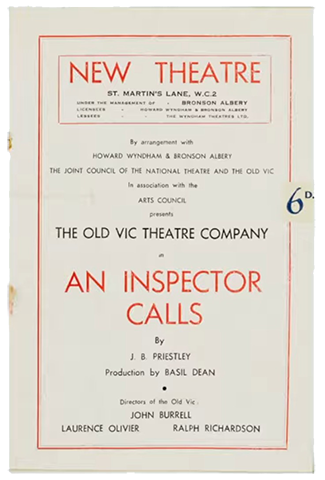
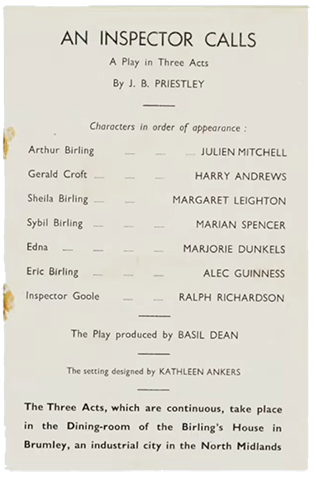
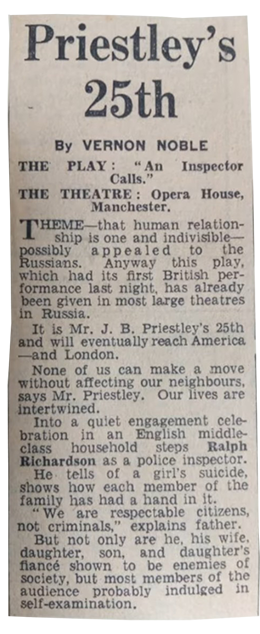
The play was reportedly written within the span of a week when London playhouses had already been booked for the season. So, the first British cast performance wasn’t until March 1946 at the Opera House in Manchester, and then at the New Theatre in London, now known as Noël Coward Theatre, beginning in October 1946. The play ran for 161 performances and notably starred a young Alec Guinness (yes, later to play Obi-Wan Kenobi in Star Wars) as Eric Birling, son of Arthur Birling.
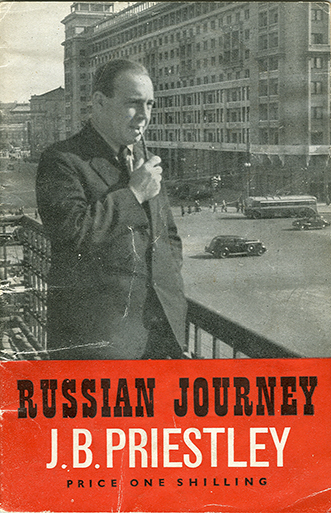
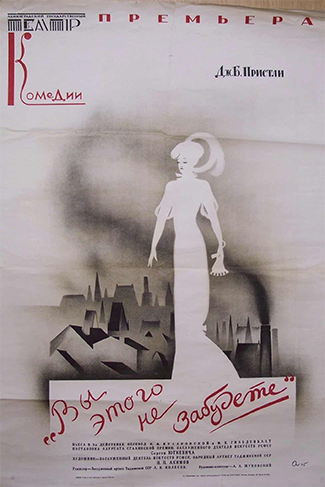
The significance of the delayed English season lies in the play’s true debut and later, implications about Priestley’s politics. In my edition of the play, the Penguin Modern Classics edition, it states that the play “was first performed at the New Theatre in October 1946.” Of course, this is inaccurate. Without a venue in England, the play was first performed in the Soviet Union in 1945 where it was renamed This You Will Not Forget for its performance in the Comedy Theatre in Leningrad and He Came at the Kemerny Theatre in Moscow. The play was warmly regarded. It received standing ovations and Priestley was feted by the Russian cultural scene.
In 1945 when Priestly went to Russia with his wife, Russia was still nominally an ally of the West. The alliance was necessary rather than natural. The Soviets had invaded Poland in collusion with Germany on September 17, 1939 as part of the Molotov-Ribbentrop Pact. It wasn’t until Germany’s invasion of Russia in 1941 that Soviet Russia was compelled to form an alliance with Britain and its allies. Even so, staging a play in Leningrad and Moscow during this period was bound to raise eyebrows. The alliance quickly disintegrated after the war. During the Yalta Conference, Britain and America could not agree with Russia on the mode of free elections in liberated Europe. By the following year Churchil gave his ‘Iron Curtain’ speech after the Soviets refused to withdraw their troops from Eastern Europe. By 1947 Truman had announced his policy of containment of the spread of communism – the Truman Doctrine – and beginning in 1948 the allies spent fifteen months airlifting supplies into areas of Berlin controlled by the West because the Soviets had imposed a blockade.
All this may seem extraneous to the matter of the play, but it suggests two things. First, that Priestley would be held in some degree of suspicion in England for his views. Second, that An Inspector Calls is an overtly political play, a fact supported by its reception in Russia. In Russia it was understood to be sympathetic to ideals held by their revolution. It denounces the exploitation of workers by capitalists and advocates for a better treatment of the working class. It even raises the spectre of a workers’ revolution, as advocated by Marx and Engels in the Communist Manifesto.
It is therefore not surprising, given Priestley’s politics and the play’s unconventional debut in Russia, that Priestley would be brought to the attention of the British government as a possible communist sympathiser. What is surprising is the means by which this was done. George Orwell, himself, identified Priestly for the Information Research Department (IRD) along with 37 others, including the historian E.H. Carr, Charlie Chaplin and Cecil Day-Lewis, a poet and the father of actor Daniel Day-Lewis. The IRD was a secret department responsible to the Foreign Office. It published anti-communist propaganda, supported anti-communist politicians and even ran smear campaigns against trade unionists and others it deemed to be sympathetic with communism. The department was established in 1945, at the end of the war. The activities of the department were kept secret until 1978.
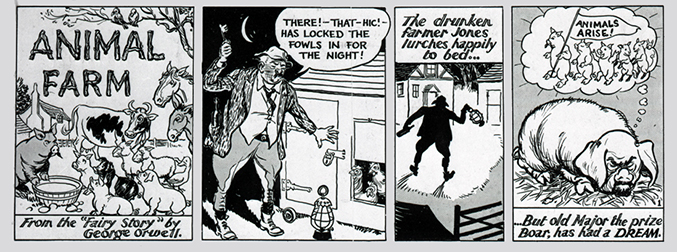
Orwell was asked to supply a list of possible communist sympathisers to the department in 1949, even as he was dying from tuberculosis. It is a great literary irony and difficult to reconcile with the common impression of Orwell as a writer who denounced governmental control of its people: who wrote against totalitarianism and the means by which it establishes and maintains power. Perhaps there might be something in the fact that Orwell’s political fable, Animal Farm, against Stalin and Soviet Russia, was promoted more heavily by the IRD, as well as disseminated and translated, more than any other work for years. Orwell was asked to supply a list and he did. Apologists will say that he only named people who already had a reputation.
But let’s get back to Priestley. None of this is to say that Priestley was a communist or a sympathiser. He wasn’t. His politics were left-leaning and he advocated for health care and a welfare state. He had helped found the Common Wealth Party in 1942. But in 1946 and 1947 when An Inspector Calls was playing on the British stage, there was enough known about him and enough expressed in his play, that he was worthy of suspicion.
Back to the Play
So, Inspector Goole calls on the Birling family after their meal to celebrate Sheila’s engagement which will help lift her social standing and maybe help her father get that knighthood he wants. Except, even though none of them have actually committed a crime against Eva Smith, their moral turpitude is unmistakable and the threat of scandal looms large over the family. Given Priestley’s political background the scenario seems obvious: a working-class girl has her life ruined by rich industrialists. It is a morality play in the strictest sense of that term. The characters are of a type and they have something to teach us about ourselves and our society.
From this point I will focus only on Arthur Birling, himself, and the inspector, and leave a discovery of the details of the rest of the family’s culpability to a reading, or perhaps a viewing of the play or a screen adaptation. After all, Birling is something of a foil for the inspector. Though he runs a profitable manufacturing business he is a morally simple man whose ideals are predicated upon simplistic notions of the efficacy of capitalism. Even his personal life is directed by his capitalist creed. His daughter’s engagement with Gerald is understood as a business arrangement, too, since Gerald’s father’s business has traditionally been in competition with Birling’s. Now he anticipates “lower costs and higher prices”. Birling’s thinking is purely in the interests of capital, not the working class. He tells Gerald, “a man has to make his own way”, and he complains that, “the way some of these cranks talk and write now, you’d think everybody has to look after everybody else.” ‘Crank’ is Birling’s word for left-leaning social progressives. He later suggests the inspector was, “Probably a Socialist or some sort of crank”, as he tries to dismiss the implications of what has been revealed of Eva Smith’s fate from his mind.
Birling is clearly against any form of social welfare and believes in the extremes of Social Darwinism. He has never considered the real impact of his doctrines on the poorer classes. For Birling, capitalism is a natural order that has the potential to eradicate conflict – not competition, of course – and install a utopian world motivated by market imperatives only. For this reason, it is impossible for Birling to credit that a war is looming, as his son, Eric insists. Progress, in his mind, is too wonderful a thing to risk on the chances of war and conflict. He tells Eric:
The world’s developing so fast that it’ll make war impossible. Look at the progress we’re making. In a year or two we’ll have aeroplanes that will be able to go anywhere. And look at the way the automobile’s making headway – bigger and faster all the time. And then there’s ships.
For Priestley’s audience, watching this play at the back end of two world wars in a span of just over thirty years, Birling’s naivety could not have been plainer. What Birling calls progress is also the catalyst for the mechanisation or war: aeroplanes, automobiles and ships. To drive the point further, Priestley allows Birling to continue his lecture, ironically undercutting his doctrine of industrial progress and stability:
Why, a friend of mine went over this new liner last week – the Titanic – she sails next week – forty-six thousand tons – New York in five days – and every luxury – and unsinkable, absolutely unsinkable. That’s what you’ve got to keep your eye on, facts like that, progress like that – and not a few German officers talking nonsense and a few scaremongers here making a fuss about nothing.
Birling’s argument is figuratively sunk by his own example in the eyes of Priestley’s contemporary audience. Weighed against his judgment is the philosophical approach of the inspector whose line of questioning implicates the Birling family deeper and deeper in the death of Eva Smith. Against Birling’s assured sense in his own position, that he did nothing wrong in terminating Eva’s job the way he did, is a sense that Birling’s capitalist doctrine is not stabilising, but that instability is inherently an element of its function. It’s a point made explicit by the example of Eva, who was sacked for leading Birling’s workers in their campaign for higher wages. Birling is still so incensed at her audacity, all this time later, even after her death, that he cannot help but assert, “If you don’t come down sharply on some of these people, they’d soon be asking for the earth.” The inspector’s rejoinder undercuts Birling’s belief in capitalism as a force for peace and prosperity: “. . . it’s better to ask for the earth than to take it” he states ominously. Unlike France and the rest of Europe, Britain had never experienced a revolution in the 18th and 19th centuries. Inspector Goole reminds Birling that this state of affairs is not an absolute given. The capitalist system and the people who run it are too unwitting or uncaring in their disregard for the suffering of workers. When Birling complains that the inspector has spoiled their dinner, the inspector counters with the implication that they have spoiled Eva Smith’s entire life: “a nasty mess somebody’s made of it”. When Gerald insists that they are “respectable citizens not criminals” the inspector’s rejoinder – “Sometimes there isn’t as much difference as you think” – highlights the hypocrisy and deceit that the family’s self-assurance is predicated upon.
The inspector’s final speech before he leaves the Birling home is key to all he has been saying, and he is clearly serving as a mouthpiece for Priestley. That Eva Smith is representative of a class and the social ills of England is made explicit: “One Eva Smith has gone – but there are millions and millions and millions of Eva Smiths and John Smiths still left with us.” On the matter of the threat to prosperity and peace that widening class divisions pose, he reiterates:
We don’t live alone. We are members of one body. We are responsible for each other. And I tell you that the time will soon come when, if men will not learn that lesson, then they will be taught it in fire and blood and anguish.
The inspector portrays Birling’s capitalist creed as anathema to the social body, not its saviour.
An obvious criticism to make of the play is that it is too full of coincidence and that its characters are drawn a little too narrowly to be entirely credible. Stephen Potter, a reviewer for The New Stateman in 1946 suggested, “the character of the remorseless father is drawn flatter than life, so that we expect, in the programme, to find him personified under some such name as Tycoonus, if not Share-do-well, or Mr. Busyman Hardhead.” Potter was referring to the practice of morality playwrights during the Middle Ages to give their characters (who were not characters at all but allegorical representation of a certain vices or virtues) names that made explicit for their audiences all they needed to know about them. It is a fair criticism to make of the play to some degree, if all we care about is social realism. But there is a certain amount of license granted crime fiction to begin with when it comes to realism, since the genre, especially during the Golden Age of crime fiction, was functioning as puzzle stories: as intellectual exercises. In a sense, Priestley has done the same, except that his slow reveal of culpability is in the service social debate. So, the Birling family has to be just believable enough for the drama to work, for its characters must dramatise a range of class exploitations and insensitivities for the play to prick the audience with its barb. It is a polemical play and its strength lies in the permission it gives the audience to reconsider or even change its views. While Mr and Mrs Birling cannot see (or accept) the moral lesson they have been taught once they begin to disbelieve in the inspector, their children understand that something has changed in them, and that what they have learned about themselves is not nothing.
An Inspector Calls was revived for the stage in 1992 by Stephen Daldry, a British director who took advantage of the perspective of Priestley’s contemporary 1946 audience and the pre-war setting of the play for his staging, to help keep it relevant for his own audience. The production won the Drama Desk Award for Outstanding Revival of a Play, and since then the play has gained new popularity. The play seems particularly relevant at our current juncture in history when concerns are increasingly being raised about the influence and priorities of billionaire elites and the progressively difficult financial straits in which many people find themselves. Ironically, Trump came to power in America partially by exploiting those concerns, though he was no friend of the working class in reality. Priestley displaced his concerns about class and exploitation into the pre-war era so that he might speak to his 1940s audience about these issues. It seems reasonable to argue that this play still has relevance in our own contemporary circumstances.
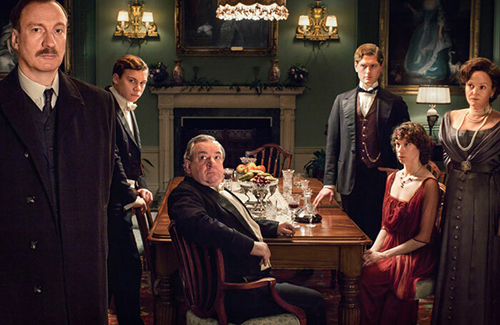
I highly recommend reading this play, particularly if you feel sympathetic with its political position. If you would rather see a production, you would obviously have to be lucky that one was being performed. Instead, I can recommend the 2015 film adaptation by Aisling Walsh, starring David Thewlis as the inspector. It is extremely faithful to the play, even though, for the sake of the screen adaptation, some scenes that are described by characters in the play receive a dramatic interpretation, instead. It is rich in atmosphere and tension, and the performances are excellent.
The London Production, 1946
The Ailsing Walsh Production
Animal Farm