- Category:Science Fiction
- Date Read:20 May 2026
- Year Published:2019
- Pages:142


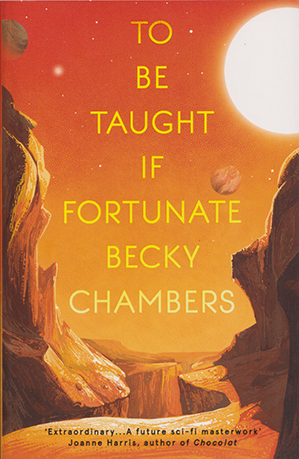
Ariadne O’Neill, the narrator of Becky Chambers’ To Be Taught If Fortunate, remembers entering the astronaut garden at OCA (Open Cluster Astronautics), an organisation independent of governments and corporations, funded entirely by the donations of rich and ordinary people, alike; people who want to support the dream of space exploration. Their names are etched into the thick glass of a tunnel that runs beneath the garden: thousands and thousands of them. Above, the garden is full of trees, each one planted for an astronaut who has been launched into space by OCA. To enter the garden one must travel through the tunnel, beneath the trees. Ariadne recalls looking up through the thick glass and seeing the wonder of the complex system that supports the garden:
Don’t believe the lie of individual trees, each a monument to its own self-made success. A forest is an independent community. Resources are shared, and life in isolation is a death sentence . . . [the forest is supported by a] world of tendrils and worms, fungus and rock, locked together in an unbreakable web.
It is a wonderful metaphor that underpins some key ideas in this book. Our narrator’s very name – Ariadne - incorporates this idea of a web of interdependence. Science, itself, is an enterprise larger than any one person, regardless of the giants of the past: the Curies, Einstein and Newton. The work of science is boring and unglamorous much of the time. In the vastness of space, it is an act of personal sacrifice: of leaving family behind, of personal discomfort and a suppression of the ego. Before they leave on their missions, Astronauts are given a day to farewell their families, forever. The role of the scientist here is almost the province of a saintly anchorite of old.
Later, when she is about to be the first to step onto the surface of Aecor, Ariadne recalls the first time she visited our moon and saw the footsteps of Neil Armstrong preserved under protective glass domes. Everyone remembers Armstong, and this preservation effort is an attempt at the heroization of an individual as much as it is a monument to national pride or history. Upon stepping onto Aecor, Ariadne reflects, “My footprints would not stay there, I knew.” The fact that the world of Aecor is solid rock and ice is beyond the point. Ariadne understands her place, as part of a vast human enterprise that surpasses her own ego.
As this story begins it has been fifty years since the crew of the Merian spacecraft left Earth on a mission to survey four planets orbiting the star, Zhenyi, in what is planned to be an eighty-year mission. Ariadne is the ship’s engineer. When the Merian left Earth, the crew were placed in torpor, a deep sleep or what we might think of as a form of suspended animation, allowing their bodies to physiologically age around only two years during their twenty-eight-year-long journey. Their ship’s system had awoken them because they had reached their destination. Their mission is to explore the lifeforms and worlds of Aecor, Mirabilis, Opera and Votum, the four planets that form Zhenyi’s system. The Merian’s crew are a part of the Lawki program, a study of exoplanets: planets suspected to be habitable outside our own solar system.
The length of time since they left Earth and the length of their journey tells us that the crew of the Merian must have been conducting their mission in Zhenyi’s system for the last twenty-two years. So, this story isn’t being told in strict chronology, though most of it is. Chambers begins the novel with a narrative frame. Ariadne’s initial message to Earth, “Please Read This”, suggests trepidation and uncertainty. As a result of Ariadne’s initial address to Earth, we always have a sense that we are reading not only a story of exploration, but also, a mystery. Ariadne’s intended audience is OCA, but she admits, “I don’t know whose eyes or ears this message has reached”. The mystery of the story lies in Ariadne’s uncertainty and why she thinks clarification is needed about the mission. What has happened? Has something gone wrong during the mission, or are there broader issues at stake? A reply will take twenty-eight years to receive if her message receives a prompt response. So, the story we read is really an explanation to Earth about what the mission has discovered and a plea for clarification. Ariadne states, “the why of what we need from you is important”. Essentially, the crew of the Merian need to know whether there is still a point to what they are doing. They need direction.
This book is essentially about issues that encompass the long-term purpose of the human race and its goals as we look towards the stars. The Moon has become a commonplace for space travel – it now possesses a lunar base – and Mars has also been explored. Earth faces its usual problems of war, famine and climate change but the Lawki missions have been publicly funded because there exists a belief in science and knowledge beyond whatever utilitarian benefits may attend the program. One of the beauties of this book, I found, was that it was not overstated. Science is awesome, its discoveries profound, but they are not of a kind that will require a final desperate flight to avoid destruction to preserve the knowledge that will suddenly fix Earth’s problems in a plot we might expect of a Hollywood spectacular festooned with CGI spectacle. Chambers confers a quiet dignity to the process that will never be that exciting to the non-scientist, except if its implications are explained without patronising the audience. Sometimes there is profundity to be found in the smallest of details; the smallest of discoveries.
Becky Chambers’ To Be Taught if Fortunate is as much a philosophical rumination about the import of science, its purposes and efficacy, as much as it is an immersive story about what the crew discover and their experiences on the four worlds of Zhenyi’s system. But it is also a story about our own humanity. Chambers writes that she was inspired by a lecture given by a PhD student, Lisa Nip, about “genetic engineering as practical supplementation”, an idea that avoids the usual dystopian tropes of “eugenics or transhumanist evolution”. The idea of evolving beyond what we currently understand to be human is common in science fiction, after all. The HAL-9000 of 2001: A Space Odyssey alludes to the possibilities and terrors of human intelligence evolving into what we would now call AI: Artificial Intelligence. Or the quantum powered ‘qubes’ – humanoid robots – of Kim Stanley Roberston’s 2132. Or the Minds of Iain M Banks’ Culture Novels. Or the replicants of Blade Runner. The list would seem endless. Generally, the idea is that the vast distances of space and time will necessarily require artificial versions of ourselves to overcome the frailties of our physical forms.
What Chambers was inspired by when she heard Lisa Nip speak in 2018, a moment she describes as “blowing my mind wide open”, is the possibility of human adaptation through the use of artificial short-term modifications to the human genome. Thus, when Ariadne and her crewmates land on Aecor, a planet that is a vast distance from its own sun, their skin is made to glitter and reflect light, making each crew member easier to see and requiring less artificial light that might otherwise affect the environment they are working in. On Mirabilis, a planet larger than Earth with twice the gravitational pull, the crew use skin patches to give themselves extra muscle fibre to help cope with the increased physical strain on their bodies. And so, each planet requires some modification which can be shed when no longer needed in a process called ‘somaforming’. Instead of terraforming a planet, the human body, instead, is made to adapt to its environment. It is a step beyond the notion of an essential self. It is a step outside the Biblical Garden, that Edenic assumption of humanity reflecting some divine form, a perfection sullied by knowledge, not enlivened by it, and unchanging. It is the need for an ever-evolving self and constant adaptation, which speaks to the concerns for our species’ long-term viability:
A moth was a caterpillar, once, but it no longer is a caterpillar. It cannot break itself back down, cannot metamorphose in reverse. To try to eat leaves again would mean starvation
Chambers’ narrative provides a new perspective of our lives on Earth and our assumptions about life on our own planet. Evolutionary theory, while sound in its conclusions, can nevertheless delude us in our arrogance. If evolution has produced human beings, then it is an easy step to consider humanity as a superior end rather than part of an ongoing process. Human beings are subject to climate change and other environmental stresses, a fact touched upon by the monthly media reports the crew receives from Earth. As Ariadne points out, the term ‘survival of the fittest’ is often taken to mean the fittest within a population, thereby leading to the false justification of a “dog-eat-dog” world, which is the dark side of Social Darwinism. Instead, ‘survival of the fittest’, meaning “most suited to”, is another way of saying that a species or organism is best adapted to an environment. In this way, Chambers’ use of the term ‘somaforming’ also reflects upon our potential to adapt to challenges like Climate Change, or to succumb to them. As such, the enterprise of space travel is represented as a collective effort, not the heroizing enterprise of early expeditions. Humanity’s best chances lie with cooperation rather than corporatisation, nationalism and war. We are all part of a forest, not each an individual tree.
Like a monoculture that has only a narrow range of beliefs and a limited understanding of the world, humans without space travel have a limited perspective on life and the sense of our own identity and purpose as a species. For this reason, though a shadow is cast over the narrative by uncertainty and possible disaster, this is also, paradoxically, a hopeful story, because outer worlds provide us with that perspective. The crew of the Merian, like the people of Earth they have left behind, face an uncertain future. Their options are limited and the choices predicated upon the simple question, “Where do you want to go?” It is a question implicitly asked of our own world, a world in which we have not yet faced species-ending disaster, and still have choices; that we may understand our choices and to decide how we wish to proceed for the benefit of all.
The experience of reading this book reminded me of Samantha Harvey’s Orbital, which won the Booker Prize in 2024. In Orbital Harvey uses a group of astronauts on the International Space station over the course of a twenty-four-hour period to reflect upon the state of the Earth and the human race. Both that book and this have a philosophical bent, but for those who may not have liked Orbital, you can be reassured that Chambers’ book has a much more defined plot with a limited degree of characterisation for Ariadne’s crewmates, Elena, Chikoni and Jack: enough to make you interested and care about them and their mission. Although, it provides a deeper insight into her narrator, whom we learn has watched the metamorphoses of caterpillars into moths as a child and has all her life understood instinctively “the fluidity of form”.
To Be Taught If Fortunate is both an engrossing story and an opportunity for reflection, and is highly recommended.
The Voyager Missions
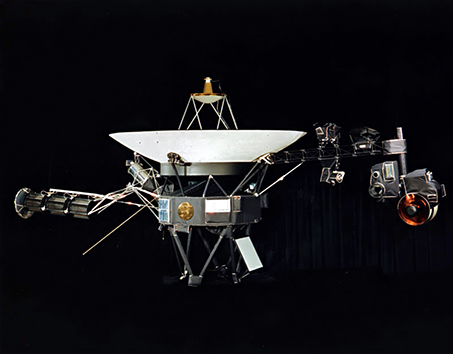
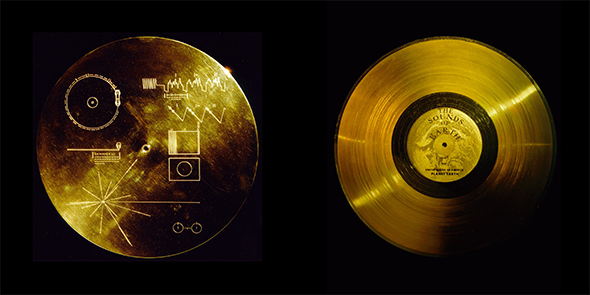
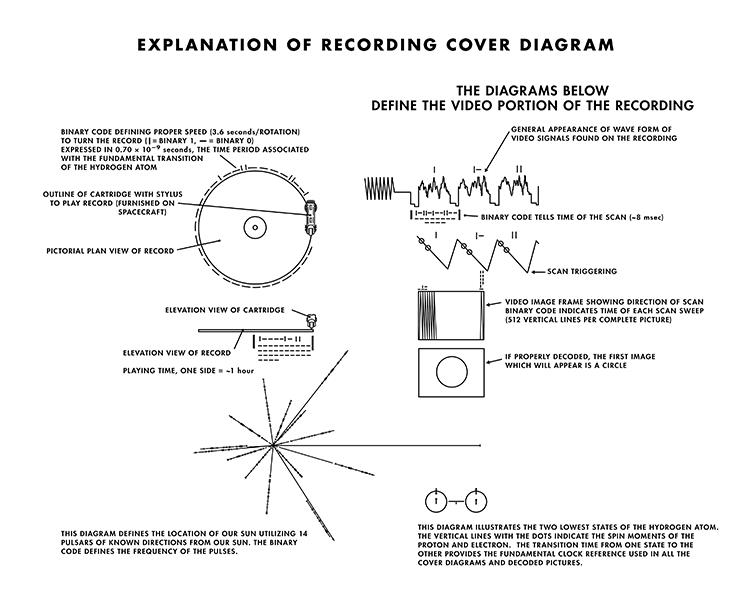
The inspiration for the title of Becky Chambers’ book is made explicit at the end of her novel. This is not a spoiler. She simply quotes from the Voyager Golden Record which included a message from the 1977 UN Secretary-General Kurt Waldheim. In part, she quotes:
“We step out of our solar system into the universe seeking only peace and friendship — to teach if we are called upon; to be taught, if we are fortunate.”
It is a humble, hopeful message which Chambers’ book strives to reflect, despite the real challenges acknowledged to be facing the human race at this time in our history.