
Las viudas de los jueves [Original Spanish Title]
Văduvele de joi seara [Romanian Title]
- Category:Crime Fiction
- Date Read:11 May 2026
- Year Published:2005
- Pages:286
- Prize:Clarín Prize for Fiction 2005


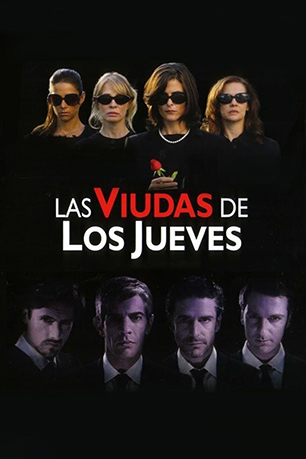
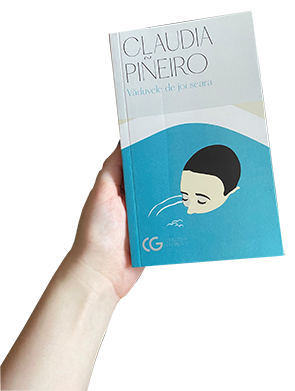
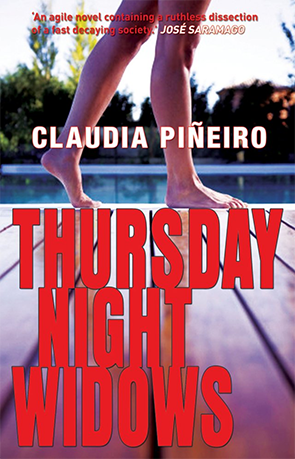
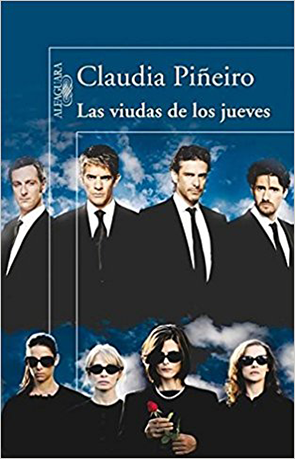
Claudia Piñeiro made a really good impression on me with her novel Elena Knows. As soon as I finished writing my review, I went on the hunt for more books by her and I landed on a crime mystery thriller: Las viudas de los Jueves in the original Spanish, Thursday Night Widows in the English translation by Miranda France, and Văduvele de joi seara in my Romanian translation by Lavinia Similaru. It was adapted as a movie in 2009, then again as a Netflix series in 2023.
This novel opens with a shocking scene in the gated community of Altos de la Cascada, near Buenos Aires, on the night between 27 and 28 September 2001. Three men are found dead in one of the swimming pools: Tano Scaglia, the owner of the house, and his friends, Gustavo Masotta and Martín Urovich. They were well-known buddies who had a tradition to meet up every Thursday night to drink and play cards. The fourth member of this friendship group, Ronie Guevara, is witnessed by his wife, Virginia, coming home earlier than usual, staring intensely at the Scaglia house from their balcony, then suddenly falling down the stairs and having to be taken to hospital by Virginia.
From the very first pages there is a very palpable oppressive atmosphere. Altos de la Cascada is perfect: imposing mansions, carefully mowed lawns and curated gardens, cul-de-sacs, golf courses, squadrons of maids, gardeners and security guards, so luxurious, so modern, so American. They are shielded from the crime, violence and tragedy that should only exist in the dreaded outside world. Things like Argentina’s tumultuous politics in the 90s, or the economic crisis caused by the 9/11 terrorist attacks, shouldn’t be able to reach them there.
Meticulous, multiple-page long explanations about the golf course schedule and nearly thesis-style descriptions of how the gardens are to be landscaped, in accordance to one of the dozens of Committees, give Altos de la Cascada an uncanny valley feeling. Everything is so perfect only because it’s so staged. The residents, of course, have the duty to reinforce it. The way it’s described gives the impression of an eerie combination of condescension and desperation for approval.
Ronie hasn’t been able to find a job in years. Martìn, too, is bankrupt. Gustavo physically abuses his wife. Tano is a manipulative parvenu lying to everybody. Mariana Andrade resents her adoptive daughter’s dark skin. Virginia’s son witnesses their neighbour assaulting his dog through a window. Carmen Insùa develops alcoholism after finding out her husband is cheating, then she runs away with a maid. These are just a few of the tales from the affluent neighbourhood. Everyone is aware of everything, but all of them stay quiet. Many would rather die than be humiliated. Every interaction between supposed friends is strategically planned – there is an expected script full of platitudes that must be followed.
Being able (or having the luck) to secure a house in Altos de la Cascada comes with a perceived superiority. You have it better than the poor, miserable, uncouth and violent working-class outsiders (that you perhaps originated from, but shhh!), and therefore you have to act better, or at least have the wits to pretend.
Entrance into The Cascade induces a certain magical forgetfulness of all that went before. The past is reduced to last week, last month, last year, “when we played the Inter-Club Challenge and won it”. Gradually we forget our lifelong friends, the places we once loved, certain relations, memories, mistakes.
[In Romanian . . .]
Stabilirea în La Cascada produce o anumită uitare magică a trecutului. Trecutul care rămâne este săptămâna trecută, luna trecută, anul trecut, “când am jucat intercountry și am câștigat”. Se şterg prietenii de o viață, locurile care înainte păreau de neînlocuit, unele rude, amintirile, greşelile.
Thursday Night Widows, page 28
The mystery is unravelled very slowly over the course of many flashbacks, in passing remarks and overt gossip about each resident. Casual mentions of things like the Guevara house’s previous owner having killed himself, or toddlers with foreign nannies screaming “bitch” at the playground, help maintain a sinister tension. Piñeiro practices a lot of restraint, giving the reader just enough to make you pause and question. You can almost picture Virginia discreetly side-eyeing you as she tells you the story, making sure you understand there is more than she can politely say out loud. Many things are only implied, trusting the reader’s intelligence to pick up on them.
Virginia is the main first-person narrator. As a real estate agent in Altos de la Cascada, she literally and figuratively knows every household. The narration is sometimes taken over by an anonymous collective “we” of the community.
“Behave yourself, or you’re going down in my red notebook,” she would threaten, laughing. She claimed to jot down everything, even when she was not sure of the usefulness of some notes. The outflow of the irrigation channels. Which garden is prone to flooding. Who is the best electrician in the area. And the best locksmith. Which neighbour is impossible to deal with. Which one neglects his pet. Which one neglects her children. People say she even notes down the names of men who are cheating on their wives or who underpay their maids.
[In Romanian . . .]
“Fii cuminte, că te scriu în carnet” amenința și râdea. Ea spunea că notează totul, chiar dacă nu era sigură de utilitatea unora dintre notițele ei. În ce măsură adună șanțurile apa. Ce parc se inundă. Cine este cel mai bun electrician din zonă. Și cel mai bun lăcătuș. Ce vecin este morocănos. Cine nu se ocupă cum trebuie de animalul de companie. Cine nu se ocupă de copii. Unii zic că notează până și cine-și înșală nevasta sau cine nu-și plătește servitoarea.
Thursday Night Widows, page 60
Virginia’s retelling of the events leading up to the pool incident is sectioned in rotating chapters about each of the other wives: Teresa Scaglia, Lala Urovich and Carla Masotta. Just like the houses that must follow the same aesthetic “guidelines”, all the women are extremely similar. Living in this gated community erodes all individuality. All of them are stereotypical hoity-toity rich housewives, or at least try to be.
These wives are under the dominance of their husbands who are, honestly, losers. Their business ventures fail one by one, their children are running around doing God knows what, and they spend all day playing tennis, or golf, or whatever, while their wives are the ones who have to take up the responsibility to provide. The men are still the heads of the households, though, with veto power over the women’s attempts to fix the messes they were forced into. Tano, in particular, is so unbelievably selfish and everything he does is born out of a desire to maintain his own superior, undefeated image.
The story has a tendency to meander, getting caught up in long expositions about Altos de la Cascada’s lifestyle. There’s an entire chapter about what dogs you may see in this neighbourhood. It is written in a semi-stream of consciousness style: memories, scenes and characters’ feelings are jumbled together in very dizzying paragraphs with short and choppy sentences that evoke the agitation they are going through at that moment. While effective, it was sometimes hard to keep up with it and I had to reread certain passages a couple times before I fully understood what was happening and who was speaking.
But, overall, I enjoyed this novel! It is an excellent exploration of domestic toxicity and the different ways, small or severe, it can manifest. Like Elena knows, it is a very atypical crime thriller, very introspective and with few actual investigative procedures.
I’m also glad I read this in my native language rather than English because, like in the original Spanish, there are many instances of neologisms and products written in English, further showing how modern and insufferably nouveau riche Altos de la Cascada is: country club, shopping center, cul-de-sac, scooter, home theatre, etc, are ostensibly written in italics. The novel has been translated in multiple languages, so I’m curious how the effect is preserved in them as well!