The Hainish / Ekumen Cycle
- Category:Science Fiction
- Date Read:5 December 2025
- Year Published:1972
- Pages:188
- Prize:Hugo Award 1973


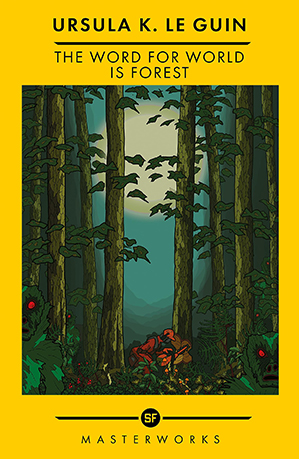
Usually one expects a science fiction novel to feature some new technology and how it impacts humanity. However, Le Guin usually imagines a new morality and its conflict with humanity. The lush planet of Athshe has been colonised by humans for there are no forests left back on Earth. The peace-loving and non-violent Athsheans have been enslaved, although on paper there is no such policy of enslavement. They are made to cut forests. Forests that are their home. The word ‘Athshe’ in their native tongue means world. It also means forest. The humans see Athsheans as dumb and lazy; to the invaders their small physical size seems to be an invitation to break them. They are colloquially called “creechies” and the slave creechies are kept in pens next to human camps. They are put to harsh physical labour and as there are no or few women at the colony, the females are often raped.
The Athsheans are a peaceful people. They live in innumerable tribes across the forest. There is no fighting among them. The concepts of violence and domination are alien to them. They are unable to understand humans as much as humans are unable to understand them. The Athsheans are wired differently from us. They sleep and wake at different times of the day than us. But to them, even more important than sleep is dreaming; especially dreaming that is deliberately done while awake. The Dream World provides them the archetypes and ideas through which they make sense of the world around them. They believe the Dream World is equally real as the material world. The human inability to dream like them is seen as a kind of sickness. They believe the humans take drugs because they don’t know how to dream.
In this world, one Athshean, namely Selver of Eshreth begins to dream a new kind of world. When his wife is raped, subsequently leading to her death, he is fundamentally changed. He dreams of routing out the humans. He is quickly hailed as a god by others who follow his lead. The Athshean mind is intimately linked to their calm forest surroundings. Le Guin describes this in Chapter 2, when a tired and injured Selver finds himself on the outskirts of a village. He is at peace while his mind is clouded:
“The ground was not dry and solid but damp and rather springy, product of the collaboration of living things with the long, elaborate death of leaves and trees; and from that rich graveyard grew ninety-foot trees, and tiny mushrooms that sprouted in circles half an inch across. The smell of the forest was subtle, various, and sweet. The view was never long, unless looking up through the branches you caught sight of the stars. Nothing was pure, dry, arid, plain. Revelation was lacking. There was no seeing everything at once: no certainty. The colors of rust and sunset kept changing in the hanging leaves of the copper willows, and you could not say even whether the leaves of the willows were brownish-red, or reddish-green or green.”
While Selver represents the Athshean thought, his nemesis is Captain Davidson, the rapist. Davidson is a mix of misplaced masculinity and racism. He believes that his way of doing things is the only right way of doing them. He wants to dominate the creechies and the planet regardless of official policy:
“He could tame any of them, if it was worth the effort. It wasn’t, though. Get enough humans here, build machines and robots, make farms and cities, and nobody would need the creechies any more. And a good thing too. For this world, New Tahiti, was literally made for men. Cleaned up and cleaned out, the dark forests cut down for open fields of grain, the primeval murk and savagery and ignorance wiped out, it would be a paradise, a real Eden. A better world than worn-out Earth. And it would be his world. For that’s what Don Davidson was, way down deep inside him: a world-tamer. He wasn’t a boastful man, but he knew his own size. It just happened to be the way he was made. He knew what he wanted, and how to get it. And he always got it.”
When the official policy is no longer in line with his outlook, he secretly pursues his own ends while attracting like-minded men with whom he hunts Athsheans for sport. Davidson echoes the kind of morality back on Earth that would have been responsible for commissioning this mission in the first place.
The title and the setting make it sound like environmental depredations would be a major theme of the book. This is a concern for the Athsheans, but the main theme is the conflict between two different societies. There is always conflict within the humans as to what is the right thing to do, whether to bite into another continent or not, whether to employ Athsheans as slaves or not, whether to follow the instructions of Ekumen or not – a kind of inter-galactic EU that has been founded after the colony was established. The Athsheans are in one mind about everything. They never doubt the path that they have chosen. They may not like what they are doing (and Selver suffers personally for it) but they are always certain that what they are doing is right. One race is mighty, advanced and capable of doing unimaginable violence to achieve its goals. The other is rooted in peace and harmony, and driven by their determination to conserve their way of life. They fill their bellies, dream and are content to go on living like that. Athsheans do not compete to earn more and go on fancy vacations. The Athshean society is presented in great detail. The women lead the tribes while the men dream and provide a kind of philosophical guidance to them. To say more about that would be to ruin the experience of reading the book.
In this day and age one does not expect to find Athsheans anywhere on Earth except in stories, because humans everywhere are driven more by economic need than by any intuitive will to do the right thing. Yet we encounter the Athshean spirit in our day to day lives. Some small and noble gesture that still resonates, where someone does what they think is right against popular opinion. I remember several years ago, while in the Garhwal Himalayas, I asked a stall-keeper the price of bananas. He quoted sixty rupees a dozen. I asked him to give me half-a-dozen and paid him thirty. When he handed me over the bananas, I counted eight. I brought the fact to his knowledge. ‘Yes,’ he said. ‘These bananas are smaller so I put in two more.’ Imagine a planet full of people like this.
The story is spread over seven tight chapters. No sentence is superfluous, no detail out of place. It is told masterfully and the story is complete in all aspects. However, it did not resonate with me in a way that it would seem great. When the poet, Goethe, lay dead, his friend Johann Peter Eckermann went to see his “sublimely noble countenance” for the last time. He noted, “A perfect man lay in great beauty before me.” Reading this book felt like looking at dead Goethe. Everything is beautiful, but it does not sit up and perform wonders. We can appreciate the Athshean way of thought, but the ending is almost tragic, for humans as much as Athsheans, or as the popular social media expression goes: “too real”. Humans are still humans; they do not take a lesson from the revolt. The only man on the colony who could have carried the Athshean message back home has been killed in the conflict. The Athsheans have tasted violence, their world will never go back to their old ways, except perhaps if left undisturbed for another millennia. The book ends truthfully. There are no contrived grand-ending goodbyes or lofty promises that the future holds for humans and Athsheans. Only the cold, hard truth that violence begets violence, and the more violent wins.
The Hainish / Ekumen Cycle
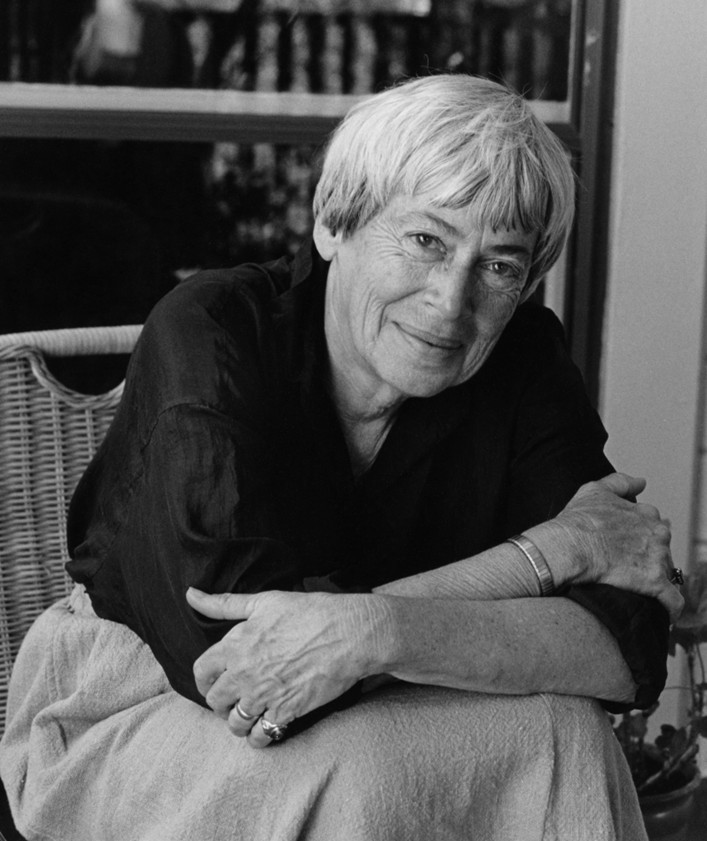
Many of Le Guin’s books that are set across various planets comprise what is known as the Hainish Cycle or the Ekumen Cycle. While every book in the story can be read independently in itself, they share a common interstellar history and polity. In these stories, the world is governed by interplanetary institutions of economic and political nature. The first book in this series is Rocannon’s World (1966) in which a ‘League of All Worlds’ is teetering at the edge of a catastrophic war with another intergalactic alliance known as ‘The Shing’. Although every book (planet) has its own story, we see these grand institutions crumble and rise again over millennia in these stories.
As per Hainish history, the earliest humans evolved on the planet of Hain. Once the Hainish people developed interstellar transportation, they set up colonies on various planets, also using genetic engineering to adapt to local climate. Then, as is the custom with all grand designs, all interstellar transportation ceased for several millennia. During the interlude, the Hainish people evolved as per local conditions. For instance, the humans of the planet Athshe (The Word for World is Forest) have learned to enter a dreaming state while still awake. Similarly, the humans of the planet Gethen in The Left Hand of Darkness do not have a specific sex. Rather they enter into a sexual heat each month (a kind of menstruation) in which they are never sure whether they will be male or female (thus, the famous sentence from the book: “The king was pregnant”).
The six key books in the Hainish / Ekumen Cycle are:
- Rocannon’s World (1966)
- Planet of Exile (1966)
- City of Illusions (1967)
- The Left Hand of Darkness (1969)
- The Word for World is Forest (1972)
- The Dispossessed: An Ambiguous Utopia (1974)
Apart from the above, there are a number of other books and short stories that are also set in the same world.