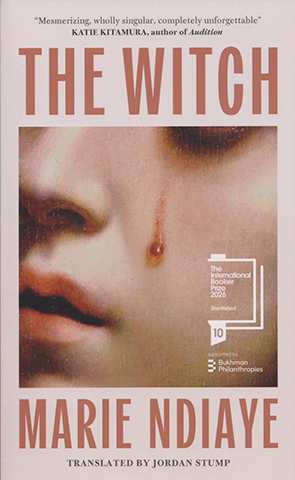
Translator: Jordan Stump
- Category:Contemorary Fiction, Feminist Fiction
- Date Read:13 May 2026
- Year Published:1996 (original French), 2026 (English Translation)
- Pages:130


At only one hundred and thirty pages, The Witch is a slim novel with a lot going on. First, it seems to address relatable issues even if there is a fantastical element to its story. The title is a big clue. Yes, there is a witch, witches in fact, each with varying levels of magical ability. Lucie, the narrator, has only weak powers. She struggles at basic divination, while her daughters’ powers outstrip her own almost immediately after she begins to teach them. She even describes her own mother as a “sorceress of the first order”. But the novel also addresses issues that readers may find familiarity with: with difficult marriages, adult children who drift away or become estranged, and the familiar doubts and self-recrimination that we all have experienced at some time in our lives. There is a dreamlike quality to the storytelling, a sense of allegorical import, both explainable and inexplicable. On the surface, the novel speaks to the experience of being a parent or being a woman, but there is more happening in this short book.
Lucie is teaching her daughters how to divine future events and see things from afar. She does this in the basement of their house, hoping to avoid the attention of Pierrot, her husband, who does not approve of her using witchcraft. No male character in this novel does, which would seem to make it obvious that witchcraft is an evident divide between male and female concerns. Meanwhile, Pierrot brings home a former client, Monsieur Matin, whom Pierrot seems to admire. Matin needs somewhere to stay since he has just left his wife and children. Matin’s presence is the harbinger of Pierrot’s own intention to leave his family. Ah ha! we might observe: we understand how men will be portrayed in this novel. Already, it seems, we have an easy dichotomy, a male female divide, that speaks to feminist issues.
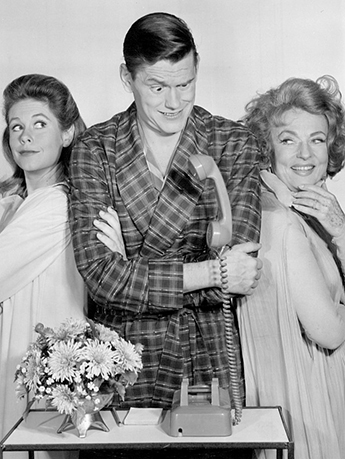
After all, we already understand this template. For those old enough to remember, there are aspects of this story that might remind readers of that old 60-70s sit-com, Bewitched. Samantha Stephens is a modern-day witch married to Darrin, a mortal who forbids her to perform witchcraft. For the most part, Samantha tries to obey her husband and maintain the illusion that he is in control. But her mother and a host of other magical characters can always be trusted upon to create havoc. Bewitched spoke nicely to the Feminist issues of its era.
And now NDiaye draws upon witchcraft again, but uses of witchcraft as a trope in a somewhat more complex manner than we find in Bewitched. There is little solidarity among women in her story, for a start. When Lucie’s husband, Pierrot, steals an enormous amount of money given to her by her father, her mother-in-law merely asserts her son’s rights as her husband. Lucie tries to uphold her family’s tradition by teaching her daughters witchcraft, but they do not understand their power within the context of a feminine lineage. Instead, they use their powers for trivial purposes or to serve their own desires with little regard for the impact they may have on others. And Isabelle, a grotesque parody of suburban working-class women, controls all the women within her social sphere through her extant knowledge of gossip and her willingness to use it as a weapon. Later, when she appears to lend Lucie a helping hand, she betrays her, instead, when it is expedient to do so.
The Witch is brimful of bad relationships: poor parents, indifferent children, nosey neighbours, mistrustful students and deceitful spouses. My sense in reading The Witch is that it is not a book that taps into a feminine experience, specifically, as the basis for a feminist narrative. Both women and men are perpetrators in this novel, both are victims, and all suffer or effect in one way or another the estrangement of family. Lucie is abandoned by both her husband and daughters, and turns in a childlike way back to her parents who, themselves, have become estranged after thirty years of marriage. Longing for rapprochement, Lucie tries to persuade, pressure and bribe them to get back together, even though her mother has a new partner and her father has far greater legal and professional concerns to occupy him.
Overwhelmingly, this novel speaks of the sense of loss, estrangement and disappointment, but the witchcraft trope makes it difficult to reconcile this with what we might presume are specifically feminist issues, as was experienced in Bewitched. Something else seems to be happening. Pierrot’s abandonment and exploitation of Lucie would seem to be an obvious basis for a feminist narrative about power within sexual relationships. But the emotional disconnect Pierrot’s actions seem to signal are also apparent in the actions of other characters, too. Lucie’s father embezzles money in much the same way that Pierrot does. Lucie’s mother is unwilling to reunite with her former husband and does him a terrible injustice when Lucie makes her. Lucie’s daughters abandon her when they no longer depend upon her, and they sabotage their paternal grandmother’s hopes for another grandchild. Most significantly, however, is the neighbour, Isabelle, who acts with the same contempt and disregard for her son as Pierrot does for his family. She tells Lucie,
“You know, if I had all that money just for me, I’d go away, all alone, oh yes I would, no doubt about it. I’d get in my car and so long, everybody.”
Later she asserts,
“Forget all that [‘parents and children’], be like me. Do I talk to you about that little crumb Steve [her son]? You know, I have to work just to remember his name. I’ve forgotten his face, poof, gone! Everything flies away, everything is forgotten!”
Isabelle dominates her suburban social set and she shares the same business success that Pierrot once enjoyed selling vacations, except Pierrot does not have the same success as the grasping Isabelle when he attempts to run his own business. His power of independence is derived from the theft of Lucie’s money, while Isabelle clearly links her success and financial independence with her own personal freedom: the freedom to abandon her unsympathetic son to his own fate.
This idea of personal freedom seems to be a more prominent concern within the novel than more easily identifiable totems of female oppression or manipulation that we might first expect. This ‘freedom’ – this success – is associated with the concomitant rejection of family and the rise of interpersonal estrangement. So, while the novel is not an obvious feminist text at the personal level, at the sociological level the estrangements and failed families that pepper the novel speak of a deep anomie within the capitalist system that equates money and success. Rather than a vehicle for fulfilment and reward, the traditional family has become a hindrance to personal fulfilment. This is why Pierrot admires Matin so much to begin with. Matin has broken free of the anchor of his family, just as Pierrot soon intends to do. Pierrot is less enamoured of Matin when he is made to ring his wife, who moves quickly to claim him back. Matin’s fleeing across the fence when his wife turns up is merely the comic incarnation – an anticipation – of what this novel is about.
If we approach the novel from the broad dichotomies of feminine and masculine, assigning traditional understandings about family and its association with the feminine, and the broader capitalist world as an instrument of late patriarchal power, it begins to be easier to look past the associations made from character to character – be they female or male – and see the broader anomic failure of modernity.
For this reason, we have characters who would traditionally have been associated with feminist power, who instead abandon that traditional narrative role. In Naomi Alderman’s The Power women become the dominant sex when they develop the ability to emit jolts of power through their hands. But in this case, Lucie’s daughters use their newly-discovered power to transform themselves into birds to fly away and abandon her, making them little different to Isabelle who desires to forget her son: “everything flies away”. This is because their attitude and values aren’t taken from their mother’s teaching, aren’t embedded within feminine experience. Instead, their newly acquired powers are directed by their embrace of a capitalist consumer culture predicated upon patriarchal norms. Like Isabelle, whose “erudition” is that she “knew the price of every brand’s latest models”, the hearts of Maud and Lise are “hard, capable only of sentimental, sporadic lamentations, quickly repressed, over miseries glimpsed between two TV shows”, and they control their father through his desire to feed their “frivolous consumerism.” His daughters enjoy the fruits of his success but do not admire him. Lucie understands that, “Maud and Lise seemed to inhabit a distant, hypothetical world, the world of their future glory, where nothing of the present had a place”. Like a consumer product, Lucie finds she has also become expendable.
On a personal level, the novel speaks to those senses of loss in our lives. Of the failure of relationships and the sad, inevitable loss of our children they grow older and inhabit their own lives. But it is also cognisant of the role that modern social values play in these estrangements.
But the more you dwell on the story the more you seem to notice details that are significant, or others that only seem so and ultimately seem to mean little at all. For instance, the suburban neighbourhood where Lucie and Isabelle live is full of “identical houses”, “a place otherwise devoid of pointless greenery” we read, and it is not difficult to conjure the image of development neighbourhoods devoid of soul, built upon the exigencies of capitalist utilitarianism. It’s a detail easily missed, but it contributes further to the major themes of the novel.
The novel is a deftly constructed piece of writing but it is not flawless. The ending seems to undercut the relationship established between Pierrot and Lucie, as though there was no point to anything that happened between them. Perhaps this sense of inconsequential meaningless to relationships is just another facet of what the novel shows us about relationships. But other details seem less explicable, like the long focus on the assassination of Israel’s prime minister, Yitzhak Rabin, announced by Robert, the new partner of Lucie’s mother. His pedantic irritation at Pierrot’s mother for mistaking Rabin for a local man, Monsieur Rabine, may tell us something about Robert’s character, but this moment and the mention of another historically noteworthy date seems significant, except there is no sense to be made of it. Maybe it is merely another instance of loss, this time on an historical scale. After all, a sense of loss, meaninglessness and estrangement pervades this novel. It’s ending may leave you somewhat unsatisfied, too, but perhaps that’s just also a reflection of how we experience our lives.
The Witch is well worth a read. Its concerns are identifiable, and it will leave you with much to think about.