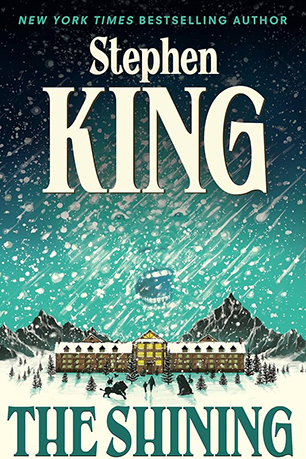
- Category:Horror Fiction
- Date Read:1 January 2026
- Year Published:1977
- Pages:497

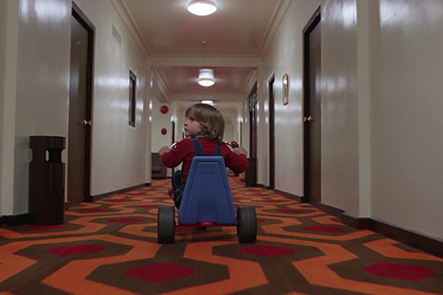
The Shining is perhaps one of the stories most associated with King across his time as a writer; it is almost synonymous with him. It’s also, rather unfortunately, associated with Staney Kubrick’s cinematic interpretation and one very specific carpet pattern that I’ve wanted in my living room since time immemorial.
The Shining follows a family of three: Jack, a hard-done-by, attempting-to-recover alcoholic, Wendy, a long-suffering, slightly psychic victim of indentured domestic abuse, and Danny, a very psychic, absolute sweetheart of a boy. We learn a little about the three of them, and then follow them to our haunted hotel, the Overlook, a grand old lady high in the Rocky Mountains.
At the beginning of the book we meet a man named Dick Halloran (who is, unquestionably, my favourite character and an all-around kick-arse dude), who explains to Danny he has something called a ‘Shine’ - a sort of psychic connection with others that allows him to see glimpses of the future, as well as see past the veil, to read minds, and also to contact others who ‘Shine’.
With time, and, snowed in during a harsh winter, the Overlook starts to show exactly what it can do, and how it can do it, with disastrous effect for the Torrance family.
It begins with small things – noises heard in the night and strange premonitions from Danny – and it escalates as the winter does. We see some terrifying scenes, like a costume party full of debauchery and ghosts, and a room with a lady who’s been in the bathtub so long she’s gone past pruning and entered decomposition territory.
There’s also the added threat of the corporeal; things like unemployment and reputation. I think this is something that really stands out to me. I look at books like The Amityville Horror and think it sounds wildly unrealistic to just up and leave when you have a mortgage and no savings to move when your house is haunted. King focuses on the reality of Jack’s circumstances and the reason the family doesn’t leave, even in the face of the weird and wacky. It’s realistic because they cannot afford to.
I think my one big gripe with the book lies with the ghosts in that they are simply not scary enough. The biggest sense of fear for me is in Jack and his abuse of his family, which is, I think, King’s intention. But, at the same time, the visceral descriptions don’t quite touch the sides of some of his later horror. There is only so far that you can push topiary, roaring at you, into the realm of horror.
You’d be forgiven for thinking this was a book about a haunted hotel, especially given the fact that Kubrick’s movie makes it seem somewhat that way. Rather, it’s the hotel that does the haunting. In a bigger sense, however, it’s the trauma of things that sink into the walls and give a sense of fear.
The Overlook is a nasty piece of work, and provides a character in and of itself. It keeps a certain sense of danger about it, and as we see the Torrance family trapped in the white out, we get a sense of something far bigger influencing it. As we delve deeper into the King universe and lore, there’s an argument to be made for the Overlook being a place of crossover between the Dead Zone (what is essentially another plane of existence with monsters) and reality. More on that in later reviews!
The characters in the book are all uniquely haunted. Jack, in particular, is a man who has clearly never healed from his past, and this means he takes it out on all of those around him. He’s shows flashes of a dedicated husband and father, but these are soon overwhelmed. The hotel picks him up as a willing victim because he is a victim in terms of all the trauma that he has left unresolved.
Jack, as well, provides a complex case in terms of his approach to the Overlook. He embraces it enough to witness all the ghosts, and his alcoholism, combined with his propensity for violence, makes him a threat beyond measure. In a way, Jack in the book seeks the ghosts of the hotel. They give him an excuse for what he’s faced in the past and how he’s behaved. They justify him in a way that nothing else could.
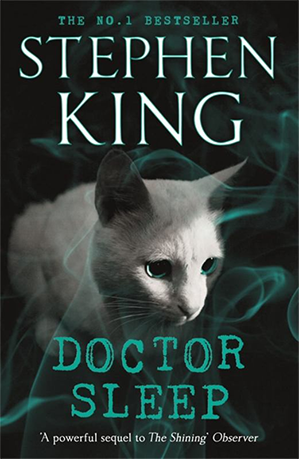
Danny, however, is focused on breaking the cycle. He speaks about his problems and he is willing to ask for help when the circumstances get dire. While we’re not up to it for a long time, Doctor Sleep, King’s sequel to The Shining, examines this in more detail. But this is an interesting set up for that.
Wendy provides a fascinating study in her own right. She’s pulled between two worlds: that of her husband, and that of her son. Her internal battle to decide whether to go down to Sidewinder to wait out the winter versus staying with Jack is incredibly painful to read – you can see her warring emotions and her regret when we reach the climax of the story.
Perhaps the most critical difference between the film and the book rests in the ending. The movie makes Dick a lost cause, whereas in the book he is an enormous force for good and realistically one of the ultimate heroes. The movie, famously, ends in ice for Jack. The book, however, ends in fire.
I’ve written before about King’s penchant for terminating things in fire, and it being in aid of purging what has been done. Fire in this book is the only cure for what ails Jack. It is the final piece of his puzzle and the only way he will ever find rest. I do think King finds a great deal of peace for his characters in fire. They are resolved by it. It wipes the slate. I do think that this motif is less significant in later books, but we have a while until that’s the case.
It would be remiss of me not to mention some of the media inspired by The Shining as well. Being an avid fan of metal of all kinds, I know the influence of the book and film is pervasive. Bands like Slipknot, Opeth, and Thirty Seconds To Mars have used references to The Shining in their music videos and songs, but a particular favourite of mine is ‘The Overlook’ by Wind Walkers. It is well worth the listen!
This book, for me, is one that has definitely gone up in the rankings slightly, after rereading it. I don’t think I understood it quite as well when I was a teenager. As an adult, I find it to be such a sad book. It left me feeling cold in a way that I didn’t realise a book could, and it took me a while to get through it simply by virtue of how painful it is to read. You can see a lot of King’s regrets in The Shining, and while it’s a credit to him to be able to put it on paper, it did leave me a little empty in that there is so little hope.
Next up on the Stephen King list we move to Rage, the first of the Richard Bachman books, and perhaps one of King’s most controversial novels.