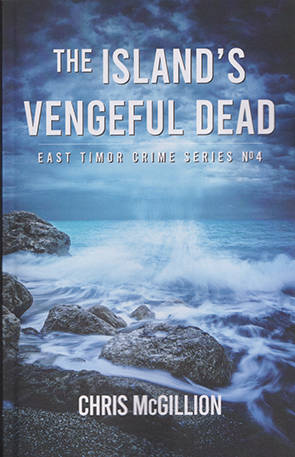

ISBN:9781684922420
East Timor Crime Series #4
- Category:Australian Fiction, Crime Fiction
- Date Read:24 March 2026
- Year Published:2025
- Pages:284


If Shakespeare had been writing now with a predilection for crime stories set in the fledgling nation of Timor-Leste, he would probably have produced something along the lines of Chris McGillion’s East Timor Crime Series. I do not refer to the florid language that some associate with that playwright, but his penchant for dramatic scenes. The nineteenth century art critic, John Ruskin, coined the phrase ‘pathetic fallacy’ in response to poetry that attributed human emotion to the natural world as an extension and heightening of overpowering human drama and emotions. Shakespeare was a master at this. Think of the opening of The Tempest, the ship seemingly floundering in a wild sea, or King Lear on the heath, madly berating the heavens – “Blow winds and crack your cheeks” – the atmosphere howling, the apocalyptic storm expressing the madness and anguish Lear is suffering.
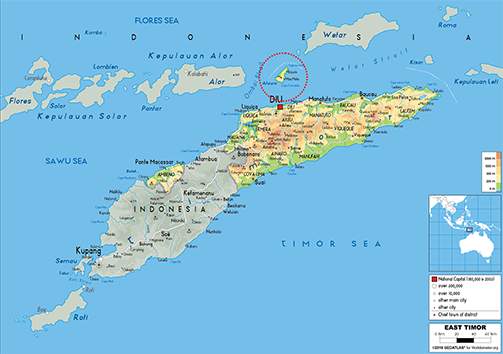
The Island’s Vengeful Dead, the fourth instalment in Chris McGillion’s East Timor Crime Series, inhabits something of this kind of stage as the story heightens towards its climactic denouement. Atauro, the small island north of the main island of East Timor, where Cordero, Carter and Estefana are investigating the murder of an American marine biologist, is wracked by a terrible storm, an event that echoes circumstances in the first book of the series, The Crocodile’s Kill. East Timor is not a mere passive backdrop – an exotic window dressing – for McGillion’s story. The island, the people and the culture are baked into the narrative, integral to the course of the police procedural. The nation, its history, its people and environment are essentially a character, too. The wrongs done during the island’s history – it’s occupation and exploitation by both the Portuguese and more recently, Indonesia, and the imprisonment and tortures carried out there – are like the terrible psychological scars inflicted on a child. Shakespeare would have understood the point of the terrible storm that wracks the island, shutting down roads and threatening life. Sometimes a dramatic mise en scene is required to capture the intensity of feeling and intent: the moral weight of what is happening.
Atauro literally has the past buried deep within the bowels of its earth, whether that be a history of Portuguese exploitation and forgotten treasures, or the terrible history of 24 years of Indonesian rule after the Portuguese left in 1975 and the graves of prisoners interred there. Because while this is a crime procedural, it is also the story of East Timor and the interplay between modern crime procedures and Western values that underpin crime investigation, and the experiences and beliefs of many in the local East Timorese population who are still tied to local customs and superstition either by family, through poverty or isolation.
By the conclusion of The Coffin Maker’s Apprentice, the third book in the series, Special FBI Agent Sara Carter was completing her three-month secondment at Interpol and was weighing her options: whether to continue her work in East Timor or return to her role as an FBI officer in America. By the beginning of The Island’s Vengeful Dead she has begun her second stint in East Timor, and finds herself once again drawn into a case headed by police investigator Vincintino Cordero, for the murder of a Western academic, Dr Frankston, who has been working on Atauro, studying its coral reefs. Frankston has been stabbed, it appears, with his own knife he uses on dives. The knife is now missing. His young wife, Susannah, appears upset but seems overly willing to receive the comforting support from the Interpol director’s young aide, Gerard Miller. Cordero notes that her behaviour is downright flirtatious. Then there is the born-again Christian, Welcome Jesus, who has been helping Frankston get out to the reef using his boat, but he seems to have a murky past and questionable motives, and he is angry about his loss of income after his propeller was damaged helping Frankston. And other complications arise, too, not the least of which is the series of break-ins of almost all the uma lulik – sacred houses – on the island, and the presence of an Australian historian, Robert Evans, whose links to Frankston raise questions about his interest in Atauro.
This time the victim is white and the concerns of the investigation might be assumed to be within the interests of white culture, but McGillion’s crime series is not focussed on an expatriate class. While as readers we may be drawn into the narrative through the minutiae of investigative detail, the series is primarily about a young nation looking to the future while acknowledging and living with its past: both its history and culture. And that culture includes superstitions and beliefs which some characters eschew or deride, but which is respected within the broader context of the stories as a rational or understandable choice for its island inhabitants, even though on the surface and at first consideration they may seem to hamper the goals of police investigations.
On a cultural level, for instance, the Matan-dook – spiritual healers – still play a prominent role in Timorese society. Cordero, the East Timorese police investigator, tells Special Agent Carter that under Indonesian rule, after the Portuguese left Timor in 1975, only supporters of the Indonesians received health care, so traditional medicine remained an important option and continues to be so, since many health facilities were destroyed by the Indonesians before they left in 1999 after a 24-year occupation.
On a personal level, old beliefs have a strong hold upon some East Timorese characters while others have embraced a more Western perspective. Vincintino Cordero spent a large portion of his formative years in Australia because his family fled East Timor to avoid persecution by the Indonesian government. Cordero is not a believer in religion or superstition, but his police colleague, Estefana dos Carvalho, who translates for Carter and has been the third main character since the beginning of the series, has only just married and now looks forward to having children and living a life that honours the traditional beliefs of her family.
For Estefana, Timorese society is like a tree, with its leaves and branches pushing into the future, but its roots being the very foundation and source of her life’s purpose and meaning. It is through insights like this that McGillion avoids a Western paternalistic judgement. Estefana’s desire to fulfil a traditional female role is weighed against the apparent freedom offered by feminism, as it is portrayed in the life choices of Sara Carter, who has chosen a stimulating career over having a family. Each woman respects the other, but their individual choices remain alien to each.
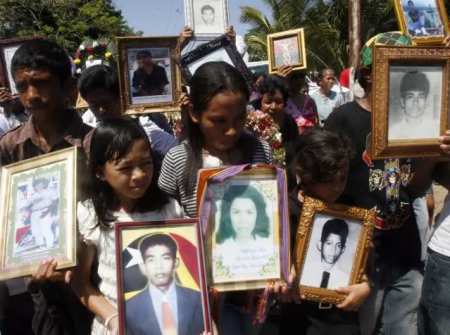
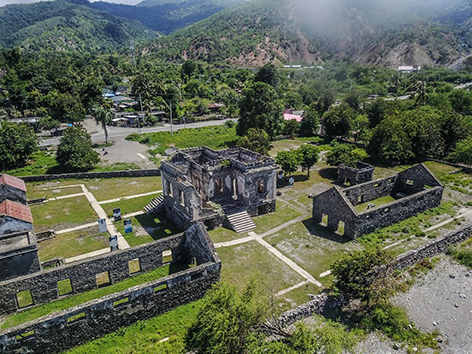
McGillion makes this blending of cultures work because the mystery in this novel and its solution is intrinsically tied to the history of the island and the traditional beliefs of its people. The island of Atauro was used by the Indonesians as a prison, earning it the ominous name ‘Island of the Damned’. Resistance fighters against Indonesia were imprisoned on the island, sometimes held in subterranean cells. In The Crocodile’s Kill Estefana’s mother, Fabiola, speaks of her husband who protested peacefully for independence but was sent to the Atauro prison, all the same. She explains:
I was angry with him at first, you know. For his political activities. But mostly for his dying and leaving me with the children to raise on my own. But now I see my children growing up in a free Timor-Leste and I am proud of my husband for what he did and grateful that he had the courage to stand up for what he believed in.
Fabiola speaks of the beatings and poor conditions of the prison as a contributing factor to her husband’s early death, but Estefana’s own understanding of his plight is darker in The Island’s Vengeful Dead. She tells Carter that her father was forced to bury prisoners, and she fears that the wrath of their spirits will affect her future children by way of a curse she feels certain is being placed upon her for her father’s forced complicity. Fabiola was reconciled to her husband’s role because she saw it in the context of a modern Timor-Leste, while Estefana obsessively fixates upon it as a precursor to spiritual revenge against her children and their future. Estefano, like East Timor more broadly, must find a way of reconciling herself with her values and the past so that she may achieve the future she desires. But if Estefana is read as a microcosm for the wider East Timorese society, then a resolution does not reside with imposed Western values, but must be achieved through the tenets of the culture. The matan-dook says of Estefana, “That girl’s problems are in her own thinking. The only solution for her must conform to that thinking.” And so, too, might this conclusion be applied to East Timorese culture more broadly.
McGillion’s narrative achieves this through the values of its characters and its own denouement. As in The Crocodile’s Kill, the final resolution to the mystery and Western justice is achieved through the agency of the island itself. If the prisoners on Atauro were buried in their cells, then it will take, in some manner, the island itself to exact retribution. So, the storm and the circumstances of the novel’s denouement are not so much a deus ex machina that contrive a satisfying moral outcome, but instead the acta est fabula – the closing moments to which the play has inevitably drawn us – which is the appropriate consolidation of two seemingly disparate ideologies, brought together in a single climactic moment.
The Island’s Vengeful Dead can be read purely as a police procedural for the enjoyment of crime aficionados. The writing is crisp, without pretence and the novel conforms to all the best practices of the genre. But for those who enjoy their crime with something more to think about, Chris McGillion’s East Timor Crime Series may be your thing. You can start with The Crocodile’s Kill, the first book, but it’s just as easy to begin with any of the novels in the series. So, if you have difficulty acquiring other books in the series, start with The Island’s Vengeful Dead.
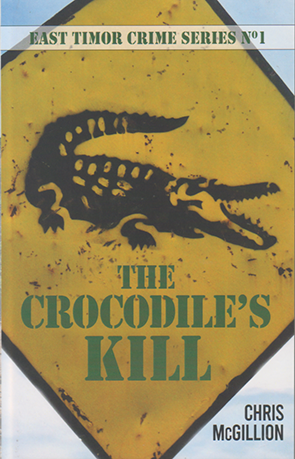
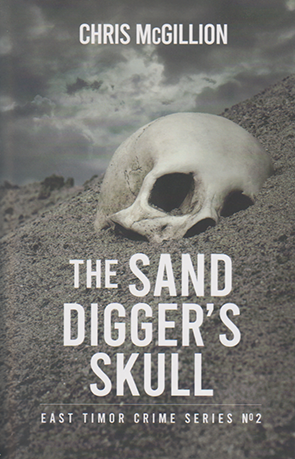
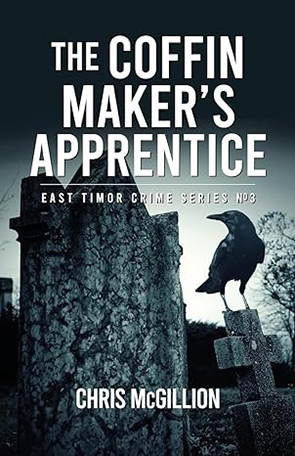
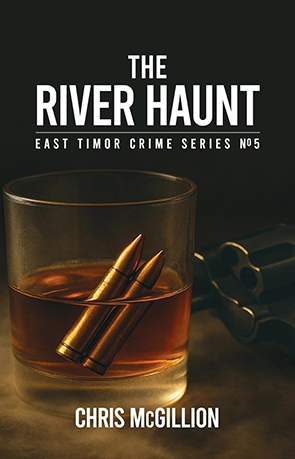
The East Timor Crime Series (so far)

“There were no prisons on this island before the Portuguese came. They made the whole island a prison and all of us its prisoners. We’ve had enough of that. My job as a healer is to resore harmony. That means bringing people together, not dividing them and setting them apart. It’s what our ancestors taught us to do.”