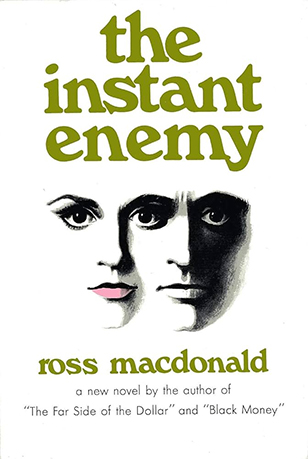
Lew Archer Series #14
- Category:Crime Fiction
- Date Read:16 February 2026
- Year Published:1968
- Pages:256

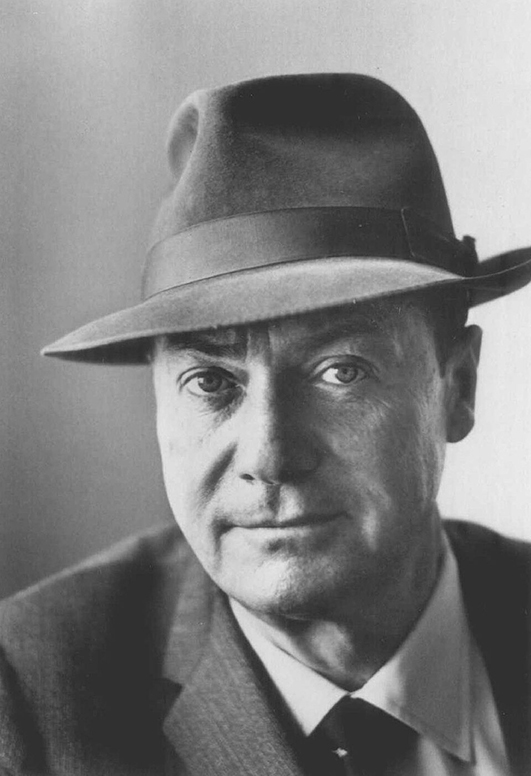
The genre is SoCal Noir, a murder mystery in the sunshine of Los Angeles city and county. Before going further, a preliminary remark is in order to quell the pedants. Kenneth Millar insisted that his pseudonym, Ross Macdonald, be spelled as it is here, no interior capital on that letter ‘d.’ He did that to distinguish the name from another murder mystery genre writer, that is, the John D. MacDonald with a pair of extravagant capital ‘D’s.’ However, all too frequently the author’s name gets the unwanted interior capital ‘D’ on some of the books. Moreover, the auto-complete and spell-checker have to be tamed to respect his wishes. So be it. But then a writer as famed as George Orwell fought and lost a similar battle when he insisted in the publishing contract that the title Nineteen Eighty-Four be spelled out in letters and not put into the numbers 1984. You would never know that to see this book on shelves or web pages. After some comments on The Instant Enemy, there is a further discussion of the author and his alter ego.
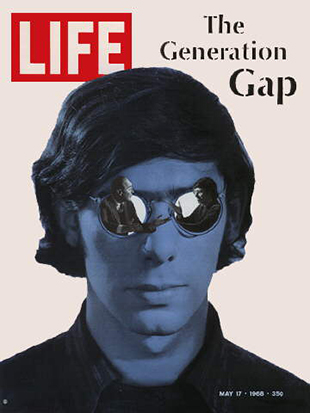
Since at least 624 BCE, according to one pundit, the older generation has complained about the declining standard of the rising generation, but in the middle 1960s that plaint was reversed for it was the rising generation whose members criticised their elders about anything and everything. This reversal of fortune was dubbed The Generation Gap, which was much discussed by talking heads in the late 1960s to explain anything and everything from Vietnam War protests to hair styles, flared trousers, and the popularity of The Beatles. This gap spawned a song, a television show, a board game, and a lot more ephemera, some of which has endured. The Instant Enemy offers Macdonald’s take on it in that, Lew Archer, Macdonald’s detective who is over thirty, is an instant enemy to members of that rising generation.
In the novel the rising generation is embodied by Young Davy and even younger Sandy, his squeeze, who together seem bound for mutually assured destruction while taking a few others with them. Yet both come from comfortable homes in the green fields of the land of dreams that is Southern California. Keith Sebastian, Sandy’s father, calls in Lew Archer to find them and return Sandy home. While Sebastian offers an impressive front, it does not take Archer long to realise there is no back to this Hollywood façade.
Sebastian has failed to make the transition from a promising young businessman to a successful one. Behind the trophy wife Bernice, the ranch-style model home, and the new luxury car, Archer finds a loveless marriage, a cold house, and piles of unpaid and overdue bills on that car and all the other ever so tasteful chattels that adorn the wife, the house, and the car. Sebastian dances a desperate attendance on his wealthy boss, Stephen Hackett, in the hope of . . . something, anything to get through another week or month to keep up appearances. Then the bad gets worse when Hackett is kidnapped at gunpoint by none other than the two delinquents, Davy and Sandy. Unbelievable but true.
Why?
It is a tangled skein and by the end, a Mormon genealogical tree combined with a Lombardi Chart is necessary because the kidnapping was brewed over three generations in Macdonald’s laboratory where the retorts bubble with the ingredients of tragedy, in this case an unloved child, illicit drugs, adultery, betrayal, a surly subordinate, a very nice woman who knows too much, a venal older woman with a toy-boy husband, and assorted police officers including one whom Uri Geller could not straighten. The body count reaches Midsomer Murders heights while Archer develops, applies, tests, and rejects alternative hypotheses until finding one that fits.
While the cast of characters seems to consist of people with no connection to one another and with nothing in common, in fact, on that dark family tree, they are entwined by marriage, adultery, illegitimacy, and murder, the latter being the strongest bond.
In addition to the two teenage rebels with a cause, Macdonald also adds some Cain and Abel. And as frequently is the case in his novels, there is a black widow who has consumed two husbands. Without a doubt there be critics in the firmament who would label him a misogynist for this. Happy are the labellers. Happier still are the readers who suspend such swift and simple judgements.
Outside this terrarium of vipers and apart from the lost teenagers, Archer meets some very solid citizens: Alma in the nursing home who truly cares for her charges, a school guidance counsellor who goes beyond the call of duty, a security guard who keeps his word come what may, and many others who lend a land, like the truck driver who finds a stunned Archer on the highway, Al at the sandwich bar, and a nameless gas pump jockey with a calliper on his leg, each of whom reminds both Archer and the reader of all the decent people out there. It is a distinguishing feature of Macdonald’s fiction that these minor supporting characters, as many as twenty in each book, are endowed with personalities. None are plot cardboard. The contrast could be the BBC’s Christopher Foyle (an avatar for this all-too-common stereotype) where virtually everyone but the sainted hero himself is a liar, cheat, murderer, traitor or all three in one. Archer is secure in his own identity and modest virtue, having no need to denigrate all others to be singular.
Macdonald’s imagery at times transcends the story. Savour these opening lines from The Galton Case (1959): “The law offices were above a savings bank on the main street of Santa Teresa. A private elevator lifted you from a mean lobby into an atmosphere of elegant simplicity, creating the impression that you were rising effortlessly to the level you deserved, one of the chosen.” Or the time when Archer admits to himself that he likes the work, late at night, driving from one place to another like an antigen connecting cells in the great body of Southern California. He is a healer; we may hope, one of many, assuaging some of the injuries we do to ourselves.
Trolls should be warned that these pages reflect the manners and mores of the time and place. These are guaranteed to offend some sensitive souls. These trumpeter swans can be found venting on Good Reads.
* * *
The Midsomer Murders mayhem occurs off the page and Archer himself seldom carries a gun. Indeed, having read all eighteen titles, several more than once, I am not sure he ever fires a bullet, though his own licensed gun is stolen and used in a murder in The Way Some People Die (1951). Still less does he come up smiling after beatings, druggings, pistol-whippings, or woundings as does Philip Marlowe in the novels of Raymond Chandler. On the rare occasions when he is assaulted, as occurs in these pages, it takes him some time to recover, because he is not the man of steel that Marlowe was.
If Raymond Chandler had a screenwriter’s ear for dialogue, Ross Macdonald had a jeweller’s eye for imagery. There is seldom a wasted word on his pages. If he pauses to describe the fittings and furnishings of the Sebastians’ home or the make and model of their car in The Instant Enemy, a reader can be sure those facts will rebound in the pages that follow, so pay attention.
Sometimes Macdonald’s metaphors and images come so thick and fast that they create a traffic jam in the reader’s mind. Sometimes the psychologising slows the momentum of the story. And sometimes there are missteps. Fortunately, Macdonald follows the old coach’s wisdom: ‘Forget the mistakes and keep trying.’
The species into which cataloguers slot Macdonald’s novels is styled ‘Hard Boiled,’ but he offers neither the snappy dialogue of Chandler nor the bone-deep cynicism of Dashiell Hammet, the double litmus tests for Hard Boiled. Though it is true that Lew Archer is named for Sam Spade’s deceased partner, Miles Archer, who only believed in fifty-dollar bills, and was sired on Hammet’s typewriter.
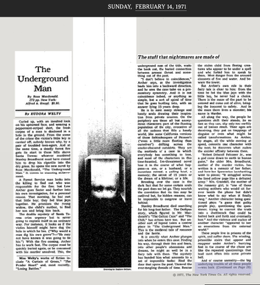
Macdonald’s The Underground Man (1971) earned a rave review on the front page of the New York Times Book Review section by that distinguished southern American novelist Eudora Welty (though I confess that I could not finish the only book of hers I tried). Yet none of his novels were ever awarded the paramount prize of the Edgar. To be sure he garnered many other awards, but not that crown of crowns. Such is the way of the world.
In his books, unlike life, the world bends towards justice of a kind, but there are seldom happy endings. Perhaps Macdonald wrote one book eighteen times, as has been said, the same story of twisted love, divided loyalties, the effects of the sins of the past, wayward offspring, fractured families, irresponsible parents, each magnified by the glare of money in the prism of California sunshine that blinded the individuals to their own motives and deeds. It was all one case.
By number eighteen in the sequence the biggest mystery is Lewis Archer, himself, about whom the reader learns almost nothing, being a man without a past. There are only a few shards with information scratched on them scattered through the books. In The Goodbye Look (1969) we learn he had been a soldier who has seen that last look on faces of men who died. In The Drowning Pool (1950) there is mention of a wife named Sue who left him because of his irregular life. In The Doomsters (1958) he refers to his police work in Long Beach. In another he has a sexual dalliance with a witness that goes nowhere. In Black Money (1966) the names of the philosophers Parmenides, Heraclitus, and Henri Bergson pass his lips. These gleanings are few and far between.
The reader is not manipulated into feeling sorry for him with a back sob story that reveals his feet of clay. Why should we? Archer does not feel sorry for himself! He is no Heathcliff forever lamenting his fate. Archer’s emphasis is on the other people in the story, not on himself. He remains in the shadows to observe and report, not to take the limelight.
He has neither the finicky mien of Colin Dexter’s Endeavour Morse, nor the quirky car of Sue Grafton’s Kinsey Millhone. Here, then, is a challenge for a Post Modernist to dissolve the twinned author Macdonald-Millar and write a biography of Lew Archer himself. The Wikipedia entry, and yes there is one, marks the starting line, not the finishing line in his life story.
This title was number fourteen of the eighteen, with a nineteenth incomplete at his death. Each stands alone but bound together they are Lew Archer’s life. Oh, and there are collections of short stories (some of which germinated into the novels) called The Name is Archer (1955) joined by Lew Archer Private Investigator (1977). Macdonald wrote at least two crime novels without Archer.
Connoisseurs may note that the doyens of detective fiction, Jacques Barzun and Wendell Taylor in their massive reference work describe this novel as ‘good,’ but offer greater praise for Macdonald’s The Ivory Grin (1952), The Galton Case (1959), and The Zebra-Striped Hearse (1962). The one that resonated the most on first reading and which has stayed with me is the last one, The Blue Hammer (1976).
Equally, Barzun and Taylor also reprove other Macdonald titles for overcooked plots and broken metaphors. Indeed, some of the plots, like that of The Goodbye Look require a GPS (that is a Genre Plotting System) to follow through a forest of grafted family trees and generations of undergrowth.
There is a great deal of literature on Macdonald and Archer’s world. Impressive as it is, to read it is to lose sight of the novels themselves. Too often the dissection of scholars leaves behind only the odour of formaldehyde. But perhaps it is justice since Macdonald as Millar earned a PhD in English at the University of Michigan.
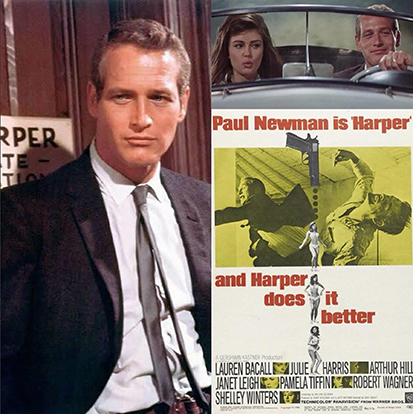
Only a few films have been made, despite the obvious appeal of the material and the setting. Some say Macdonald was reluctant to surrender control of the stories but, just maybe, it was a spectral Archer himself who objected, despite the money on offer, to preserve his own identity and integrity. He was right to do so because one film version changed Archer’s name to facilitate marketing, and another moved the locale from SoCal to NOLA, that is New Orleans. Both decompose the interwoven psychological themes to mere dollars and cents and so reduce the characters’ motivations to the supermarket mundane. These movies are Harper (1966), based on The Moving Target (1949) and The Drowning Pool (1975), based on the 1950 novel of that name. Both were vehicles for Paul Newman’s blinding star power.
Seek and ye shall also find a made-for-television movie called The Underground Man (1974) mutated from that novel, but it is larded with the tropes of television cop shows at the expense of the psychological depth or the intensity of the original. It starred a miscast Peter Graves as Archer. Even more woefully miscast was Brian Keith as Archer in the eponymous short-lived six-episode television series of 1975. Neither actor had the anonymous, everyman quality of Archer nor the compensating gravitas of Paul Newman. In addition, Macdonald’s storylines, perhaps without royalties, have also found their way into Russian and French films according to the IMDb.
If it has not been clear in the foregoing verbiage, the purpose of these musings has been to alert readers to the corpus of Archer stories in the hope that some might take a sample and find it to their liking. His novels are readily available in whatever form a reader might like from bytes to MP3 to hard and soft covers, new and used.
Sources:
Jacques Barzun and Wendell Taylor, A Catalogue of Crime: Being a Guide to the Literature of Mystery, Detection, and Related Genres, Rev. ed, (1989).
Mathew Bruccoli, Ross Macdonald (1984).
Michael Kreyling, The Novels of Ross Macdonald (2005).
Ross Macdonald’s Archer novels in publication order: https://www.fantasticfiction.com/m/ross-macdonald/lew-archer/
Paul Nelson and Kevin Averey, It’s All One Case: The Illustrated Ross Macdonald Archives (2016).
Tom Nolan, Ross Macdonald: A Biography (1999).
Bernard Schopen, Ross Macdonald (1990).
Eudora Welty, ‘The Stuff that Nightmares are Made of,’ New York Times, Book Review (14 February 1971), page 1.

Michael Jackson has no memory of why, where, when, and which Archer novel he read first, but it must have been sometime in the mid-1970s, and one was not enough! Since then, he has read all of them, and the short stories, and Kenneth Millar’s other books, and some of the twenty-seven by his wife Margaret Millar. Imagine the clickety-clack of typewriters in that Santa Barbara household.