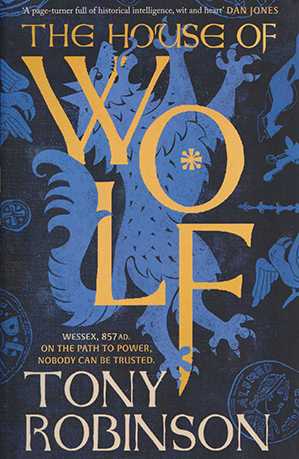
The House of Wolf Trilogy #1
- Category:Historical Fiction
- Date Read:13 March 2026
- Year Published:2025
- Pages:538


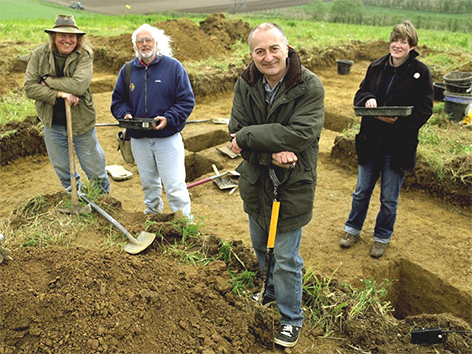
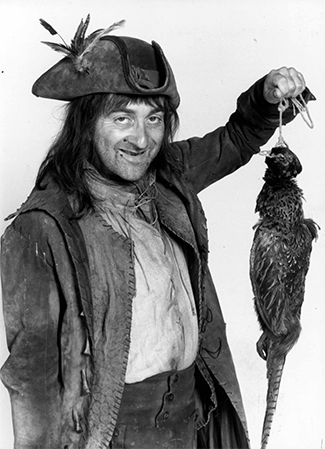
The House of Wolf is Tony Robinson’s first novel for adults. For those who know his career, it will not be surprising that the novel is set in Saxon Britain during the period of Viking incursions beginning in the late 8th century CE with the attack on the Lindisfarne monastery, and which continued for several centuries. Robinson’s historical credentials are fairly well established. He appeared on British television for twenty years as the presenter for Time Team, a show featuring real archaeological digs over a period of three days, each, conducted by prominent British archaeologists. He has also presented other historical shows like Walking Through History and The Worst Jobs in History, but he is possibly best known for his role as Baldrick, the incompetent servant of Edmund Blackadder, played by Rowan Atkinson, in the historical comedy series, Blackadder.
Robinson cites his experience as a presenter, as well as several prominent authors, as major influences on his own writing. Some of the authors are writers of historical fiction, as we might expect: Mary Renault and Robert Graves; and Seamus Heaney for his reworking of Beowulf. Surprisingly, he also cites major fantasy writers like Tolkien, Martin and Pratchett (although not that surprising, perhaps, since fantasy can feel like history with magic added). Most relevant, I feel, is Ken Follett, whose historical novels about the fictional town of Kingsbridge are not only exciting tales, but they trace the development of the town over time as its power, wealth and influence grow. Kennett’s novels are about the trials and tribulations of these great building achievements, but they also provide a metanarrative for the progress of Britain from a feudal into an emergent proto-capitalist culture, a change stimulated by the decisions to begin these building projects.
In this regard, Robinson’s story seems similar. Those contemplating reading The House of Wolf may not realise it, but it is only the first book of a trilogy, and its narrative scope is not just a story about the ruling family of Wessex in the 9th century CE, but a tale about English history: a dramatization of the emergence of a more cohesive British identity and Britian’s institutions through the figure of Alfred the Great. If you have already read Robinson’s book, you probably had the sense of this as you progressed further into the story. The main clue is the role that Aethelfraed, later to be known as Alfred, plays. Alfred is ensconced in Rome for the entire novel, so his ‘destiny’ is to be achieved sometime in the future, the subject of the succeeding volumes, of course. But for those who know Alfred’s history it should already be clear that Robinson’s story is a version of history that twists facts and jumps up and down on them to fit them to the portmanteau that is his thesis: a reading of England’s status as an emerging world and cultural power, with its roots buried deep in the minutiae of Saxon England and the legacy of Rome.
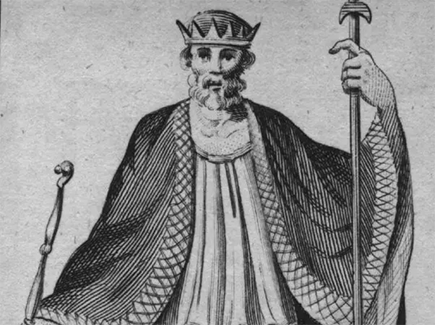
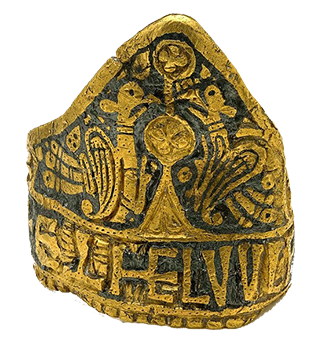
The story begins with King Aethelwulf, Alfred’s father and the leader of the Kingdom of Wessex, with some authority over Kent, Essex, Sussex and Surrey. And a little note here before I go further. For the sake of clarity, Robinson has mercifully modified some of the Saxon names for readability. Thus, Aethelwulf becomes ‘Aethelwolf’ and we know him mostly as ‘Wolf’, thereafter. Alfred’s siblings undergo a similar transformation. For instance, Aethelbald, the son who succeeds Aethelwulf to the throne, is called ‘Eathelbear’ or ‘Bear’; Aethelberht becomes ‘Aethelhawk’ and is mostly known as ‘Hawk’; Aethelswyth, Alfred’s sister, is known as ‘Swift’. When Wolf leaves on a pilgrimage to Rome in 855 CE, he leaves these siblings in charge of different parts of his domains and naturally, when he returns, there has been conflict.
Here is one example where Robinson plays loose with the historical narrative. Aethelswyth married King Burgred of Mercia, as does Swift in Robinson’s narrative, and she became Queen of Mercia. She is known to have exercised independent authority in her role as queen, but there is no evidence in the historical record for much of Robinson’s narrative concerning her. For instance, in the first Norlander attack we witness after the prologue, Swift repels the attack through cunning and bravery, demonstrating her leadership qualities and her intelligence. But her father, Wolf, snatches credit from her in the dying moments of the battle when he rides in with his small army of fighters to despatch the already defeated Norlanders. Further to this, there evidence that Aethelswyth took part in an insurrection in her father’s absence, or was imprisoned by her brother, Aethelberht, or rallied Saxon forces upon her escape in anticipation of a return of Norlander forces, originally the Scandinavian Vikings, which had been plaguing the region. Robinson has her engaged with all this. He is clearly keen to appeal to his modern audience by giving Swift independent feminist credentials beyond the scope enjoyed by Aethelswyth in the historical record. It does raise the question about what we think historical fiction is, but Robinson probably gets away with these liberties because the historical record is overwhelmingly quiet on the subject of women’s roles in history, and Wolf’s belated ‘victory’ demonstrates nicely how those achievements by women may be muted or erased.
However, not everything Robinson does is so easily reconciled. Of prime importance to his project is the role he gives Alfred in the narrative. In Robinson’s story Alfred is a young man living in Rome, running a school for boys. He is drawn into the political machinations of Cardinel Balotelli after an attack on the Undercroft, a meeting place for religious and political dissenters who wish to usher in a more enlightened system, and his fate is largely guided by this association thereafter. Father Asser, who will play a vital role in Alfred’s future is one of these dissenters. He is presumably based upon the priest who wrote the historical account of Alfred, Ælfredi regis Angul Saxonum – in English, The Life of King Alfred the Anglo-Saxon – which is our primary source for King Alfred, and from which he derives his sobriquet ‘the Great’. We first meet Father Asser awaiting execution for his unorthodox beliefs. He is saved by Balotelli as part of Balotelli’s efforts to gather like minds about him and to organise a resistance against Norlander incursions against Christendom. Balotelli has been instrumental in installing Pope Benedict III after the recent death of Pope Leo IV. Now he wants the Pope to make an alliance with Wolf to help repel the Norlander threat.
For his part, Alfred came to Rome to escape his father, Wolf, and his half-siblings who had been cruel to him during his childhood. This is the part of the story that is harder to reconcile with the historical narrative than Swift’s feminist credentials. Aethelwulf travels to Rome in 855 on a pilgrimage to meet the Pope and stays there a year. Robinson has Wolf make the same journey. Balotelli is keen for him to sign an alliance with the Pope to help mount a resistance against Norland invaders, using Wessex as the bulwark for Christendom against this threat. Robinson provides a suitably humorous reason why this compact is never made – as it never was in reality – but he signs the alliance with Charles the Bald in France during this journey, too, which eventually leads to his marriage to the French king’s 12-year-old daughter, Judith. That part is true!
While in Rome, Wolf is accidently introduced to his now-grown son, Alfred, when he visits one of Alfred’s schools. Alfred’s whereabouts have been a mystery for some time and the feelings of animosity run deep between him and his father. Except, in the real historical narrative, Alfred was only about six to eight years old when Aethelwulf made this pilgrimage to Rome, and he accompanied his father on the journey. Clearly, Robinson has taken some rather significant liberties here. Without making Alfred older, without introducing the estrangement, and without Alfred’s presence in Rome running a school for boys, much of the plot would crumble to pieces.
Of course, it is well within the purview of fiction to consider alternative history, but that is not what Robinson seems to be offering, nor is it what we might expect, given his long association with historical television series and his known interest in history. Instead, Robinson seems to have started with an historical thesis and then moulded his alternative facts around that. The premise of the entire novel, and possibly the entire trilogy to come, stems from key questions Robinson introduces about Alfred in his Author’s Note: “How did he do all this? Where did he get his ideas from?” He tells us that he takes licence to make his changes from Joseph O’Connor’s note in his postmodern novel Shadowplay, an historical fiction from the late-Victorian era, in which O’Connor warns his readers that his novel “is based on real events but is a work of fiction. Many liberties have been taken with facts, characterisations and chronologies . . . All sequences presenting themselves as authentic documents are fictitious.” But Robinson’s narrative does not possess the playfulness of postmodern fiction. Robinson is no O’Connor or John Fowles. Instead, his narrative is workaday, driven by incident, rarely reflective and gives little insight into the inner feelings of his characters. As one incident follows another, characters often feel flat, inhabiting roles rather than realities. A good example is the scene in which Swift and Alfred meet each other for the first time in many years. There is a little awkwardness as one might expect, but nothing of the personal meeting we might imagine. Swift acknowledges the meaning of the new name her brother has adopted – ‘wise counsellor’ – and tells him a bit about what she has been doing in England in a third person recount of less than a paragraph. What is clearly required of the scene is that for the purposes of the plot Swift is needed to contrive a meeting between the brother of a lately-murdered man and Balotelli so as to advocate the innocence of a friend. This is a culminating aspect of the plot this review has not detailed, and Swift immediately turns her attention to it with seemingly no thought about her brother, newly reintroduced into her life. So, in his Author’s Note Robinson has alluded to postmodernism and its concerns with the problems of narrativity as a licence for his own project, without considering that postmodernism produces problematic texts in reaction to the grand narratives of history: religion, politics, science, nationalism.
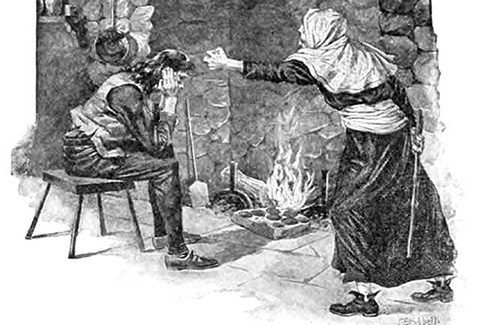
Besides, the story of Alfred is interesting enough on its own. Afterall, according to historical chronicle he was able to escape capture when Wessex was all but defeated by the Norlander incursions, and he somehow came back from that – from hiding in the swamps and conducting guerilla warfare, to slowly rallying his forces until the eventual defeat and submission of Guthrum (a key Norlander character in Robinson’s story) and his conversion to Christianity. Presumably, all this is to come in the trilogy. One of the most famous stories of Alfred, the burning of the cakes he is asked to watch over by an old woman who hides him, is dismissed by Robinson in his Author’s Note as “a story of incompetence and arrogance”. While the story is almost surely apocryphal, it seems it has endured because it suggests more to the imagination than this: maybe that there is a basic humanity and ordinariness about Alfred; that he, too, felt overwhelmed and distracted by his circumstances ; that despite this everyman quality, given the context of his later history, there was something paradoxically ‘great’ about him, too, lying dormant. Maybe it is a story like the burned cakes that is quintessentially English (in which case we are sailing close to the metanarratives that postmodernism presumably deconstructs). To return to Tolkien, one of Robinson’s inspirational authors, it is the hobbits and their quiet rural lifestyle that seem to embody a most quintessentially ‘English’ character, yet their humbleness and humility also embody a potential for heroism (‘I will take the Ring, though I do not know the way’)? Isn’t that the story of the Spanish Armada, too (‘I know I have the body of a weak and feeble woman, but I have the heart and stomach of a king’)? Isn’t that the story of the Blitz (‘This was their finest hour’)?
I think this is the most disappointing aspect of Robinson’s approach to historical fiction. While other historical fiction writers make stuff up, historical fiction usually inhabits the interstices of the historical record, or settles upon one theory or another when the record is in dispute. It gives voice to the voiceless – perhaps a Swift, but also the many forgotten ordinary people of history – and it fictionalises characters and accounts of well-known personages because the historical record only covers so much.
But Robinson’s approach to Alfred is like those academics who love Shakespeare but cannot credit that Shakespeare wrote the plays he did. Instead, fictitious backstories are manufactured to torture theories into fact: that Edward de Vere the 17th Earl of Oxford in fact wrote the plays, even though he died in 1604, years before many of the plays were written. Or that Christopher Marlowe penned them, yet he died even earlier in 1593 during the period when Shakespeare was still making his reputation in English theatre.
And this is where we are with Robinson’s treatment of Alfred, an historical personage he clearly admires. Alfred’s foray in Italy provides a backstory for Alfred’s ‘greatness’. Balotelli is Alfred’s Obi wan Kenobi: “Alfred was raw and unskilled; he would find it hard to make the compromises required, harder still to be ruthless. But Balotelli had taught him well.” But the narrative doesn’t just provide Alfred with an alternate backstory to explain his rise to leadership. It also provides a metanarrative of England as the historical successor to Rome. “Wessex, the new Rome?” Asser muses towards the end of the book. It is typical of the less-than-subtle prose which characterises Robinson’s novel. In Asser’s observation we understand that England’s systems of government, law and education are predicated upon the Roman system, and that Alfred will be instrumental in introducing them to England. It diminishes Alfred’s ‘greatness’ somewhat as an adopter rather than a visionary, but it enhances England, which is the next great empire to come.
With a bit of squinting to blur these kinds of details and a little forgiveness some might tell you that The House of Wolf is a fast-paced rollicking read. There is certainly a lot of action and intrigue, and this might appeal to readers who found themselves impatient with more nuanced historical fictions like Hillary Mantel’s other Wolf trilogy, covering the rise and fall of Thomas Cromwell during the reign of Henry VIII. Robinson makes a lot happen, but purists beware!