A Chandler Redux
- Category:Crime Fiction
- Date Read:24 January 2026
- Year Published:2014
- Pages:256

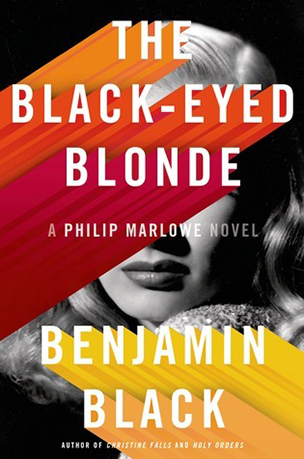
Sherlock Holmes and Hercule Poirot have transcended their originators, Conan Doyle and Agatha Christie. Other writers have, within the limits of copyright laws, revived these two fictional detectives and put them back to work. And they are not alone; the one-named Spenser of Robert Parker, Jim Chee of Tony Hillerman, and Evariste Pel of Mark Hebden, all have had second and third reincarnations. Philip Marlowe, sprung from the brow of Raymond Chandler, joined these ranks in 2014 when The Black Eyed Blonde appeared from the keyboard of Benjamin Black. This is a Marlowe who is older but no wiser than he should be.
His rebirth begins with these lines:
It was one of those summer Tuesday afternoons when you start to wonder if the earth has stopped spinning. The telephone on my desk looks like it knows it’s being watched. Traffic trickles by below, and a few men in hats are going nowhere.
So observes Philip Marlowe from the window of office 615 in the Cahuenga Building.
Thus begins another day without another dollar for him. It is some months after the events described in Raymond Chandler’s The Long Goodbye of 1953.
Welcome to the mean streets of a sweltering Bay City (aka Santa Monica), a crime noir in the sunshine state of California, a few miles south are the mystic lands of Mexico. Marlowe wallows in an enervated ennui when the bell above the outer office door tinkles, announcing the femme fatale’s entrance. With the relaxed casualness of the entitled, Mrs Clare Cavendish hires Marlowe to find a missing lover, one Mr Nico Peterson. Asked about him, she seems to know little, as if to say, ‘So hard to keep track of them, my harem.’
Her insouciance about a lover is both deflating and alluring to Marlowe. This sublime siren, exuding a heady elixir of pheromones, needs no song to attract this man. The spy-beautiful Clare is never far from his thoughts (and dreams) hereafter while he tracks the elusive Mr Peterson through beatings, pistol whippings, sappings, police interrogations, torture, gun shots, and Mickey Finns – the usual noir menu of mayhem and murder. This detective has the constitution of fiction. The body count reaches six or was it seven? So hard to keep track of them.
This Marlowe smokes and drinks a little less than Chandler’s and is less inclined to mouth the sexist, ageist, racist, homophobic, and other prejudices of the 1950s though some of the other characters do that. Even if Marlowe has been laundered, there is still plenty to offend those eager for offence. Mexicans are Wetbacks. Homosexual muscle men are weak at the core. The essence of a woman is sex. Laundered Marlowe is, but dry-cleaned, no. Set-in stains remain.
Plot, situation and characters have echoes in Chandler’s backlist. There is a stifling conservatory, a histrionic sibling, assorted alcoholics, an overbearing parent, and bushels of money which has not bought or brought happiness. His case files include a missing sister and a rare coin. As he mopes about this damsel sans distress, this Mrs Cavendish, when he gets to the bottom of a gimlet, his thoughts turn to the recently departed Terry Lennox. (Marlowe’s thoughts also turn to that absent woman in his life who is not named until late in the piece but we all know it is Linda Loring who has found him so irresistible that she had to fled to Paris.)
Bay City remains the sunny sin city of Chandler’s creation, where everything has a price and nothing has a value. Beneath the blinding sunlight of day bubbles a sewer.
The plot is a Möbius strip. As with Chandler, the savour lies in the journey, not the arrival: the snappy dialogue and evocative descriptions. Above all, the picture of Marlowe, in the words of the 1940 song, ‘bewitched, bothered, and bewildered’ by that Cavendish woman, is worth the cover price. Moreover, the ending is a corker when the sixth and last dead man exits. With O’Henry irony, the one person who survives, scared but unscathed, is Mr Nico Peterson, a premature report of whose death had stymied Marlowe’s initial efforts.
The descriptions, the dialogue, the musings on the trek are savoury. Here are a few of les bons mots to whet the appetite for the whole repast:
• ‘Using my special deep-toned, you-can-trust-me-I’m-a-detective voice.’
• Treading gracefully on her own shadow.’
• ‘Belief is not part of my program.’
• ‘The world is porous; things trickle through all by themselves, or so it always seems.’
• ‘I would have gone to her if she’d been calling from the dark side of the moon.’
• ‘Once you think a thing, it stays thought.’
There are plenty more of such strokes to reward a reader.
Had I to make a criticism, it would be of the relentless over-description of the clothes everyone wears, including Marlowe himself; it is done so repeatedly and so mechanically – upwards to twenty times on my count – that it blunts any impact. Done a few times when the clothes tell the reader something of the person or situation, and it scores points. When it is done again and again, well, the edge dulls. The same can be said of the descriptions of fittings and furnishing of rooms. These, too, are piled high. Once or twice these descriptions add perspective but after that they become padding. Black must have done a lot of research in back issues of Vogue, Esquire, McCalls, and Interiors magazines. TMI!
While in the pedant’s corner, note that Trans-Canada Air Lines did not brand itself Air Canada until 1965, and it did not fly non-stop from Los Angeles to Toronto in the middle 1950s, contrary to these pages. Moreover, all beaches in California are public up to the mean tide line. Ergo the Cavendishes did not have private sand. There is another false note that involves the plot, and it is best to say only that it involves Mrs Cavendish and her younger brother in the finalé.
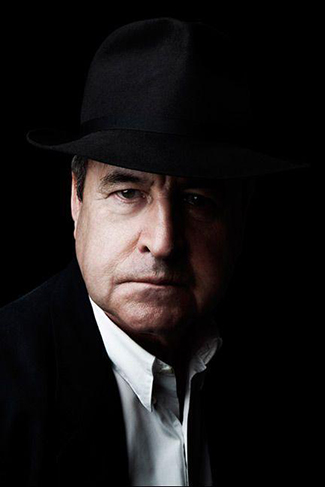
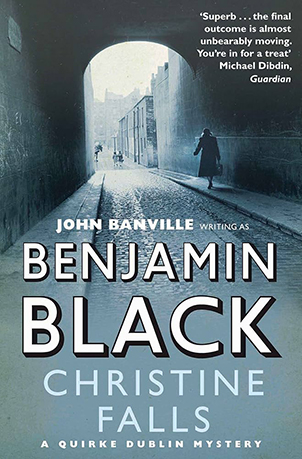
Benjamin Black is a pseudonym for the Irish novelist John Banville, who is the master of several genres, including this one with his own crime series featuring Dr Quirke (who, like Spenser, is a man with only one name) of 1950s Dublin. When The Black Eyed Blonde appeared, it was heralded as Book One of Marlowe Lazarus, implying that there would be a Book Two. It is disappointing to say now, ten years later, though it was widely and warmly reviewed and went through many editions, printings, media, and translations, that the implicit promise has not been fulfilled. Alas! One can dream of what Banville might have done in a pastiche of Chandler’s short story ‘The Red Wind,’ a personal favourite.
On the marketplace of ideas of Good Reads the book at hand scores 3.5 / 5.0 from 4,515 scorers (at the time of writing). There is the usual range, which I sampled by reviewing those who scored it ‘1’. A few of these latter scorers offered explanatory comments: the major theme is the desecration of an icon. ‘How dare Banville offer a Marlowe who differs slightly from my image of him!’ Well, he dared. His Marlowe has grown, and with growth he has changed a little. Black’s Marlowe is more introspective and more vulnerable than he was decades earlier. Aren’t we all?
Other Good Readers’ pearls included the remark, surely something we all wanted to know, ‘I hate noir’ followed by ‘I hate the fifties.’ Then there were sensitive souls whose overflowing virtue required them to sniff at the residual sexism, racism, and smoking in the story. These ‘isms’ evidently, it needs to be said, were of the time and are to be found aplenty in the Chandler oeuvre. Be warned trolls of delicate virtue.
There are two cautionary notes. (1) In reviews, advertising, and catalogue listings, sometimes ‘Black-eyed’ is hyphenated and sometimes not. It is the same book with or without the hyphen. (2) However, this book is not to be confused with Erle Stanley Garner’s Perry Mason vehicle The Case of the Black-eyed Blonde (1944) in which the compound adjective is definitely hyphenated, as it should be. By the way, Garner’s connect-the-dots story scores higher, albeit with fewer raters on Good Reads than Black’s. Chandlerholics will also note that Black’s title had an incarnation in Benjamin Schutz’s short story ‘The Black Eyed Blonde’ in Raymond Chandler’s Philip Marlowe (1988) which has a different plot, and no hyphen.
Vigilant readers will know that Black’s Black Eyed Blonde is credited as the alleged origin of the screenplay for a feature-length film called ‘Marlowe’ in 2022, starring Liam Neeson as the titular Marlowe. He is the latest in a long line of Marlowe impersonators, per the table below. Marlowe has also been animated on radio, podcasts, CDs, and audiobooks galore by Ed Bishop, Van Heflin, Gerald Mohr, and others. Then there are the innumerable translations.
Note: in some renderings Phillip has a double ‘l’ which it did not have in Chandler’s spelling.
| Year | Actor | Age | Title | IMDb Ratings |
|---|---|---|---|---|
| 1944 | Dick Powell | 40 | Murder, My Sweet | 7.5 |
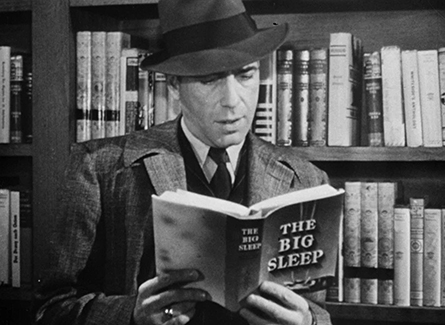
| 1946 | Humphrey Bogart | 47 | The Big Sleep | 7.9 |
| 1946 | Robert Montgomery | 43 | The Lady in the Lake | 6.5 |
| 1947 | George Montgomery | 31 | The Brasher Doubloon | 6.5 |
| 1959-1960 | Phillip Carey | 35 | Philip Marlowe (TV series) | 7.1 |
| 1969 | James Garner | 35 | Marlowe | 6.4 |
| 1973 | Elliot Gould | 35 | The Long Goodbye | 7.5 |
| 1978 | Robert Mitchum | 61 | The Bog Sleep | 5.8 |
| 1975 | Robert Mitchum | 58 | Farewell, My Lovely | 7.0 |
| 1983-1986 | Powers Boothe | 38 | Philip Marlowe: Private Eye (TV Series) | 7.7 |
| 1998 | James Caan | 58 | Poodle Springs | 6.0 |
| 2022 | Liam Neeson | 70 | Marlowe | 5.4 |
Note: In 1942 both Lloyd Nolan at 40 and George Sanders at 36 used the plot of, respectively, The High Window and Farewell My Lovely, but not the Marlowe name for Time to Kill and The Falcon Takes Over.
To say the obvious, Robert Mitchum alone has impersonated Marlowe twice. The actors who have donned his persona have ranged from a boyish 31 to a decrepit 70. Marlowe has also been black, played by Danny Glover (1995) in The Red Wind an episode on the television anthology Fallen Angels, and – wait for it – he has travelled to the mean streets of Prague in Smart Philip (2005) and Tokyo in The Long Goodbye (2014) and a cameo in an episode of Bitter Blood (2014) as Tokyo Marlowe. Surely, in an age when identity is subjective, it is time for a queer and female Marlowe or both in one.
Bibliography
Byron Preiss, ed., Raymond Chandler’s Philip Marlowe: A Centennial Celebration (1988).
Benjamin Black, Christine Falls (2006). The first novel featuring Dr Quirke.
Raymond Chandler, The Long Goodbye (1953) and ‘The Red Wind’ (1938), a short story.
Michael Duffy, Interview with Raymond Chandler, Deceased (2023). Great Writers – Raymond Chandler
Erle Stanley Garner, The Case of the Black-eyed Blonde (1944).
Frank McShane, The Life of Raymond Chandler (1976).
Richard Rodgers, Bewitched, Bothered, and Bewildered, a song from from Pal Joey (1940).
Michael Jackson read The Long Goodbye while a penurious grad student pecking out a dissertation on Aristotle and overnight became a Chandler addict. He bought a copy of the book at hand on Grafton Street in Dublin in 2014.

Marlowe’s ‘Mean Streets’
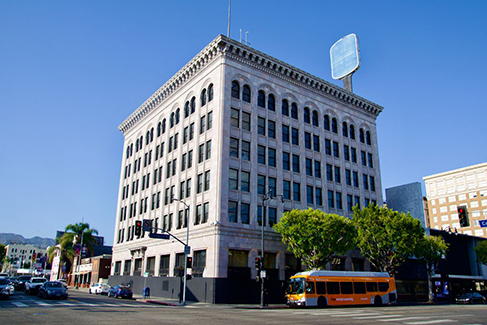
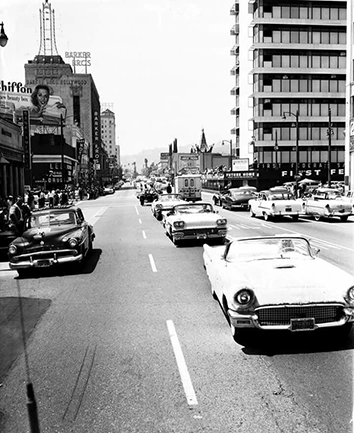
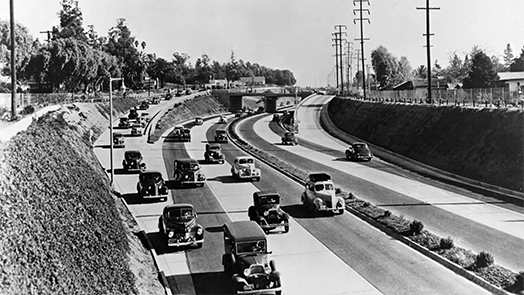
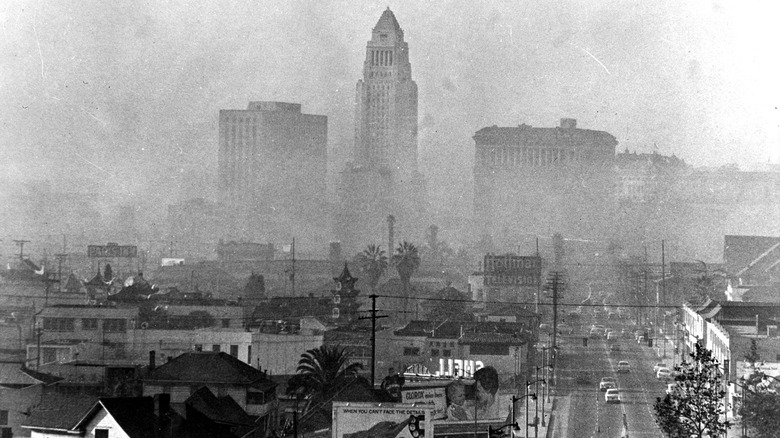
The ‘hard-boiled’ detective genre was in stark contrast to the more traditional stories of Sherlock Holmes and the ‘cosy’ detective genre, most popular in England during the 1930s and 40s. Detectives like Chandler’s Marlow or Dashiell Hammet’s Sam Spade existed in a more modern world that was increasingly emerging during the first half of the 20th Century, characterized by the growth of modern cities with skyscraper skylines and motorways. The images below represent some of this change during the period in which Marlowe’s character was originally being written.