- Category:Horror Fiction, LGBTQ+
- Date Read:16 July 2025
- Year Published:2021
- Pages:260


I started reading Tell Me I’m Worthless almost completely blind because I wanted to get more into reading 1) horror and 2) trans authors. Usually, I’m an advocate for jumping into a novel blind, but I think this is one that does earn a pretty hefty content warning. The author includes one at the start of the novel, which is a little bit of a controversial choice, especially for a thriller/horror title. Rumfitt even addresses the reader here, noting “you may disagree with the inclusion” but saying she thought it was important. In my opinion, it was well placed. This is a novel that examines fascism. It dissects the horror of it and never shies away from the gore and violence that follows. The story confronts the reader with graphic depictions of sexual violence and hate crimes. It is a very violent book, but it always uses this to illustrate that fascism is a very violent force.
Tell Me I’m Worthless doesn’t really have a hero or a monster unless you count The House itself, which certainly has a monstrous presence throughout the story. The characters, even the undead, are just people who all hurt one another, try to make things right, choose to forgive or not, and act as flawed human beings. This book doesn’t exactly draw its horror from evil but studies how every human being has the capacity for awfulness if allowed to be influenced by the force of hate. The threat of The House isn’t that it sends monsters after its victims. It turns its victims into monsters by imbuing their thoughts with hate and anger. People touched by The House, including the protagonists Alice and Ila, are never able to leave the psychological effects behind. It’s such an interesting take on the haunted house genre, as the story barely takes place in The House but studies how Alice and Ila cope having spent a single night there. It effectively conveys The House as a metaphor for fascism because it is, itself, an intangible power that only functions when humans carry out its influence. It is an evil force that sweeps people up and leads them to enact violence.
Rumfitt expertly uses the haunted house metaphor to illustrate the insidiousness of political hate. She writes extensively about how fascist ideals haunt English society. She asks the question: “What does it mean to be English?” and makes it clear that no answer is outside of the influence of The House (that is, no person is immune to the creeping hold of fascist rhetoric). While the use of The House to illustrate fascism can be a little on-the-nose, it’s also an effective way of bringing such a nebulous thing to the eye of the reader. The ways that The House affects the characters, turning them against one another, making them hate themselves; weaseling hate into their very minds. It is terrifying whether it is read as a political metaphor or not. I was really impressed by how the horror and the political commentary complement each other in this novel.
The characters, overall, are deeply flawed, bordering on utter unlikability, but they are continuously compelling. Successfully or not, they struggle earnestly for freedom from the trauma and horror of The House. The novel works hard to complicate the line between victim and perpetrator. The most egregious actors of fascist hate in this book are also the most vulnerable to it, and often the characters that inflict the most suffering are shown to suffer the most themselves from similar forces of hate and intolerance. Rumfitt offers empathetic views of her characters without ever giving the impression of excusing their wrongful actions. One protagonist, Ila, consistently spouts transphobic language, but the novel gives the reader reasons (not justifications) for why she has these beliefs. The characters are also thoroughly allowed to change.
In no small way, this is also a novel about transness and queerness, including the capacity of queer individuals to be swayed by anti-queer rhetoric – to be self-hating and ruled by anger. The House doesn’t make exceptions as it influences its visitors to hate.
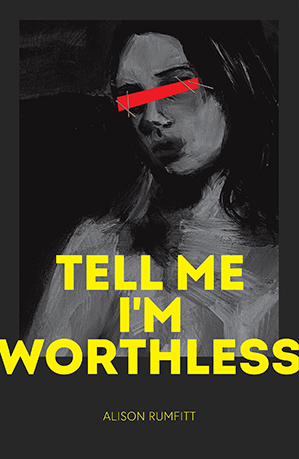
There is a lot of sexual content in the novel, but it consistently is thematically relevant to the content of the story. Rumfitt examines the rampant conflation of transness with sexual deviancy, and she isn’t afraid to get at the issue from a variety of angles. She portrays her trans characters as victims of fetishization but also as self-actualized sexual beings. The title of the book, “Tell Me I’m Worthless” actually gets at how The House – or fascism, if you read it that way – invades Alice’s thoughts, causing her to degrade herself on the basis of her transness, even (perhaps especially) in a sexual setting. It’s a really interesting and bold angle, I think. Rumfitt paints complicated, sometimes uneasy pictures of her trans characters. But she consistently notes how it is the force of fascism that creates such an uncomfortable relationship with their gender identity, not the gender identity itself.
The depth and creativity of the interactions between The House and the characters were so compelling to me as I read. Because The House primarily effects the characters psychologically, each individual has a different experience. Almost all of the novel builds up to Alice and Ila’s return to The House as well as the reveal of what previously happened to them there. Somehow, the ending delivered on the build-up with horrific, gnarly imagery. I loved that Rumfitt used a format with two parallel columns on the page to show Alice and Ila’s simultaneous but different experiences of The House. Overall, this was an amazing read for me. Rumfitt’s exploration of transness and fascism blends excellently into the suspense and classic haunted house horror of the novel. I’m excited to pick up Rumfitt’s other novel Brainwyms soon.