Swallows and Amazons Series #1
- Category:Children’s Fiction
- Date Read:21 December 2025
- Year Published:1930
- Pages:363

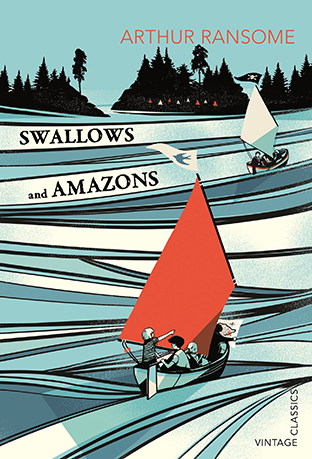
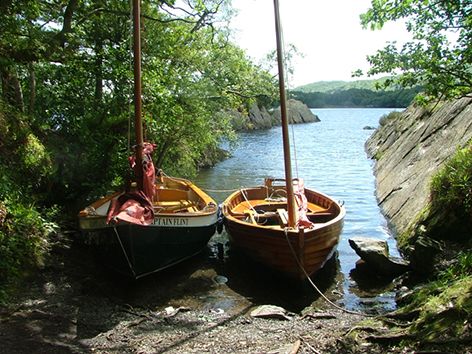
Swallows and Amazons was published in 1930. It was the first of what became a series of twelve books (with a thirteenth unfinished) that follow the adventures of English children in the Lakes District and other waterways. In this first book the Walker children, John (12 years old), Susan (11), Titty (9), and Roger (7) are visiting Holly Howe farm with their mother and baby sister. As part of their stay, they have been given permission to use a small sailing dinghy, the Swallow, so they can explore the lake and camp on an uninhabited island. The lake and island are Arthur Ransome’s imaginative amalgamation of different locations in England’s Lake District. Peel Island in Coniston Water provided Ransome with the idea of a secret harbour for his story, which was used as a location in two film adaptations. Blake Holme in Windermere is thought to have also inspired other descriptions of the island.
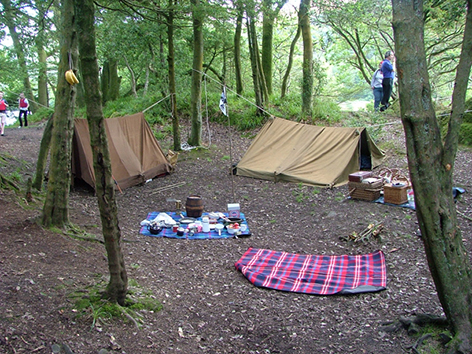
The Walker children’s father is absent during the course of the book. He sends a somewhat cryptic message to give his permission for the adventure:
BETTER DROWNED THAN DUFFERS IF NOT DUFFERS WONT DROWN
It seems like a cavalier attitude regarding the safety of one’s children, especially according to modern parenting values, but we should also understand that the message is delivered somewhat tongue-in-cheek, and that Arthur Ranson’s story is set during a period when children played independently outdoors far more than they do now. Basically, their father is telling them that if they aren’t silly, not ‘duffers’, they will be safe. If they are silly, they will put themselves in danger. Maybe he means to say that that kind of child doesn’t grow up to be a responsible adult and is no loss to anyone. John interprets it in the same vein: “It means daddy thinks we shall none of us get drowned and that if any of us do get drowned it’s good riddance.” Basically, the children have to be responsible for themselves, although their mother and other adults are obviously keeping a close watch upon their welfare from afar. Even so, Roger, the youngest of the group, is told not to swim into deeper water until he is able to swim so many metres on his own, close to shore. It’s up to him to work it out, even if his older siblings are tasked with keeping an eye on him, too.
Having gotten to the island, which the Walker children call ‘Wild Cat Island’ (the children in the 2016 film less imaginatively call it ‘Walker Island’), they discover that a fireplace has previously been constructed by someone else. They later learn that the Blackett sisters, Nancy and Polly, who live in the area, also claim the island as their own. The Blackett sisters fly a Jolly Roger flag on their sailing dinghy, the Amazon, and they challenge the Swallows to a contest: whichever group can steal the other’s dinghy first will earn the honour of their boat being the flagship in a campaign against Uncle Jim, whom they call ‘Captain Flint’ (he even has a green parrot!), while the captain of the flagship will be the Commodore of their fleet. Uncle Jim lives on a houseboat in the lake. The previous summer he participated in games of imagination with the Blackett sisters, but this summer, after returning from a trip abroad, he is ensconced behind a typewriter, writing a book. Nancy sets a firecracker off on Uncle Jim’s boat to protest his sedentary occupation, and he mistakenly identifies John as the culprit. (In the 2016 film John is responsible for accidentally breaking a window on the houseboat while skipping a stone on the water of the lake).
And yes, as is typical of children’s books of this type, there are baddies. But they remain in the background. We don’t need to meet them. We don’t need to know their motivations. The world of adults rarely intrudes on the children’s fantasy. Besides, the baddies’ crime is a minor one and their comeuppance is delivered through the imaginative play of the children at a distance, rather than summoning the police as the Famous Five would have been bound to do. Ransome’s novel is far more good-natured than the Famous Five, whose world is inspired by World War II and its aftermath, in which scientists always have secret formulas for new weapons that must be protected, or at the very least, the Five must stop nefarious smugglers.
I have to say before I go on, that I loved reading Swallows and Amazons. I love its innocence, its sense of adventure and the imaginative world the children inhabit. The worst the baddies do is steal a manuscript because it’s in a locked box that looks like it contains something valuable. I guess they are duffers.
I say all this because from the start it will be obvious that this is not the kind of story likely to be published for children, now. I think most publishers would blanche at the risks the children are allowed to take responsibility for, for instance, along with the presumption that readers will happily immerse themselves in the details of the children’s holiday while waiting for a plot to emerge. The story unfurls at a leisurely rate, and it is several chapters in before we have a sense of where it might take us. Eventually, the Walker children meet the Amazons and they start their ‘war’, and the mild complication of Uncle Jim is introduced.
Then there is the book’s length to consider. My edition is 363 pages of close type. Ransome does not make allowances for poor concentration, nor does he try to ‘grab’ the reader’s attention at the beginning. He uses technical sailing terms and other nautical jargon as though his audience is bound to know them. I can’t imagine modern writers writing this way for children.
And the children of this novel are simply different to modern children. Sure, they don’t have devices like phones or electronic games, given the period, but they are widely read and their adventures are imaginatively inspired by their reading experiences. The Amazons’ imaginative play, based around pirating, is clearly inspired by Robert Louis Stevenson’s Treasure Island. They even call Uncle Jim after the notorious pirate from that book whose treasure is being sought. And Titty, (whose name was changed to Tatty for the 2016 film based on the book), has a keen love of Robinson Crusoe, a lengthy 18th century novel. When she is left alone on Wild Cat Island as part of a plan to capture the Amazons’ boat, she imagines herself to be Robinson Crusoe. When her mother rows to the island to check on her, she styles her mother, as the children style all adults not a part of their imaginative world, a ‘native’ who has intruded. All grown-ups are natives, it seems, except Uncle Jim, but it will take the Blackett sisters some time to understand the reasons he has not been as involved in their adventures this summer.
All this is to say that while this is a wonderful book, there are very real obstacles that may impede modern readers, especially children, from enjoying it. I think to enjoy it, you have to be a little patient and appreciate the book for what it is, and not be discouraged by what it is not. A few one-star reviews from goodreads will serve to demonstrate what I mean:
‘Mind-numbingly dull.’
‘weak characters, a shallow morality, no real plot, no character arc’
‘DNF - I did not expect this book to be a DNF as I really enjoyed the movie. I thought it would be like Enid Blyton’s adventure novels, but there really isn’t much adventure at all in this book. Just endless description about kids sailing in boats. Very slow and honestly very boring.’
‘Reading about the internal fantasy world of children isn’t all that interesting, especially when the fantasy casts them as explorers discovering foreign lands teeming with “natives” and “savages”: literally, this is the Colonial Fantasy.’
‘Practically nothing happens for the first 200 pages and I was not a fan of how it was literally just children playing pretend.’
‘Can’t read this impenetrably boring book in which four irritating kids go on a boat trip. Far too much detail about halyards and fore-masts. Needs technical diagrams and/or previous sailing experience in order for it to make any sense.’
I think this is the reaction of readers who expect a ‘progressive’ plot (things move forward quickly with no irrelevant detail, with a tightly defined story arc) as opposed to an ‘immersive’ reading experience. Ransome requires us to enter into the children’s imaginative world of pirates, adventure and treasure. To enjoy this book, we have to be capable of empathetically understanding the children’s wonder and excitement; of vicariously sitting beside them as they race down the lake under sail or plan their moves against one another. Maybe having had experiences of ‘adventure’ in childhood could help, but we have to at least want to have the adventure, too.
I think the two movie adaptations are possibly a good example of what I mean. I’ve included movie trailers at the end of this review for the 1974 adaptation by Claude Whatham, and the 2016 remake by Philippa Lowthorpe, set in 1935.
For those familiar with the book, it will be evident that the 1974 adaptation is very faithful to the novel. The drama remains firmly in the world of the children’s imagination and Uncle Jim / ‘Captain Flint’ provides them with a climactic battle on his houseboat which includes cushions! The 2016 adaptation is a beautiful representation of an idyllic 1930s world, but the plot’s focus is different. Its progression is centred around the nefarious activities of two Russian agents who ultimately kidnap Uncle Jim. There is a gun, a chase along a speeding train, and the stakes of the ‘adventure’ are predicated upon an adult world, with a tight plot that is skewed towards action. This would seem to indicate that the producers thought the source material needed to be made more compelling. As awful as this might seem to those who love Ransome’s books, this later adaptation received some positive comments from reviewers. I have curated a few comments here. Trevor Johnston in the Radio Times wrote:
The added action does also give the film a bit more vim and vigour than the overly genteel 1974 screen Swallows and Amazons [. . .] With more at stake, the drama is intensified [. . .] whatever liberties it takes with the plot – the dastardly Russian spies are a new addition! – it preserves the values of an era when young people were expected to learn by doing, and left to get on with it themselves.
Other reviewers, like Geoffrey Macnab, questioned the need for the changes:
For no apparent reason, the filmmakers have grafted on a John Buchan/Alfred Hitchcock-style spy story to proceedings [. . .]
The film is at its best when the adults are kept at bay.
Peter Bradshaw of The Guardian expressed similar sentiments:
It is as if the children’s innocent fantasy world of pirates and adventurers isn’t enough. The action must be ramped up. They have to get real baddies to vanquish, but this new and implausible line in melodrama is taken at the same pace and treated the same way as the children’s innocuous high-jinks. There is even a frankly bizarre and not entirely logical chase sequence aboard a train in which sinister trench-coated figures behave strangely – to say the very least – though somehow without drawing attention to themselves.
However, Lewis Jones of The Daily Telegraph suggested a reason for what is inexplicable to Geoffrey McNab:
In the film he [Uncle Jim] is engaged in espionage and pursued by Russian agents, which gives the story some grown-up oomph, and pays fitting tribute to the author’s wildly adventurous early life. For Ransome was not merely a boaty old buffer with a walrus moustache who wrote children’s books. As a young journalist he reported on the Russian Revolution, was on intimate terms with its leaders and was himself an active player, which led to his recruitment by MI6.
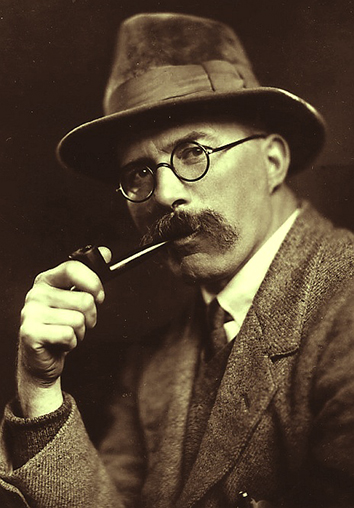
For those who see Swallows and Amazons as quaint, idyllic and innocent, Lewis’ comment is a reminder that Ransome was investigated as a possible Russian spy in the 1930s while he was writing this series of books. I think Lewis is correct in thinking that Ransome’s own notorious life was an inspiration for the 2016 changes. He had travelled to Russia in 1913 as a journalist for the Daily News, and had witnessed the February and October Revolutions firsthand in 1917. He was later given access to Leon Trotsky through Trotsky’s secretary, Evgenia Shelepina. Ransome and Shelepina fell in love and Ransome later had her added to his passport as his wife, even though he was already married, so that he could get her out of Russia. He divorced his wife in April 1924 and married Shelepina the following month. Ransome was an official informant for the British secret service against Russia but was suspected by MI5 to be a spy for the Russians. Roland Chambers, the author of The Last Englishman: The Double Life of Arthur Ransome (2009), argues that Ransome’s articles were highly sympathetic to Soviet Russia.
This is not to say that Swallows and Amazons is somehow a representation of Ransome’s own experiences in Russia (as Tolkien’s The Lord of the Rings is often attributed to his experiences during World War I), since it is clearly inspired by his own love of sailing and has a whole different context. Though Ransome didn’t sail as a child he owned six yachts over time. He took up sailing in the Lake District where his book was set, but he gained a great deal of experience from a six week voyage across the Baltic Sea from Riga in Latvia to Helsinki in Finland and back. Evgenia Petrovna Shelepina accompanied him on this trip. He published his first book about sailing, Racundra's First Cruise, in 1923. It was based upon this voyage. His boat was called ‘Racundra’. Much of the book was written while at sea. So Ransome had a keen attachment to sailing, and years later Ransome was famously inspired to write Swallows and Amazons after spending a summer teaching a friend’s children to sail. Three of those children’s names were used for the names of the children in Swallows and Amazons.
But the Russian spy angle is the kind of intriguing background that modern filmmakers evidently find difficult to ignore when trying to ‘improve’ their source material for a modern audience. Suddenly, it is not a matter of Uncle Jim’s manuscript being taken by inept thieves, but a kidnap plot involving Russian agents and guns around which the story revolves.
The comment about a ‘colonial fantasy’ by one of the one-star goodreads reviewers may be more appropriate. For some readers England’s history of colonialism will be invoked by the children’s clearly privileged lives, their claiming of territory and their ‘battles’ over it, along with their seemingly-pejorative use of the word ‘natives’. But this is a reading position we adopt as an adjunct to our own political understanding of colonial history, I think. Ransome’s invited reading remains a story about the world of childhood imagination, and the use of the word ‘natives’ is inspired by this: that the children’s perspectives and language derive from the books they read. So that the word ‘natives’ is just as natural an imaginative appellation as the language of the sea; their writing up of the ship’s papers and their styling themselves as either a ‘ship’s captain’, ‘ship’s mate’, ‘able-seaman’ or ‘ship’s boy’, along with colourful expressions – “Aye, Aye, sir!” – and the nautical terminology they adopt. Uncle Jim is given the name ‘Captain Flint’ because that is the name of a pirate in Treasure Island. And the resolution of the story remains firmly within the agency of the children’s imaginative world, even though the world of adults operates at the penumbra of their imaginings.
For readers, this intrusion is most poignantly felt towards the end of the novel when Mrs Dixon, the wife of a local farmer who has been selling the children milk each day, asks whether the children will return the following year. Titty excitedly exclaims, “Every year. For ever and ever.” Mrs Dixon’s response recognises the sad reality that the children are not yet aware of, or have not allowed to manifest in their minds: “Aye . . . we all think that when we’re young,” she replies. I imagine Arthur Ransome writing that line for adult readers. Only adults could understand the pathos of the response, like the moment in The House at Pooh Corner when Christopher Robin has learned to spell and we know that school is going to consume his time and his mind in the future.
Maybe that’s the thing with an older book like this. Perhaps it’s easier to appreciate it when older: to understand the poignancy of Mrs Dixon’s remark. When we return to what is juvenile, we can only understand it as an adult, and never as a child again. Perhaps that is implicit in the note C.S. Lewis wrote to Lucy Barfield, his goddaughter, in The Lion the Witch and the Wardrobe: “. . . some day you will be old enough to start reading fairy tales again.”
My feeling about Swallows and Amazons is that it is a book that could bring joy to adults who are able to relate to its childish perspectives and its slower pace. Children who are strong readers may appreciate it, but I imagine that reading it aloud with a child – one chapter a night is easy to achieve – would be rewarding for both adult and child, alike.
Illustrations in Ransome’s Books
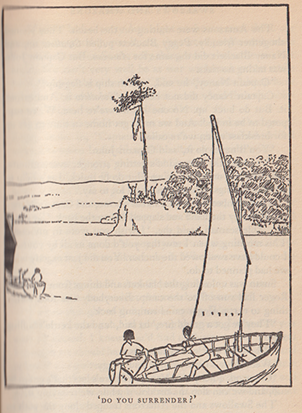
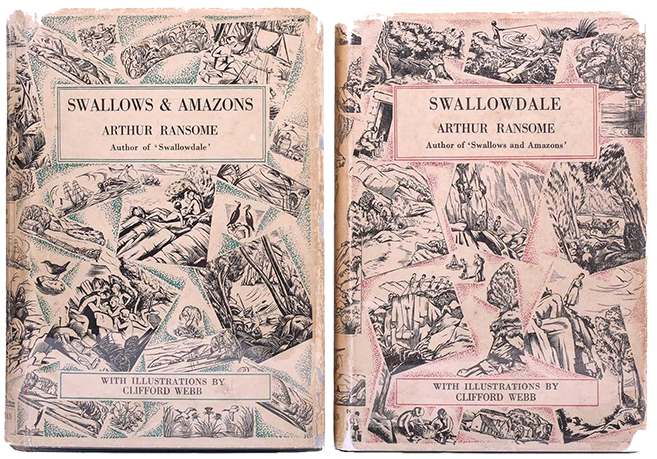
The illustrations are a part of the experience of reading Swallows and Amazons. Stephen Spurrier did the illustrations for the first edition of the book, but they were never included because Arthur Ransome disliked them. Only his map and illustration for the front cover were used.
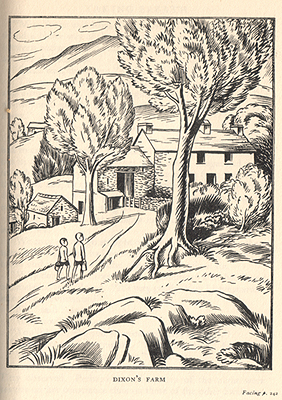
The second edition, published a year later, was illustrated by Clifford Web. I’ve included a couple of his illustrations below as a comparison to the illustrative style of the author. Web also illustrated the second book in the series, Swallowdale, published in 1931, but Ransome began to illustrate the books, himself, after that. From 1938 editions of Swallows and Amazons and Swallowdale had Webb’s illustrations replaced with Ransome’s own.
Spurier’s Work Cover and Map


Clifford Web’s Illustrations

Arthur Ransome’s Illustrations