
- Category:Magic Realism
- Date Read:6 January 2026
- Year Published:1995 (2025 in the illustated edition)
- Pages:85


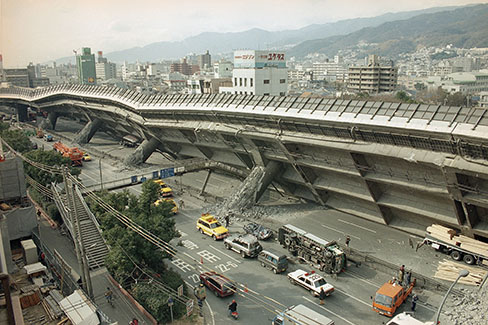
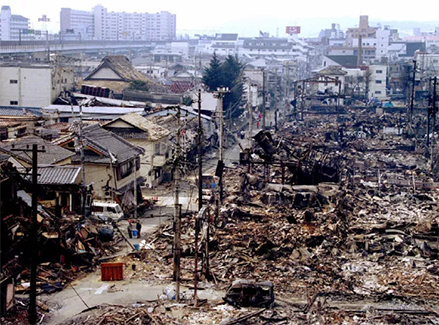
Super-Frog Saves Tokyo was originally published in Japan in 2000, five years after the story is set. The time setting matters, as will become apparent. An English version was published in GQ Magazine in 2001, but it was in the Vintage publication, After the Quake, that I first read it. After the Quake was a collection of short stories inspired by the Kobe Earthquake of January 1995. Now, I’ve reread the story because it has been published as a stand-alone short story / novella, in a hardback edition illustrated by Seb Agresti and Suzanne Dean: a gift worthy edition, which is how I received it.
The basic premise of the story is simple. Katigiri, the Assistant Chief of the lending division of the Shinjuku branch of the Tokyo Security Trust Bank, returns home one evening to discover a six-foot tall frog, who insists on being called ‘Frog’, waiting to speak to him. It is less than a month after the disastrous Kobe earthquake of January 1995, and Frog says that an even-more-deadly earthquake is about to hit Tokyo. Worm, a subterranean creature that absorbs seismic movements – which it eventually manifests as rage – is about to stir into action and cause the quake. Frog predicts around 150,000 people will die. Frog says he needs Katigiri’s help to stop Worm.
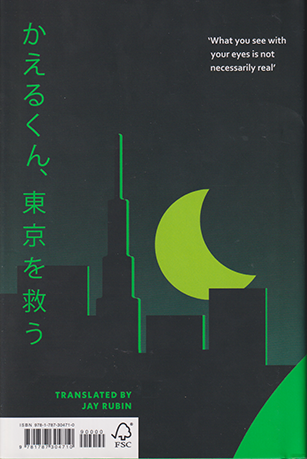
Of course, the scenario is quite surreal, as we might expect of Murakami. There is never any certainty about what is reality and what is the product of Katigiri’s imagination. At certain points in the narrative, we appear to receive outside confirmation that Frog is real – Katigiri receives a phone call from someone about Frog, for instance – although it is just as easy to speculate that this may be imagined, too. Everything may be imagined. Including a circumstance near the end of the story, there are certainly enough allusions to imagination and fiction throughout. Frog, alluding to Joseph Conrad, tells Katibiri, “true terror is the kind that men feel toward their imagination.” There are other literary allusions: Nietzsche, Tolstoy, Dostoyevsky and Hemingway. Murakami, through the agency of his Frog, will not let us forget the literary nature of his work and the experience of reading it. In fact, Frog tells Katibiri that the fight with Worm occurs in the imagination and that, “What you see with your eyes is not necessarily real”, suggesting that reality and perception are limited and personal: that reading, itself, is a deconstructive experiment, with no definitive truth. As readers, we must inhabit all realities and all perspectives within a story: “My enemy is, among other things, the me inside me. Inside me is the un-me” Frog also tells Katigiri.
Even so, as readers we will insist we know some things about the story that only the most perverse readings would question. Whether imagination or not, Frog turns up, gives his warning and makes his demand of Katibiri. Nevertheless, Murakami introduces some playful uncertainty. Near the beginning Frog tells Katigiri, “A real frog is exactly what I am. A product neither of metaphor nor allusion nor deconstruction nor sampling nor any other such complex process, I am a genuine frog.” As an allusion to the reading process itself, Frog seems to instruct us to read him literally and to apply no other meanings than those the story reveals, like a children’s fairy story understood at the level of a child. But things are never that simple with Murakami. Much later Frog tells Katigiri, “I am, indeed, pure Frog, but at the same time I am a thing that stands for a world of un-Frog.” It is a complex piece of signification which anticipates the “un-me” of Frog’s later speech. Frog is a frog – although his unique stature means he is like no other frog – and he also signifies all that he is not. So, this formula encourages us to look outside the story and consider those words, ‘stands for’. Whether Katibiri is delusional or not seems to be beside the point.
And the truth is, there is no simple equation between narrative signification and meaning: no final definitive explanation of this = that. Before the story might ‘stand for’ anything, we have to acknowledge, first, that it is almost impossible to consider the destruction of Tokyo by giant subterranean creatures rising to its surface without recalling to mind the creatures of Japan’s Godzilla movies and their association with radiation and the Atom Bomb. Murakami’s story is steeped in Japanese popular culture. Godzilla was never just a mindless movie monster. It was also this: a meditation on the national trauma of two atomic bombs that ended World War II.
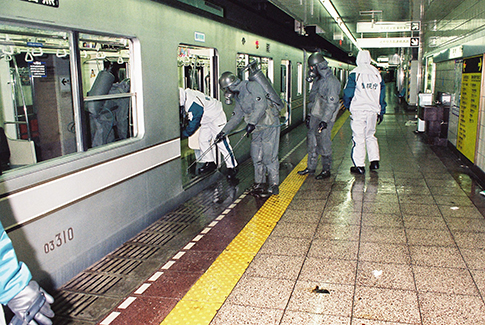
Neither is Frog’s warning about Worm to be taken literally, if we are not children. Worm, we can infer, is no simple monster, either. Creatures that lurk beneath may represent traumas of a past event, like Godzilla, but equally they may serve to illustrate lurking concerns and a fear for the future. In fact, Murakami’s story is book-ended by two nationally traumatic events. There was the Kobe earthquake in January, and in March 1995, the month after the story is set, there was also the Sarin gas attack on the Tokyo subway, which Murakami documented in detail in his non-fiction account, Underground. The event is chronologically after Murakami’s story, but the story is published five years later, and Murakami’s non-fiction account was published in 1997. The fear of the threat from beneath was already a part of Japan’s collective imagination. Frog anticipates the death toll from the earthquake to be “Mostly from accidents involving the commuter system” and he says of Worm that “. . . he is as big as a commuter train.”
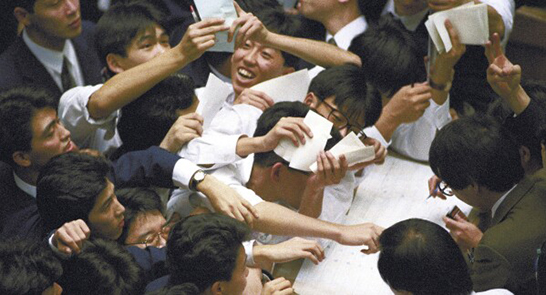
If Frog is to signify all that is ‘un-Frog’, then it is not hard to imagine Murakami meditating on these events when he wrote this story. In fact, national disasters often constitute a symbol of prevailing concerns and threats. Japan’s economy, for instance, is also called to mind by the story. In the 1980s Japan’s economy had seemed bullet-proof. But in 1990 the economic bubble burst: deflation, stagnant wages, bad bank loans and slow government response saw the beginning of a stagnant economy that lasted decades. One aspect of the financial crisis facing Japan over the period had been the falling value of assets which underpinned loans, bad loans and the weakening of banks. In Super-Frog saves Japan, Katigiri’s job, specifically, is to chase bad loans, which has made him an unpopular figure with Chinese Mafia, Korean mobsters and businesses in general for the last sixteen years. During the time of economic boom, he performed this unpopular function while his colleagues reaped the benefits of the bullish economy:
Everyone in his division preferred to make loans, especially at the time of the bubble. They had so much money in those days that almost any likely piece of collateral – be it land or stock – was enough to convince loan officers to give away whatever they were asked for, the bigger the loan the better their reputations in the company.
There is a strong association between the financial crisis and the Worm. In fact, Frog is very specific about the access point needed to attack Worm: “Their way would be in through the basement boiler room of the Shinjuku branch of the Tokyo Security Trust Bank.” There is a specific temporal setting, too. Katagiri is to descend into the earth beneath the bank on February 17 1995, the day before Frog predicts the earthquake will occur. At this point in February 1995 Kobe was still suffering the aftershocks of the initial January 17 earthquake at, which would continue for at least another year. Frog draws a physical link between Worm, an agent of natural disaster that will strike Japan, and the financial crisis that Katigiri is describing. Frog insists he needs Katigiri’s help because, “Tokyo can only be saved by a person like you.” Frog characterises Katigiri as a person of “courage” with a “passion for justice”. When his parents died, Katigiri helped his siblings financially, and helped them find a husband and wife. He has received no thanks and his own life is lonely and miserable. Katigiri is selfless. He may work in a financial institution, but we have seen that his hands are clean of the speculative adventurism that has harmed his bank and Japanese culture in general.
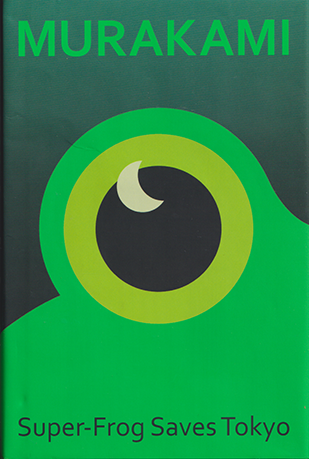
I have made a comparison between Godzilla and Worm, but by the 1990s anime was also immensely popular in Japanese culture. Some aspects of it besides film, like Yu-Gi-Oh!, focus on a combative culture with some hierarchical structures. Apart from the visual impact of manga cartoons, an overwhelming stylistic feature, for me, has always been what I think of a static animation, with limited movement that reduces the costs of production. If you read this story in the edition I received, I think it is worth keeping this in mind. Seb Agresti and Suzanne Dean’s illustrations are stylistically simple with bold colours. The text is formatted to fit within these bright images. Many pages have little text while others, usually pages heavier with exposition, are almost filled with text. The illustrated pages contribute to the surreal atmosphere of the story and sometimes assume some of the narrative burden. A good example, if you have access to this edition, are pages 24-27, just after Frog has told Katigiri of the impending disaster. Only four words appear on these pages. The terrible import of what Katigiri has learned is conveyed entirely through the looming face of Frog, whose changing face is almost manga-like. This is a beautiful book, and well-worth owning if you’re a Murakami fan.
And finally, we might ask (whether we believe Katibiri is delusional or not): why a frog? Look up the status of frogs in Japanese culture. In short, Google says “The word for frog, kaeru, shares the same pronunciation as the verb “to return”, leading to a rich array of symbolic meanings related to fortune and safe travel.” Frogs are associated with good fortune, success, safe returns and positive transformation. Super-frog is going to set Japan right. With the help of a selfless, honest and caring man, all that has gone wrong as a result of greed and short-sightedness can be overcome. At least, that is one reading of ‘un-Frog’: of ‘un-me’. Murakami sets his short story during one of Japan’s darkest periods. He also creates an avatar of change and hope.

In 1978, Haruki Murakami was twenty-nine and running a jazz bar in downtown Tokyo. One April day, the impulse to write a novel came to him suddenly while watching a baseball game. That first novel, Hear the Wind Sing, won a new writers’ award and was published the following year. More followed, including A Wild Sheep Chase and Hard-Boiled Wonderland and the End of the World, but it was Norwegian Wood, published in 1987, that turned Murakami from a writer into a phenomenon.
Japanese Disasters of the 1990s