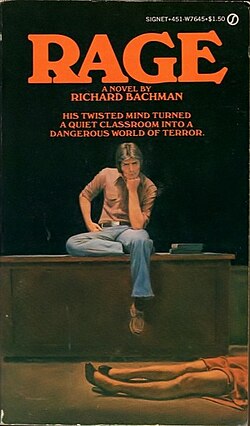
(Stephen King writing as Richard Bachman)
- Category:Thriller
- Date Read:2 March 2026
- Year Published:1977
- Pages:211


Rage is perhaps the most controversial of Stephen King’s novels in that it is the only one that he has ever removed from direct circulation. It is only now available in the Bachman Books, the compilation of short novels of King writing as Richard Bachman, and only in older editions. I am fortunate enough to have one of those older editions, and have held myself lucky to have my copy for as long as I have.
It would be remiss of me to not preface this review with a statement, given King’s own comments on Rage. I understand the utility of the novel, and I do not believe that fiction should shy away from more difficult topics, particularly topics that deal with the epidemic of gun violence in the United States. With that said, I fully understand King’s thoughts behind removing it from publication, and I think it is not unreasonable to have let the story fall into some level of obscurity over the years.
I do not think Rage has much value as a story (more on that later), but I do think it is still very much worth a review and commentary. Absence of commentary and critical thought about controversial topics and pieces of work is, quite frankly, dangerous – so I will be looking at Rage in the same way I will be looking at all of King’s work. With that said, I used to believe this was a four-star book but I have now revised it down to one and a half stars, now that I’m older.
Rage is the story of Charlie Decker, a fairly ordinary teenager who decides to wake up one day and take revenge on those he believes have wronged him at school. He chooses to send his school into lockdown by enacting a killing spree, and then he locks up his classmates and takes them through a philosophical journey into his rationale, and eventually down an even darker path.
We follow Charlie at the start of his story, facing his imminent expulsion for beating one of his teachers over the head with a pipe wrench. I think what is particularly interesting about Charlie from the beginning is that he is clearly reasonably intelligent. He shows flashes of wild violence amongst (what is at least) pseudo-intellectualism. He is a troubled young man who believes he is owed everything and is able to do anything to get it.
I do find that King’s writing of Charlie is particularly interesting. He is coloured as a villain but he is also somewhat an antihero, which is a particularly fascinating take. He is not designed to be utterly unlikeable, which I think is perhaps the most dangerous thing about him. He does his best to be convincing and savvy, filtering in violence piece by piece, but that is critical to his character. I find him interesting as a study because if you peel away even just a corner of the veneer, you see a particularly ugly sight: his philosophy is flawed at best, and it shows a really interesting view into the mind of an utterly psychopathic teenage boy.
He’s not particularly aggrieved as a person either. Realistically, his sole point of tragedy (beyond his abuse at the hands of his father) is that he couldn’t manage to finish a sexual interaction with a girl because he was stoned out of his mind. It’s not overly sad, and it means that there’s only so far that sympathy towards him can be extended.
Following the expulsion conversation, Charlie goes to his locker and decides that now is the time to set his locker on fire and start shooting his teachers with a pistol that he has been housing there. What follows is a familiar (particularly post-Columbine) lockdown and hostage negotiation situation.
During that period of time he holds his maths class hostage and he slowly draws out more and more information from them about their embarrassing private secrets, mostly to do with their parents and sexual endeavours. There are flashes of King’s brilliance here with characters like Pig Pen, who speaks about his struggles with his rather novel mother and her penchant for purchasing everything with coupons to the point of socially isolating him and his siblings beyond belief, but generally it comes over somewhat lacklustre, especially when it comes to the female characters who are somewhat reductionist. We end up bearing witness to a rather paltry catfight that doesn’t really do much of anything or go anywhere, and somehow, we’re meant to believe that the sole focus of teenage girls is to call each other various derogatory names. It’s just less developed than the male characters, and it leaves a bit of a sour taste.
Eventually, Charlie gets shot, but gets saved by the rather bizarre coincidence of having a padlock in his breast pocket. Rather than this being exciting, it reads more like a deus ex machina with no real payoff or purpose, as he simply gets right back into the hostage holding and continues to traumatise his classmates.
Following this, Charlie encourages the class to ‘do as they will’ to Ted, the one conscientious objector in the classroom. We’re not told explicitly what happens to Ted, but we are told that he ends up on the floor, bound, his mouth stuffed with textbook pages, and beaten within an inch of his life. In a way, avoiding the full explanation of the violence is more effective. I do think that there was definitely a solid thought in the classroom turning on Ted and the comment on the inherent darkness in all of us. I just don’t think it was done particularly well. But the ending leaves us with very little to work off, with Ted comatose and essentially non-functional. The book doesn’t have the kind of character development that King usually achieves.
I will confess that I did particularly enjoy the sentiment of the girls saying that you’re (essentially) all brains or all beauty (albeit in a far more perverse way). This is something that I wish King had gone further into instead of pitting the girls against each other in a cat fight, but it merely treated as a throwaway comment that doesn’t go as far as it could have. I think there’s also an attempted commentary on nature vs nurture as part of Charlie’s story, too, but it doesn’t quite become significant, thematically, as it should.
The novel concludes with Charlie in custody, saying he needs to leave us now and turn out the light. He’s just received a letter with news about all the other children in the class with various details redacted alluding to the fact that they too have ended up committing heinous acts - but we never quite find out what.
I do think Rage is a really interesting insight into those who actually do something as horrific as this, but at the same time it’s one of the weaker of King’s works in that it doesn’t do much with what it has to work with. I understand it was written as a piece of work that was written partly as an absurdist power fantasy, but now it reads more like a manual.
Rage is definitely one for the diehard Stephen King fans and less so for the anyone else.
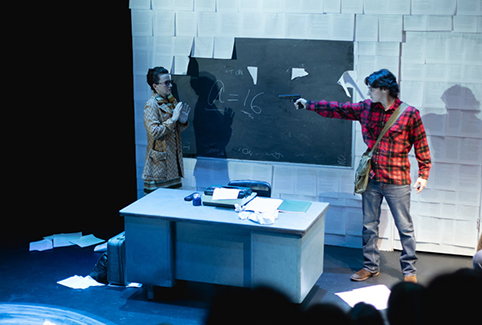
(Photo by Crandall "CJ" Yopp, from Allison Considine’s article Quinnipiac University Students Unleash Suppressed ‘Rage’
Four School Incidents Linked with Rage
Heath High School Shooting: This shooting took place in 1997 and was the primary culminating reason for King’s withdrawal of the book from sale. Michael Carneal, only 14 years old, killed three students and injured another five. A copy of Rage was found in his locker.
Frontier Middle School shooting: In 1996 Barry Dale Loukaitis, also only 14, killed his teacher and two other students. He is reported to have used Charlie Decker as a model for his own actions.
Jackson County High School: In 1989 Dustin Pierce tried to replicate the plot of Rage when he took a class hostage.
San Gabriel High School: In 1988 Lyne Cox held a class hostage for over half and hour using a semi-automatic rifle. He was eventually disarmed by a classmate. He cited Rage as an inspiration for his actions.