- Category:Crime Fiction
- Date Read:12 January 2026
- Published:1932
- Pages:192

Hercule Poirot #8
- Category:Crime Fiction
- Date Read:12 January 2026
- Published:1932
- Pages:192

Peril at End House was the first Christie mystery that I didn’t enjoy the first time I read it. The reason I didn’t enjoy it is a strange one – I solved the mystery. I thought it was obvious, with several clues that jumped off the page and slapped me in the face. Perhaps some people like being able to solve a Christie mystery, but I prefer it when the solution comes out of left field, and looking back, I see all the subtle clues I’d missed. On this reread I also found Poirot’s actions at the end unpalatable.
The book starts with a retired Hercule Poirot and his friend Hastings, returned from Argentina where he has a farm. He’s been absent for a few books and now he’s back in Britain for a visit, where he has met Poirot in Cornwall. They have a chance encounter with Nick Buckley who lives near their hotel, at End House. Nick mentions that she has recently had three escapes from sudden death: a heavy painting almost fell on her; her car brakes failed; and a boulder narrowly missed her as she walked down a cliff path. While they are talking, Nick jerks her head away from what she thinks is a wasp flying past. Poirot, however, notices that what Nick thought was a wasp was actually a bullet. It has left a hole in the brim of her hat. Although Nick refuses to take the risk seriously, Poirot is convinced someone is trying to kill her. He assures Nick that he will protect her but several days later, the killer strikes again. Poirot is left with a murder to investigate.
While I thought the solution to this mystery was too obvious, the plot is clever and I did enjoy the way Christie uses the stereotype of the hopeless female victim to manipulate readers and disguise her intentions. This is clever. I just wish the clues to this cleverness were disguised a little better. I also appreciate the quick pace of the story. Christie establishes the mystery quickly and moves everything along at a good pace. She throws a few other crimes into the story to complicate things for us, such as missing wills, a stalkerish ex-husband, dodgy Australian tourists and drug addiction. All of these do make for a lot of plot elements that need resolution at the end, though, resulting in a rather crowded final few chapters.
And the overall story does give a flavour of life among the Bright Young Things of the 1930s. Nick and her friends seem only to be interested in enjoying life and seeking out thrills. Nick’s original attitude to Poirot’s suggestion that a murderer is after her is to treat the idea as a great joke that has been sent to entertain her. The rather staid and traditional Hastings is judgemental of their behaviour but Poirot seems more indulgent and understanding.
But apart from this, there is nothing about this particular mystery that stands out to me. I think Christie felt the same about it herself. In her autobiography she says of it “Peril at End House was another of my books which left so little impression on my mind that I cannot even remember writing it.” (p.436 of An Autobiography by Agatha Christie)
Oh, and Poirot’s actions at the end that I said I didn’t like - this is one of the books where Poirot acts to dispense his own version of justice. It left a bad taste this time even though the killer is utterly callous and does not deserve to escape traditional justice. Christie has used similar techniques in other stories, but this time she lets two decidedly evil characters escape while she makes sure a lesser criminal is punished by the law. This is not a satisfying ending, especially given the attitude Christie expressed in her autobiography about how she saw the detective novel at the time.
“When I began to writing detective stories I was not in any mood to criticise them or to think seriously about crime. The detective story was the story of the chase; it was also very much a story with a moral; in fact it was the old Everyman Morality Tale, the hunting down of Evil and the triumph of Good. At that time, the time of the 1914 war, the doer of evil was not a hero: the enemy was wicked, the hero was good; it was as crude and as simple as that. We had not then begun to wallow in psychology. I was, like everyone else who wrote books or read them, against the criminal and for the innocent victim.”
(p.437 of An Autobiography by Agatha Christie)
This extract comes interposed between her comment on Peril at End House and other comments about The Murder of Roger Ackroyd (1926) and Lord Edgware Dies (1933), and a comment about The ABC Murders (1936). If this was Christie’s attitude to crime and punishment at that time, it seems strange that Poirot condones two separate criminals escaping the legal punishment of the day.
This is not a Christie that I’d recommend people read.
Adaptations
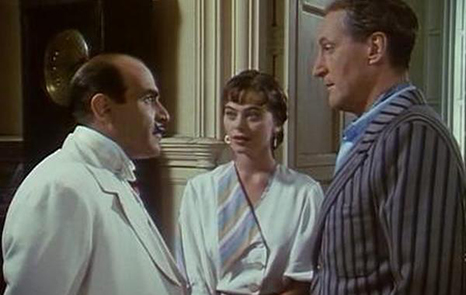
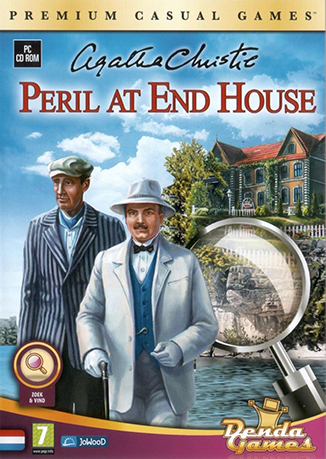
Peril at End House has been adapted for stage, radio, video game and graphic novel, in addition to four screen adaptations.