- Category:Fiction (General), Satirical Fiction
- Date Read:5 April 2026
- Year Published:2018
- Pages:289


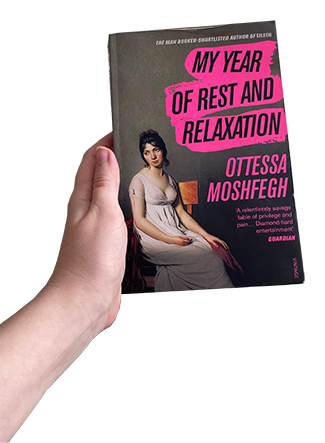
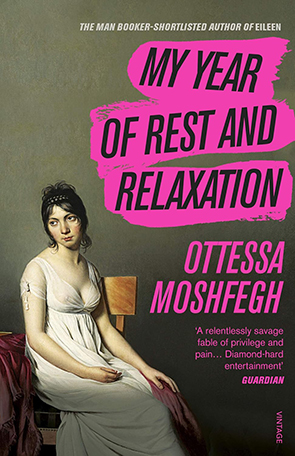
I was starting college when My Year of Rest and Relaxation by Ottessa Moshfegh was first published and was making waves on the interwebs. It caused Moshfegh to have an almost mythical presence in my mind as a young reader: this daring author of the grotesque. My fellow reviewers’ impressions of her other novels, Lapvona and Eileen, made me curious about her works again.
So here I am, eight years fashionably late, finally reading My Year of Rest of Relaxation. Now that I read it, I have a hard time putting into words just how disappointed I am.
Let’s start with a summary: the unnamed narrator is a 26-year-old New York socialite in the year 2000. Despite her immense wealth, beauty and endless opportunities, she is extremely depressed. After both her parents die in the same year, her father of cancer and her mother of suicide, she is deeply disillusioned with the world and no amount of luxury can soothe her growing hatred of everything. She decides that the only way to cure her existential fatigue is to go to sleep for a whole year, to “hibernate” and wake up “reborn”, something she achieves through a plethora of drugs.
While I understand the narrator’s depression because of my own similar experiences, I had a hard time reading because she has such an insufferable voice. Moshfegh intended her to be unlikeable, I get that’s the point, but I think there’s a limit as to how much you can make a main character unlikeable and still keep the reader invested in what they are doing. This narrator is very unlikeable in a very boring way. She is a racist, self-pitying, hypocritical and obnoxious woman, and she stays that way throughout the entire story.
There is a good premise here, but the execution leaves me cold. As a former depressed young adult, I can still understand the appeal of this idea: going to sleep until all your problems are over and you don’t have to deal with them directly. I believe it is what drew so many people to this novel, many of them fellow depressed young women looking to connect with a relatable character.
The narrator’s “hibernation” was never intended to be a realistic experiment, but her transformation at the end, everything going exactly as planned, still felt far too convenient. The second-to-last chapter is this corny victory lap that feels very unearned. She locks herself in her house for months – of course the outside world will appear more beautiful when she’s out. She is bound to be miserable again after the initial burst of optimism wears off, but that aspect is never explored. It has this really icky vibe of “she finally got over it” and “she just needed to change her perception to stop being depressed”.
And then 9/11 happens in the very last chapter. Of course, the reader sees it coming and there are cheeky mentions of the World Trade Centre leading up to it, but it’s such a last-minute addition to the plot it’s almost comical. All the narrator has to say about this national tragedy, that forever changed the American society she hated so much, is that one of the women falling to her death is “beautiful” and the one truly “wide awake” (page 289). It comes off as ridiculous at best and deeply offensive at worst.
As for the way this story is told – the form and language – let’s start with the positives: My Year of Rest and Relaxation is very easy and quick to read. Moshfegh loves run-on sentences that would leave you breathless if you tried to read out loud. The scenes with Dr Tuttle, the narrator’s shady pill supplier, are darkly charming, and the passages about the narrator grieving her parents are hauntingly beautiful. They’re the best parts of this book, in my opinion.
“[. . .] In a few dreams, I’d answer the phone and hear a long silence, which I interpreted as my mother’s speechless disdain. [. . .] Occasionally I’d spot my parents in places like the lobby of my apartment building or on the steps of the New York Public Library. My mother seemed disappointed and rushed, as though the dream had pulled her away from an important task. ‘What happened to your hair?’ she asked me in the Starbucks on Lexington Avenue [. . .]" (page 62)
The descriptions follow the same breathless structure, but most of them end up sounding like brand-name word salads. There are constant mentions of pills, products, celebrities, artists, movies, and locations in New York. However, the narrator’s world is restricted to her apartment that she hardly leaves, a bodega around the corner and Dr Tuttle’s office, which makes her criticism of New York society sound rather hollow. All the morally bankrupt and performative behaviour she refuses to participate in anymore are things that happen elsewhere, or occurred at some point in the nebulous past. It’s a lot of telling and not enough showing. We have to take the narrator’s word for it that it’s indeed that bad, but she pretty openly admits to having an unreliable pessimistic perspective.
Everything you need to know is established in the first 50 pages, then for the next 200 the same ideas cycle over and over again with slightly different wording, until you feel drugged too. The introspective musings are shallow and peppered with obscene language, the shock value wearing off extremely fast, which made me feel nothing. Honestly, that’s my biggest gripe with this book: except for the grief passages, it made me feel nothing. It’s such an unpleasant reading experience and not in any thought-provoking way.
There is definitely a feminist sentiment in this novel, but it’s drowned out by the relentless misogyny perpetuated to and by the narrator, as well as bigoted statements she makes about every minority you can think of. I’m not being hyperbolic. Yes, the story takes place during the early 2000s, a not-so-politically-correct time, but there is no commentary whatsoever being made. Like the obscenities mentioned above, all of these shocking comments and drive-by insults feel like they are there just for the sake of being shocking. It feels like Moshfegh is going through a checklist of highly sensitive topics to make an edgy remark about, in-between talking about pussies and Whoopi Goldberg. Is this really a satire of American society, or is it a string of offensive nonsense she wrote just because she could?
There is a unique sort of disappointment when you finally get your hands on a book you’ve been curious about for years, only to hate it. Moshfegh is a genuinely skilled writer – her prose can be quite beautiful – but this novel left a really bad taste in my mouth . . .

Associated Art