Full Title
- Felix Holt: The Radical
Key Publications
- Published as a three volume novel by William Blackwood and Sons in June 1866
- Cabinet Edition (1878) published by William Blackwood and Sons, included George Eliot’s final revisions and corrections.
Review Edition
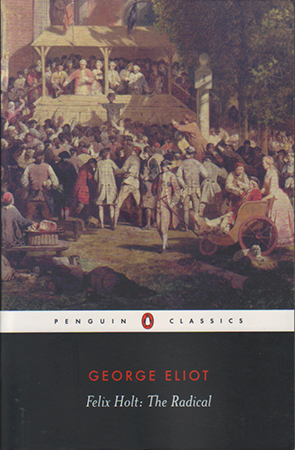
Eliot, George, Felix Holt: The Radical, London, Penguin Books, 1995
Introduction: Lynda Mugglestone
No. of Pages: 478 (545 with notes and appendices)
Review
Reviewer: bikerbuddy
Category: 19th Century Fiction, Historical Fiction
Date Read: 4 May 2026

Category: 19th Century Fiction, Historical Fiction
Date Read: 4 May 2026
Reviewer: bikerbuddy
Please Note: There are features in this review which can only be viewed on a wider screen.
There are so many things wrong and difficult in the world, that no man can be great—he can hardly keep himself from wickedness—unless he gives up thinking much about pleasure or rewards, and gets strength to endure what is hard and painful.
Romola, Epilogue
The above advice is given by Romola to Lillo in the closing paragraphs of Romola, George Eliot’s novel that directly precedes Felix Holt: The Radical (Felix Holt, herafter). It is the expression of a moral creed that embraces self-abnegation and service over the unprincipled pleasure-loving egoist, Tito Melema, Romoloa’s treacherous former husband.
It’s interesting to recall this because by the time Eliot is writing Felix Holt she is exploring this personal moral doctrine within a wider context, envisioning a political landscape in which a better-educated and ethical actors population might achieve a more stable and comprehensive reform than possible through legislation alone.
Felix Holt is therefore a political book but it does not read like traditional political realism. As we read we are observers of the political process from the perspective of a candidate and through the manipulations of the working class, but it does not provide a detailed understanding of the machinations of the political world. It is less about the pragmatic manoeuvrings of politics and more about the philosophical underpinnings of political idealism, and features a story that ultimately reads more like a morality tale than anything else.
So, the title of George Eliot’s fifth novel seems to suggest what the book is about. Felix Holt, we might assume, is a Radical politician from the period of the first Reform Act in 1832. But we would be wrong. Felix is no politician, merely a political activist, and judging by his attempts to influence workers in the Sugar Loaf pub, he is not a particularly strategic one. He is easily outplayed by the smooth-talking John Johnson who plies the workers with alcohol and sends Felix on his way. Yet the book has become Eliot’s least read book in the modern era, partly because of this impression, that it is about the minutiae of politics from the period of England’s early political reform, including, also, a complicated inheritance plot on top of everything else.
But Felix Holt is only a political novel to the degree that it is about the ideals that we hope underpin our political discourse, even if they are found wanting in application. On the face of it, it is a story about class and love and inheritance and idealism. It helps to know a little about the changes happening in English politics during the period it is set while reading it, but the novel is also about the personal lives of the people of Treby Manor, a small town that will host a polling both for the first time in the upcoming election. Eliot’s narrator tells us early in the novel,
These social changes in Treby parish are comparatively public matters, and this history is chiefly concerned with the private lot of a few men and women; but there is no private life which has not been determined by a wider public life . . .
On a first reading, this oft-quoted extract might suggest that the private lives of Eliot’s characters, subject to the vicissitudes of social change, are of secondary importance to the wider concerns of history. In fact, Eliot’s exposition that follows – describing the chain of events that have created the conditions for the personal stories in the novel – would seem to support this:
For if the mixed political conditions of Treby Magna had not been acted on by the passing of the Reform Bill, Mr. Harold Transome would not have presented himself as a candidate for North Loamshire, Treby would not have been a polling-place, Mr. Matthew Jermyn would not have been on affable terms with a Dissenting preacher and his flock, and the venerable town would not have been placarded with handbills, more or less complimentary and retrospective—conditions in this case essential to the “where,” and the “what,” without which, as the learned know, there can be no event whatever.
Eliot’s framing suggests the personal is subservient to the wider historical context. Yet, as in other Social Realist novels from this period, it is the personal lives and stories we read that provide a more accessible context for the broader issues which underpin them: in this case, Eliot is exploring personal qualities and moral rectitude as idealistic prerequisites to a functioning social compact. Her musings are much the same as she left them at the end of Romola.
Yet, like many novels of the period, it is also a love story. It involves not only the election in Treby – a small part of the plot to be honest – but also a story about a complicated inheritance that tries the moral fibre of the heroine, Esther, who is forced to make a love choice which helps characterise the broader moral path that Eliot is dramatizing beyond where she left readers in her previous book. It also the story of a personal tragedy steeped in secrecy, and includes a Machiavellian villain who had me thinking of Darth Vader long before he said “I am your Father” in a dramatic reveal that predates Star Wars by over a century.
So, even if you’re one of the millions who have read The Mill on the Floss, Silas Marner and Middlemarch, it is likely that you have skipped Felix Holt: that you are unlikely to read it as well. But if you are interested in Eliot at all, my recommendation would be to read Felix Holt. It still contains the the type of clever panoramic opening she had established in her previous novels, it is still written with the wit and insight her audience had come to expect, and it still contains a compelling story, though less so than her more popular works up to this point. The thing is, Felix Holt is not Eliot’s finest novel, but it is not a bad novel. If nothing else, it is a novel full of good intentions: I mean the philosophical underpinnings of Eliot’s intentions.
If you are reading this review to find out more about Felix Holt, I will warn you that it will not always be possible to avoid spoilers while discussing it, though I have tried as much as possible. If you have read the novel, you may want someone else’s insight or an explanation of aspects of the story, like the inheritance plot. I have covered that further into the review.
This review includes a general overview of the plot, a brief discussion about the political changes that affect the storyline, a simple (I hope) explanation of the complicated inheritance plot, as well as my interpretation of aspects of the story.
The Plot
The story begins with Harold Transome returning to England. He has lived in Smyrna for fifteen years making his fortune as a merchant and banker. He has been married but his wife has died and he brings home with him his son, Harry. Harold is returning after the death of his elder brother, Durfey, to take control of Transome Court. His mother, Arabella, has been running the estate with the help of Matthew Jermyn, a lawyer, who has profited from the family in unscrupulous ways. Harold’s father, John Transome, is partially paralysed, possibly from a stroke, and incapable of taking any further responsibilities. Harold returns during the period of political reform that expanded the voting franchise and ended some political inequalities in England in 1832. He is expected to run as a Tory candidate but he chooses to run as a Radical instead: a progressive position which generally advocated for extending the vote to the working class and breaking the power of landed aristocracy. Harold, himself, is heir to an estate that has been the subject of numerous legal disputes over its ownership, beginning in the previous century, centred on a complicated matter of inheritance which I discuss further, below. As a result, the family finances have been drained and the estate is in poor repair. Popular rumour has it that Harold will set things right with a vast fortune he is returning to England with: a fortune more imagined and ever-growing in the minds of Treby community members, but modest in its reality.
Reverend Rufus Lyon is a Dissenting priest who is minister of the Independent Chapel in Malthouse Yard, a structure that was formerly a malthouse and is now used as a place of worship. Dissenters tended to oppose state interference in the church and believed that the Church of England was still too Catholic. One aspect of Rev. Lyon’s character is that he provides a focal point for a small Dissenting community in Treby which is largely disdained by established aristocratic families like the Debarrys. Lyon’s Dissent mirrors the Radicalism of Felix Holt, who slowly forms a relationship with Rev. Lyon’s daughter, Esther, and wins the support of Lyon, himself. Felix is introduced into Lyon’s household after Rev. Lyon agrees to speak to Felix on his mother’s behalf. Felix has denounced reading the Bible, has given up his medical studies and now works as a watchmaker. Worst of all, it would seem, according to his mother’s estimation, he has refused to continue selling medicines developed by his now-dead father because he knows they have no medical efficacy and, in some instances, may be dangerous. It is a financial blow to his mother but Felix sweeps aside concerns about poverty and personal benefit. In every aspect of his life Felix takes a moral stand. He endeavours to help educate working-class children and on the matter of the expanded vote, he acknowledges that it is an important thing, but he ranks education and moral rectitude as greater goals for society, so that the vote may not be corrupted by unscrupulous practices, like bribery or trickery, when it is widened. Felix has no affinity with the rich and sees his own poverty as a kind of super power: he is beholden to no one and can do as he wants. This is a different kind of Radicalism to Harold Transome who, as a result of his status as a second son until now, prefers self-made men to titled men and understands that political winds are turning in England towards reform: that Radicalism is perhaps a more viable political position for the future.
Everything changes after the election when both men suffer setbacks as a result of a riot. Felix, ever morally motivated, tries to save Spratt, the unpopular colliery manager, from the mob, and inexplicably finds himself leading the mob in an attempt to dissipate its worst impulses. As for Harold Transome, the riot results in the loss of the family estate to Esther Lyon due to a complicated entailment from the century before. The death of Tommy Trounsem in the riot has caused this. Trounsem is the last member of the original line of the Transome family. With Trounsem dead the property rights revert to the Bycliffe family, of whom Esther, in a convoluted series of improbable events during the last century, as well as circumstances involving her parents, is now the heir. Though Harold has lost the election, he sees it within his means to save the family estate if he can only persuade Esther to do his family no harm or, at an extreme, to marry her. The only problem is, Esther has fallen in love with Felix, a man she believes elevates and stimulates her, but who now faces an uncertain future as he sits in prison, awaiting trial for the events of the riot.
Political Background to the Novel
The key thing to understand about the political background to Felix Holt is that democracy in 19th century England was not as we understand it. It wasn’t just that women couldn’t vote. A vast majority of the male population could not vote either. Voting rights were tied to land and property. Prior to the Reform Act of 1832, the limitation of the franchise and borough divisions (some of which were extremely small and therefore gave certain voters exorbitant political power) worked to keep political power within an aristocratic class. The 1832 Reform Act partially reformed the borough system and expanded the franchise to small landowners, tenant farmers, shopkeepers and all householders who paid a yearly rental of £10 or more. The Act expanded the franchise from around 400,000 to around 650,000 men. But this was still less than 20% of the population. This is the situation that exists during the events of Felix Holt.
By the time Eliot began writing Felix Holt in 1865 the question of expanding the franchise even further had been debated since 1859 when Disraeli first attempted to introduce a new reform bill. The Second Reform Bill was first introduced to the House of Commons in March 1866. Eliot finished writing her novel at the end of May 1866. So, the matter of political reform was topical. In this way Felix Holt was typical of Eliot’s previous books set in England, since she used the recent past, usually somewhere between 30 to 60 years prior, to reflect upon current issues.
But electoral issues form only a small part of the plot of Felix Holt. When Felix goes to the Sugar Loaf pub his intention is to persuade workers to attend a political talk he will be giving and to eventually gain their support to open schools for their working-class children. Instead, he faces the machinations of John Johnson, a political operative of Matthew Jermyn who, for his own reasons, wishes to support Harold Transome’s candidacy, and is not averse to manipulation and bribery. The widening franchise is understood to be an opportunity to establish a new support base, but for Felix the question is not a political one, but moral one.
Felix’s Characterisation
Felix’s character may be somewhat difficult for modern audiences to credit. His stance embodies the ideals of the novel to an extent that he seems less like a character and more like a mouthpiece for Eliot. Harold Transome is a more pragmatic man. He is honest and scrupulous in his own way (although his views about the submission of women will surely grate for modern readers). Even so, his pragmatism makes him Felix’s foil. Eventually, Esther must make a choice between the two men. But it feels somewhat contrived because the story is overplotted. The intricacies of the inheritance plot – the twists and turns that have been taken to install Esther into her position of power – only adds to the sense that everything has been a complex intellectual construction: as though Eliot has arranged the pieces in a game of chess (Eliot uses the chess metaphor several times in the novel) for the purposes of working through a problem.
In fact, a log of moments involving Felix in the novel reveals that he is constantly being constructed within the text as an avatar for this moral framework. His moral stances and stated principles are made manifold, with only one flaw allowed – his quick temper – which he is also working to ameliorate. He speaks against the sale of his mother’s quack medicines even though it could hurt the family financially; he resolves to live an honest, upright life; he eschews middle-class contentment; he fears serving his own interests rather than those of others; he dislikes euphemism; he believes a wife and family would only distract him from his higher life purposes; he criticises Esther’s frivolous reading tastes; he is critical of greed and self-interest in politics; he reports on electioneering malfeasance; he consciously determines that he will deal honestly with people, which is a good thing but his point is rather too determinedly made within the panoply of his moral assertions; and he is involved in good works of political education for his peers, along with the education of working-class poor. Except for the unfortunate events during the riot which result in Felix being arrested, he never missteps on the narrow ethical road he has chosen to walk, and his arrest is the result of actions motivated by honourable intentions.
Nor does Felix sully his elevated goals with political ambition – he is not a candidate in the election – and he never considers Esther as a romantic possibility while ever she seems frivolous and pursues the self-centred pleasures of a young woman. He tells Rev. Lyon,
This world is not a very fine place for a good many of the people in it. But I've made up my mind it shan't be the worse for me, if I can help it. They may tell me I can’t alter the world—that there must be a certain number of sneaks and robbers in it, and if I don’t lie and filch somebody else will. Well then, somebody else shall, for I won’t. That's the upshot of my conversion . . .
Felix imagines himself in such an elevated moral position that he seems to eschew the political system as an instrument for incremental progress towards good, because it does not comport with his own sense of elevated moral identity:
I’m a Radical myself, and mean to work all my life long against privilege, monopoly, and oppression. But I would rather be a livery-servant proud of my master’s title, than I would seem to make common cause with scoundrels who turn the best hopes of men into by-words for cant and dishonesty.
It is little wonder that Felix is unimpressed by Esther when they first meet. For Felix, Esther is too much “a fine lady to him” (a hint, also, to the revelations later made about Esther’s parentage). It is an impression widely shared by the people of Treby, particularly in her father’s Dissenting congregation and in the local marriage market in which she is considered to have “notions not only above her own rank, but of too worldly a kind to be safe in any rank.” Esther teaches French to aspiring ladies like Louisa Jermyn; not the kind of education needed for an informed working class of future voters as Felix imagines. He criticises her for her interest in Romantic poets, particularly Byron, which provides a means by which we can measure Esther’s character arc throughout the novel with her changing tastes. Later, Felix refers to Esther’s earlier fixation on Byron to assess his own character. He states that he consciously avoids the tropes of Romantic heroes like Byron; of melancholy, initially made popular in the previous century with Goethe’s The Sorrows of Young Werther, as well as the solipsism of idle suffering, all characterised by Felix as “the Byronic-bilious style”. Instead, Felix aspires for something different; to be at “the level of what I see to be best”, and to do this he must withdraw not only from the squalor of politics, but also from “the push and scramble for money and position.” He tells Esther:
I will never be rich. I don’t count that as any peculiar virtue. Some men do well to accept riches, but that is not my inward vocation: I have no fellow-feeling with the rich as a class; the habits of their lives are odious to me. Thousands of men have wedded poverty because they expect to go to heaven for it; I don’t expect to go to heaven for it, but I wed it because it enables me to do what I most want to do on earth.
In short, Eliot has fashioned Felix Holt as a young man who is little short of a secular-political saint.
Eschewing wealth and ambition is not a compelling argument for a 19th century man with hopes to marriage. But Felix, as we have seen, is not motivated to marry. Ironically, it is this extreme moral fixation that leavens Esther’s feelings for Felix, since she feels herself to be elevated by his company. It is for this reason that her hopes for social elevation in marriage are finally displaced because, “with Felix she had always a sense of dependence and possible illumination.” Without Felix she fears her life will be reduced to “moral mediocrity”.
So, Felix is a moral construction who never quite steps off the page as a rounded human being, and for this reason the rest of the novel, despite its achievement, feels polemical rather than a true slice of life. It is an evaluation that is further supported by the ‘Address to Working Men’ which Eliot wrote at the behest of John Blackwood, Eliot’s publisher, for his magazine after the publication of the novel and after the passing of the Second Reform Bill in 1867. Eliot agreed to write the address in the voice of Felix Holt, and it is redolent of the conservative stance that Felix adopts in the novel. What may surprise us, coming from a self-avowed Radical, is the tempered response to the widening of the franchise. Eliot, writing as Felix, speaks to the working class, though her audience assuredly is more likely a middle-class audience who reads the magazine. The tone of the piece is one of forbearance: that it must be the working class who sets the moral tone of society because it is the working class, through dent of its numbers, that has a political power. In fact, the importance of the vote is diminished in the piece because a morally strong working-class, according to Felix/Eliot, is all that is needed to shame the higher classes to produce a better system:
We could groan and hiss before we had the franchise: if we had groaned and hissed in the right place . . . We should have made an audience that would have shamed the other classes out of their share in the national vices.
Over and over, Felix (and by extension Eliot) makes the argument that moral power is more important than the political power the franchise confers. To this end Felix/Eliot argue for ‘Class Functions’ over ‘Class Interests:’ for ‘Duty’ over ‘Interest’: that is, for a sense of moral purpose and social regard over selfishness. Felix/Eliot argues for a consensual model of society which he/she imagines as a body of integrated parts – “this society of ours, this living body” – in which each part must be mindful of the interests of all parts for its own sake as well as others. Eventually, the overarching response in ‘Address to Working Men’ is an appeal to “Let us demand they send their [working-class] children to school.” It is a laudable goal, to be sure, but it is set within the context of the debate about the franchise and it echoes the argument made by Felix to the men of the Sugar Loaf pub, and later to Rev. Lyon, about the uselessness of the franchise while ever political operatives like John Johnson can manipulate and bribe voters so easily: “But while Caliban is Caliban, though you multiply him by a million, he’ll worship every Trinculo that carries a bottle.” Of course, Johnson had done just this at the Sugar Loaf: he had won workers over with beer and Felix had been sent away clutching his high ideals.
The Entailment Plot
The choice Esther is finally made to make between Felix and Harold Transome is an extension of the political ideals that Felix embodies. Her choice is not so surprising, despite her early desire for social advancement and the many allusions to blood and status in the novel. Eliot was influenced by Evolutionary theory but she clearly did not adhere to a determinist belief in class and bloodlines. While Esther is a lady by birth, she has been raised with the tenets of the Dissenting church, a movement with a political will like Chartism or Radicalism. Though Dissenters in Treby are generally not supporters of Radicalism, their instinct to achieve a more egalitarian society comports broadly with the tenets of Radicalism. Therefore, when Esther must choose either Felix or Harold, her choice is not just between the look and style of two individual men, but the kind of life and future she imagines for herself. When she thinks upon her choice, she decides that Harold would be “a moral descent”. She instinctively feels Harold to be “vulgar,” while “Felix had ideas and motives which she did not believe that Harold could understand.” Further to this, “life at Transome Court was not the life of her day-dreams: there was dullness already in its ease, and in the absence of high demand”. Conversely, Esther feels that her association with Felix has brought her to a more profound understanding:
I think I didn’t see the meaning of anything fine—I didn’t even see the value of my father’s character, until I had been taught a little by hearing what Felix Holt said, and seeing that his life was like his words.
It is through the agency of the entailment plot that Esther’s choice of Felix is foregrounded as an elevating and moral principle. Harold is not aware of Esther until his property is threatened, although we must credit him with feelings that seem genuine once his advances are made: he understands the benefits of marrying her, also. But Eliot found it quite difficult to contrive this aspect of the plot, though it was a necessary contrivance, since there is no plausible reason for Harold to take notice of Esther, otherwise. To achieve it Eliot had to make Esther the heir of Transome Court without Harold dying. And Eliot also wanted the plot to work on a strictly realistic legal basis as existed during her time. She wanted the circumstances that lead to the inheritance being placed so far back in history that it would be reasonable to accept that its details would be unknown to most characters, and that Esther’s inheritance would come as a general surprise, without it then falling foul of laws governing the statute of limitations.
In gaining legal access to the property Esther is presented with moral choices which underpin the point of the novel. Harold Transome, the current occupant of Transome Court, seeks Esther’s hand in marriage in order to ameliorate his family’s tenuous position. Esther, however, has already given her heart to the poor but morally upright Felix Holt whom she feels has an edifying effect upon her own character and whom she believes will make her happy, despite his relative poverty. Other factors complicate her choice, but that is the crux of it. Esther’s choice is between security and ease on one hand, and purpose, morality and personal growth on the other. On the social stage, Esther’s choices reflect the broader political conundrum outlined by the stance Felix takes in the novel and in the Blackwood article penned in his name by Eliot: a choice between short term political expediency – the franchise – which may result in other social complications, and the longer road advocated by Felix of education and moral improvement as a basis for society’s advancement. This characterisation is a broad lick of the brush, but the situation of choosing that Esther must make is reflective of other literary problems like the choice Portia forces on her suitors between the three caskets in The Merchant of Venice, as a representation of their moral fidelity, or the choice King Solomon forces upon two women battling over a child they both claim as their own: only a moral choice is acceptable in either case.
To help her construct this situation Eliot sought the advice of a barrister, Frederick Harrison, with whom she had a correspondence as she wrote the novel. She even allowed him to read the manuscript in development, a privilege she never allowed anyone normally, except her partner, George Henry Lewes. Harrison checked the legal aspects of Eliot’s plotting and suggested solutions which she adapted.
To this end this aspect of the story is somewhat contrived. It’s a necessary device: a vehicle for explaining an unlikely situation. And its complications have been attributed, along with the impression of the novel as political, as part of Felix Holt’s relative unpopularity in George Eliot’s canon. The basic importance of this complicated construction is that Esther becomes the legal heir to Transome Court with the death of Tommy Trounsem. He is the last of the original Transome line, yet he had no legal claim to the property since his rights were bargained away the century before.
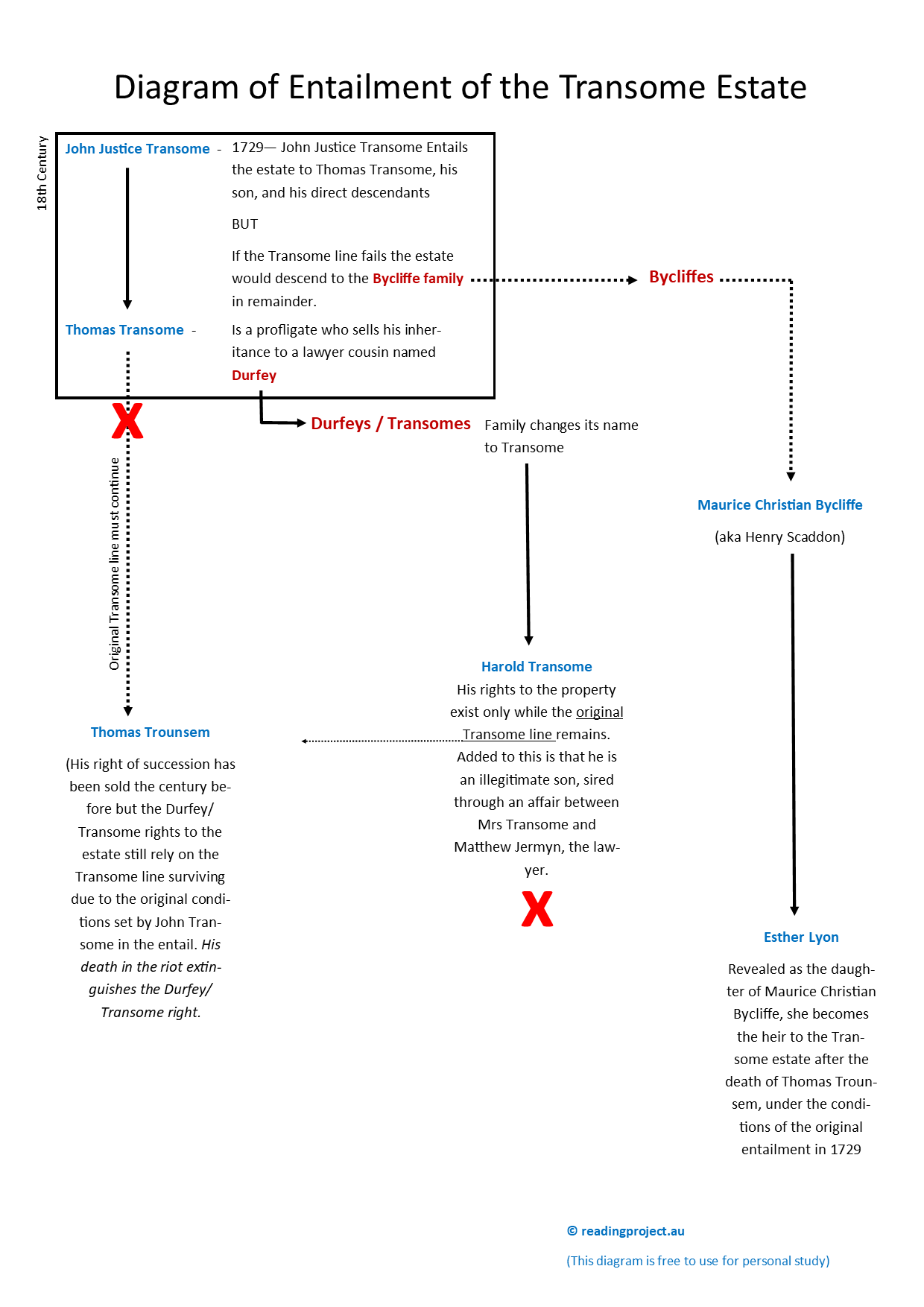
To help readers understand this complicated aspect of the plot (more difficult to grasp as it is delivered piecemeal in the story) I’ve created the following diagram which simplifies the circumstances:
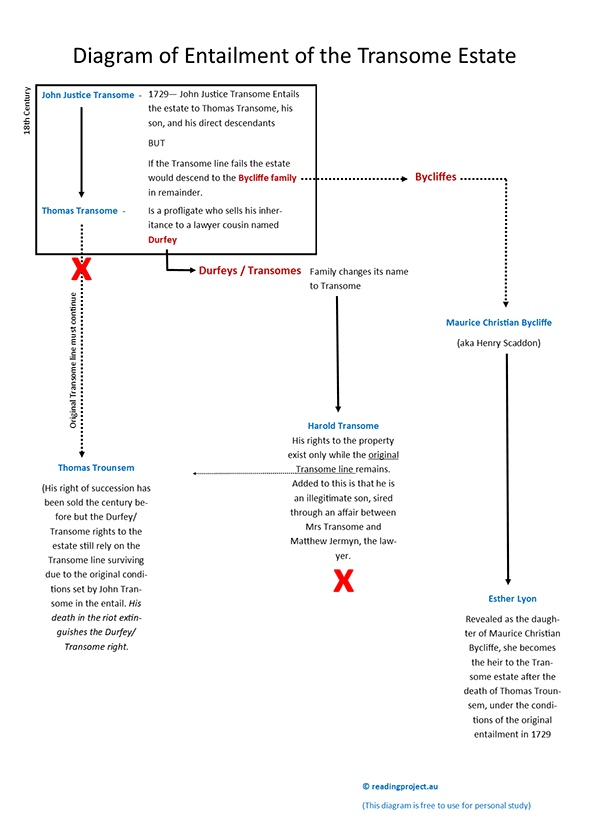
Click here to view an enlargeable copy of this diagram
Click here to download copy of this diagram
Entailment was a legal means by which property could be passed from one generation to the next (it was abolished by the Law of Property Act 1925). Part of the reason for its use was to prevent properties being carved up over time, especially to meet the needs of multiple sons. This is why Harold initially leaves home and moves to Smyrna where he becomes a self-made man. He is the younger son and had his older brother, Durfey, lived, he would have taken possession of Transome Court upon their father’s death. Entailment usually operated by primogeniture – the passing of title through the eldest son – and it protected the interest of the landed classes by preventing title of land passing to other families through marriage by daughters, or by land being sold off to pay debts. Heirs to the property could not will their land to whomever they chose, either, since the terms for inheritance are set by entailment. This is part of the plot of Pride and Prejudice. Mr Bennet inherited the family property, Longbourn, but he has had five daughters with no male heir, so the property will pass to Mr Collins upon Mr Bennet’s death.
But the circumstances are somewhat different in Felix Holt. Transome Court was entailed by John Justice Transome in 1729. His intention was that the estate would pass to his son after his death, and to his son’s heirs after that. However, if the Transome line were to fail, John Justice Transome made the provision that the Bycliffe family would then inherit the estate. Except, Thomas Transome does what would normally not be allowed. To satisfy his own financial needs he sells his right to the property to a lawyer cousin, Durfey, before his father even dies. After this the Durfeys have control of the property and change their name to ‘Transome’. We are told in the introduction:
Generations back, the heir of the Transome name had somehow bargained away the estate, and it fell to the Durfeys, very distant connections, who only called themselves Transomes because they had got the estate.
So, the property eventually passes down to Harold Transome (otherwise a Durfey in the line of succession). But when Thomas Trounsem – a local nickname reflecting his lowly status as a drunken billposter – dies, the property rights revert back to the Bycliffe family, since the terms of the original entailment are still legal. Thomas Trounsem, or Transome, is the last in the line of Transome heirs. He would have lived in comfort and security at Transome Court, as Harold has lived, except for his ancestor’s profligate ways.
Conclusion
The fate of Thomas Trounsem helps to exemplify Eliot’s broader purpose in Felix Holt. Thomas has been manipulated by Jermyn and discouraged from pursuing any claim he might have on Transome Court. He is uneducated and a drunkard. He is in financially dire circumstances which make him dependent on men like Jermyn for employment. And his fate at the hands of the rioting mob is tragic, since his life has not been his own. Harold Transome and the other Durfey/Transomes before him have sat in Transome Court while Thomas has essentially lived the life of a homeless man. He epitomises the missive Eliot articulates early in the story that “there is no private life which has not been determined by a wider public life” which we might also understand to mean that our lives are never entirely our own to choose. Thomas’ life has been determined by the self-interest of an ancestor who has disregarded the duty he has to his descendant to keep the family property whole. Now Thomas Trounsem falls victim to the worst impulses of political agitation as a result. He dies in the riot.
In this way the moral stance of Felix Holt is diametrically opposed to the self-interest of the former Thomas Transome who sold his rights and the rights of succeeding generations. In ‘Address to Working Men’, Eliot (through Felix) argues that changes,
. . .can only be good in proportion as they help to bring about this sort of result: in proportion as they put knowledge in the place of ignorance, and fellow-feeling in the place of selfishness. In the course of that substitution class distinctions must inevitably change their character, and represent the varying Duties of men, and not their varying Interests.
Felix Holt dramatizes idealistic impulses for social change with an appeal to our better natures, by advocating a process of education and social obligation. It is an ideal wrought in the imaginings of Enlightenment thinkers like Rousseau, whose idea of the Social Contract held that individuals would forego individual freedoms to serve a larger concept of social freedom, justice and equality. Likewise, Felix accepts self-abnegation and even privation in the hope of serving a greater social good. But there are limits to ideals, and while Felix Holt reads like a love triangle, as might be found in other 19th century works like Wuthering Heights or Madame Bovary, and might well be enjoyed as that kind of novel, there is a strong sense given by Felix’s extreme idealisation and the elaborate construction of the inheritance plot that the story is structured as a polemical device. We might admire Felix, even if we don’t believe in his reality, but because of that the novel’s premise seems to founder somewhat on the experience of human nature; a fact James Madison could not dismiss when writing The Federalist Papers:
But what is government itself, but the greatest of all reflections on human nature? If men were angels, no government would be necessary. If angels were to govern men, neither external nor internal controls on government would be necessary. In framing a government which is to be administered by men over men, the great difficulty lies in this: you must first enable the government to control the governed; and in the next place oblige it to control itself.
‘Men’ are not angels (nor women) and so the historical fact of the franchise remains as a change wrought by legislation. But it has also gone hand in hand with an increasingly better education for society since the mid-nineteen hundreds, though the promise of education and its efficacy wavers and fluctuates, as do the fortunes of republics rise and fall according to the wisdom of their people.
So, read Felix Holt as a social drama, as a love story, or even with the view to understanding political ideals and their practices in the 19th century. The book is too contrived to be Eliot’s best work, but its dramatic moments mostly land well and the dilemma faced by Esther is compelling, even though we see the nuts and bolts of its construction.
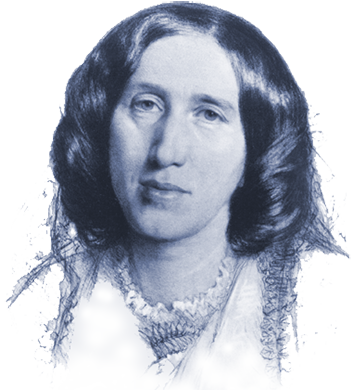
George Eliot
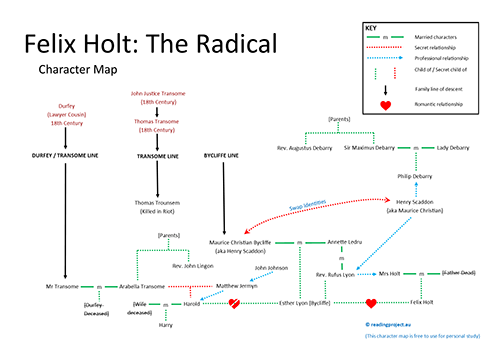
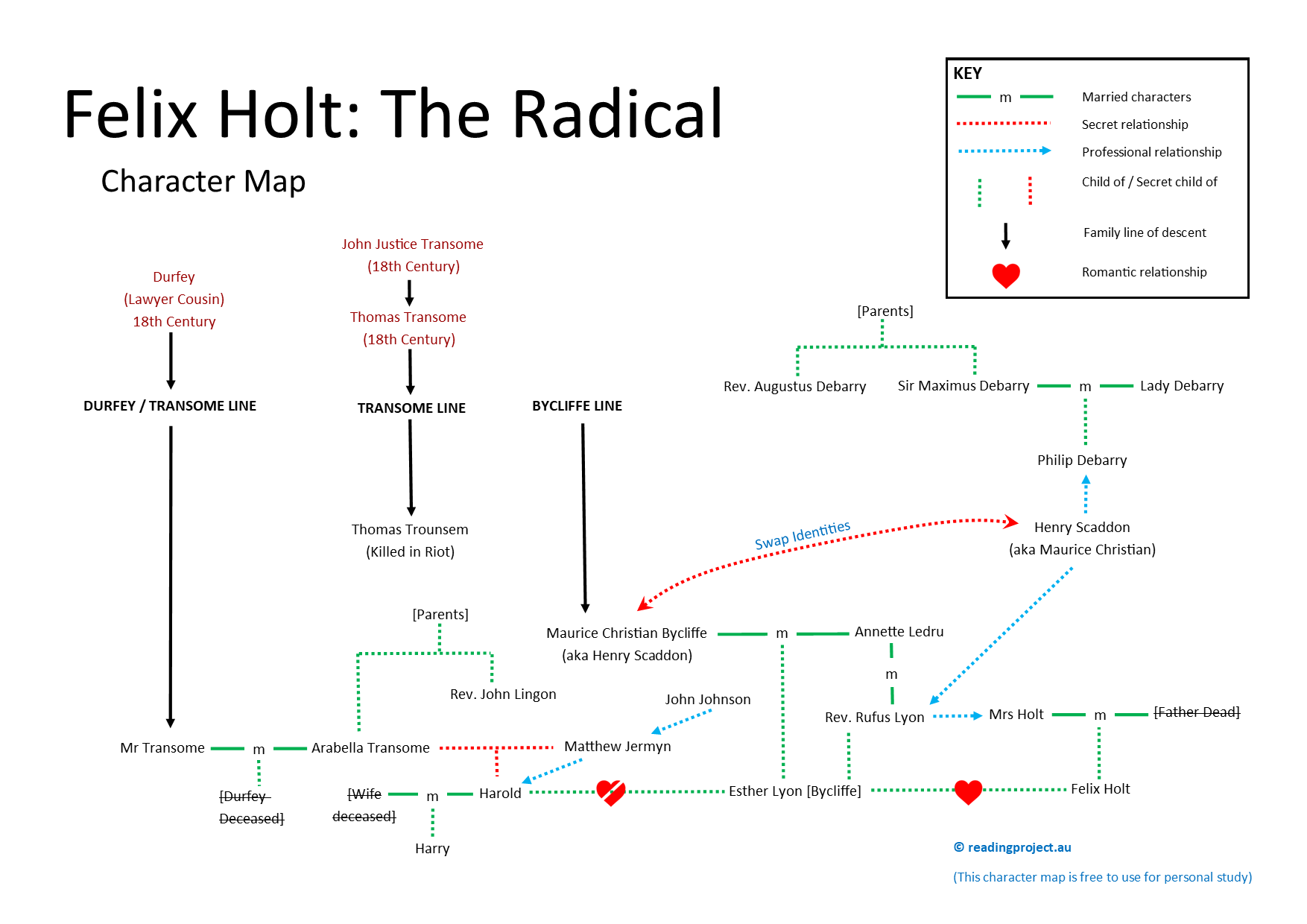
Felix Holt Character Map
This character map can be viewed more closely by clicking the image. You can download this character map for the purposes of private study by clicking here.
Political Reform
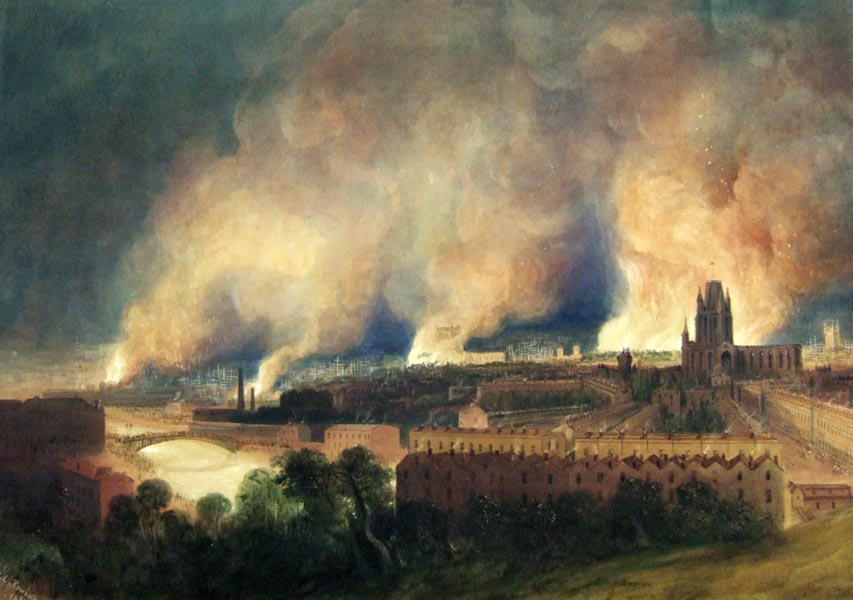
At the end of October 1831 riots broke out in Derby, Nottingham and Bristol after the second Reform Bill was defeated in the House of Lords. In Bristol rioters controlled the city for three days after unrest broke out on 29 October when the anti-reform judge, Charles Wetherell, came to the city. A good portion of the city centre was destroyed by fire.
The Third Reform Bill passed the House of Commons in March 1832 by an even larger majority than the previous year. The House of Lords attempted to delay the Bill with amendments but reform seemed inevitable. France’s recent political unrest – the July Revolution of 1830 – convinced many that the English government might also fall to revolution without reform. Eventually the bill was passed into law. Over two hundred peers abstained from the vote to avoid the possibility of the House of Lords being packed with new reformist peers by the king.
The images below are political cartoons from this period as well as two paintings of the Bristol riot.
The riot in Felix Holt is not connected to these protests. Instead, it begins from a series of practical jokes against political supporters from each side. The unserious causes of the riot and its serious consequences only support Eliot’s thesis that moral and educational reform were prerequisites for widening access to the vote.
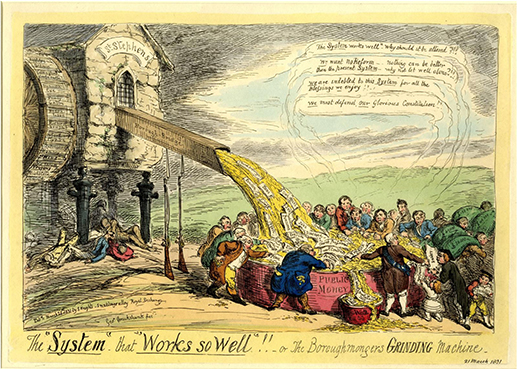
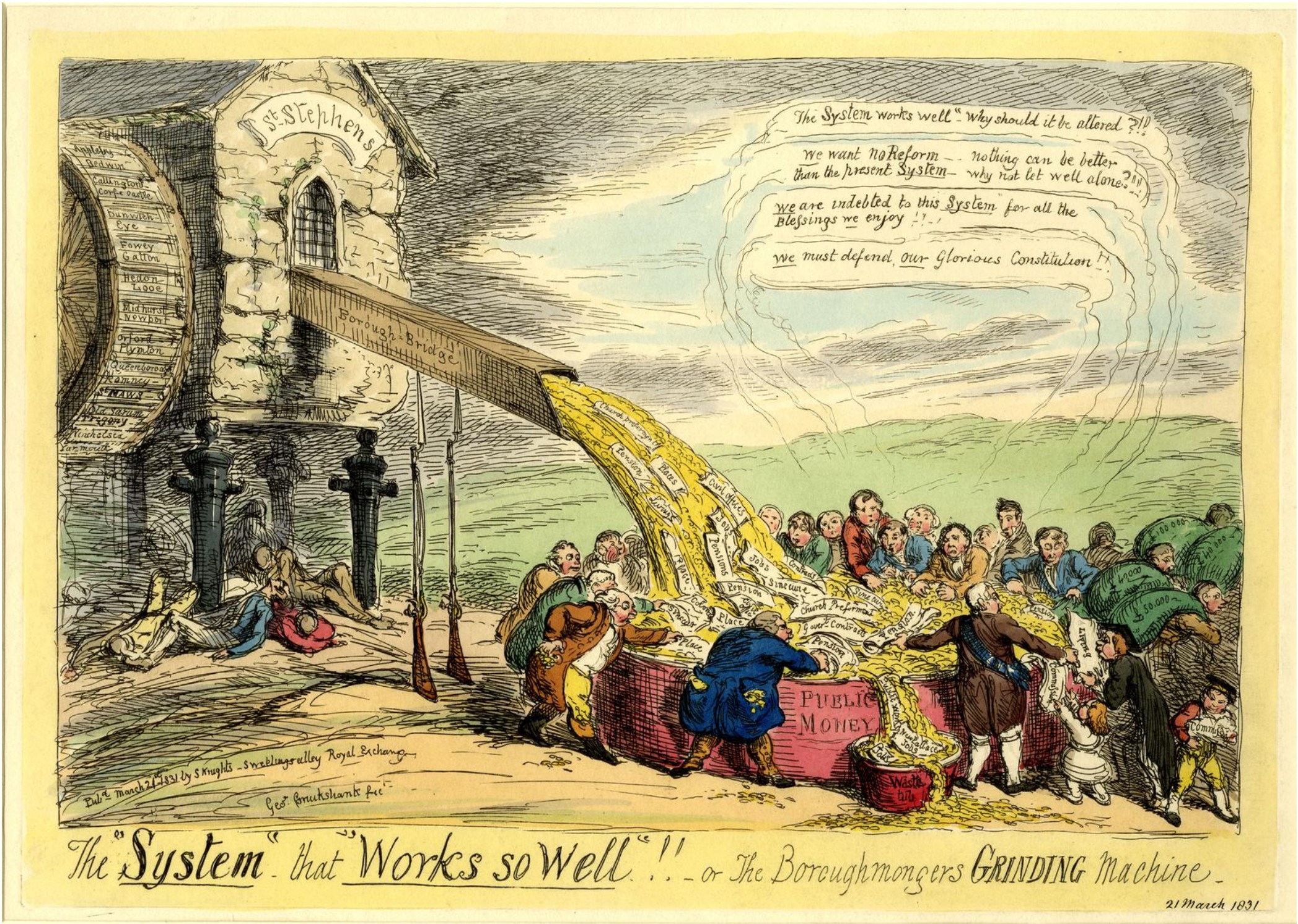
‘The System that Works So Well’ by George Cruickshank, 1831
This political cartoon was produced by George Cruickshank, one of Charles Dickens’ early illustrators, on 21 March 1831, the day before the First Reform Bill was to be voted on in Parliament. The first vote was carried by one vote, but the bill was defeated on later votes concerning the reduction of members in the House of Commons and procedural votes.
For a clearer look at this image and an accompanying explanation, click here.
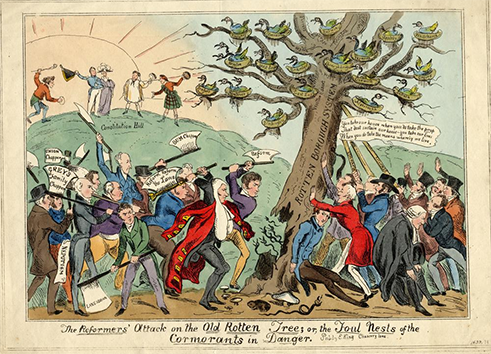
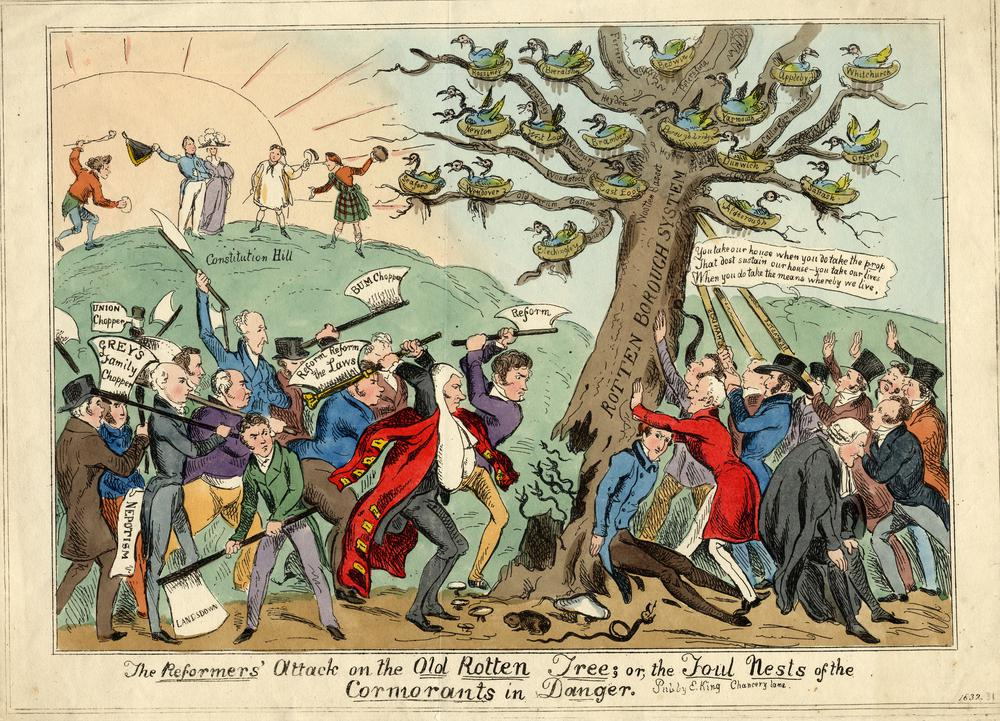
‘Attack on the Old Rotten Tree’ by E. King, 1831
This cartoon was a response to the failure of the Second Reform Bill in 1831 and the riots that ensued in Derby, Nottingham and Bristol. For a larger scalable image of this cartoon with further explanation, click here.
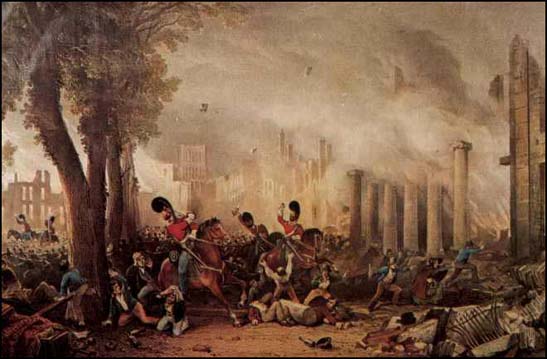
‘The Bristol Riots of 1831’ - Anonymous Artist
The Bristol riots were violently suppressed by the 3rd Dragoon Guards and 14th Light Dragoons over the course of three days.
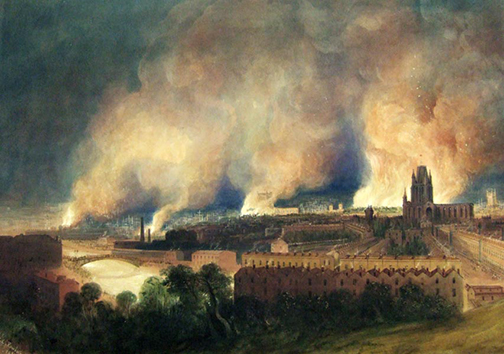
‘Bristol Burns’ by William James Müller, 1831
The burning of Bristol during the three days of rioting in October 1831 is the subject of many paintings by various artists. William James Müller, who was 19 years old at the time, produced sketches and eight key paintings. click here to see a larger scalable view of this painting.