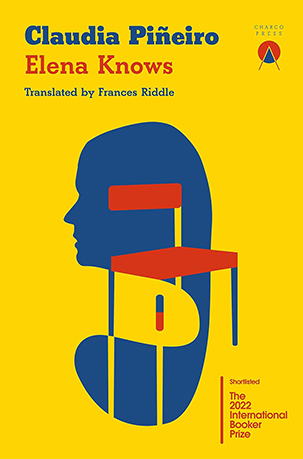
Translator: Frances Riddle
- Category:Crime Fiction, Fiction (General)
- Date Read:21 April 2026
- Year Published:2007
- Pages:143
- Prize:German LiBeraturpreis


Elena Knows is a novel that takes place over the course of one day, featuring Elena, a woman in her sixties with Parkinson’s disease. She lives in Buenos Aires with her daughter, Rita, a neurotic, abrasive and very conservative woman in her forties. One day, Rita is found hanged from the church belfry in the chapel she dedicated her life to. The police quickly dismiss it as suicide, but Elena is convinced her child would have never done that due to a detail only she would know to be suspicious. Elena embarks on a journey to figure out who killed Rita – something easier said than done due to her debilitating condition.
While the mystery of Rita’s death is the main plot of the story, this book is, above everything else, a visceral exploration of what it’s like to live with a disability. Elena having to go across the city to look for an old acquaintance becomes a physically and mentally agonising trial. The most basic of movements, such as raising her foot off the ground to take one step forward, have to be carefully planned and timed with her medication.
It’s a tedious, frustrating, almost Kafkaesque existence, fighting at a disadvantage against her degrading nervous system and waiting for the pills to take effect, with obsessive repetitive thoughts as her only “company”.
“Daylight signals the start of the fight she has ahead of her, from the moment she tries to get out of bed, pulling on her ropes until her unresponsive back unsticks from the wrinkled sheet, resting both feet on the cold floor tiles, gathering momentum to stand up, dragging her feet towards the toilet where she’ll try to sit to urinate, lower her underwear, try to stand, stand, drag her underwear up, tangled, damp, try to straighten it, and then after that, after that, always after that, always a new challenge [. . .]” (page 37)
Piñeiro does not hold back on the details. A specific phenomenon is portrayed in this novel, one that I found myself doing with my own chronic illness and that I was quite impressed by how Piñeiro wrote it: Elena views her Parkinson’s almost like a malicious entity. It’s so simple yet so harrowing: trying to move your body one day only for it to refuse, as if it’s no longer yours. Her life as she knew it is getting more and more limited and there is nothing she can do. There is a very authentic bitterness towards her illness, towards this thing that decided to appear one day and ruin everything.
“[. . .] when her brain orders her feet to move, for example, the order only reaches her feet if the dopamine takes it there. Like a messenger, she thought that day. So Parkinson’s is Herself and dopamine is the messenger. And her brain is nothing, she thinks, because her feet don’t listen to it. Like a dethroned king who doesn’t realise he’s not in charge anymore. Like the emperor with no clothes from the story she used to tell Rita when she was little. The dethroned king, the emperor with no clothes. And now there’s Herself, not Elena but her illness, the messenger, and the dethroned king. [. . .]” (page 3)
Now, add to all of the above the grief of losing her child in such a strange and awful way.
Elena believes she knows her daughter better than anyone else. She is her mother, after all. She knows all of Rita’s idiosyncrasies, what she would and wouldn’t do. Neither of them are warm and compassionate people, and their interactions, as shown in Elena’s memories, are dysfunctional to a comical degree. But despite everything, it is undeniable they love each-other. Rita was Elena’s only caretaker and she was deeply frightened by her mother’s diagnosis, by the undignified state Elena was reduced to, as well as by the painful knowledge it would only get worse, “watch as her body dies without her dying” (page 136). The upending of not just Elena’s life, but Rita’s too, is very compelling.
With Rita gone, Elena is completely alone. She has alienated herself from their community since nobody is able to understand her pain, be it the grief or the illness. Everybody accepted that Rita killed herself and moved on – everybody except for Elena, the unreasonable old lady. The horrific image of the priest, Father Juan, a man whom Rita admired, continuing with the sermon while knowing Rita was still hanging above his head, just so the other parishioners wouldn’t panic when the cops arrive, is darkly representative of that desire to go back to brighter days as quickly as possible. But Elena can’t have bright days anymore.
The only person Elena has left is Isabel Mansilla, whom she has not seen in 20 years and who may not even live in Buenos Aires anymore, but Elena knows she has no other choice but to try to ask for her help, for Rita’s sake and for her own.
This novel is written in the third person perspective, with a focus on Elena and her mind. Riddle’s translation is excellent. I can still feel the original Spanish sentence structure underneath. It kind of reminds me of Cormac McCarthy’s writing style, with these long, winding and exquisite paragraphs, and little to no indication as to who is speaking, but the characterisation is strong enough that you don’t need it. So much is packed in only 143 pages, although certain points and imagery get really repetitive. Yet I found myself more aware of everything I was doing throughout the day, and of how screwed I would be if I couldn’t move certain ways anymore.
I also enjoy how complex Piñeiro’s characters are and the specific ways they are flawed. It feels like I’m reading about actual people who exist. Rita is not a perfect victim. Far from it. She was especially horrible towards Isabel (which I can’t elaborate here because it would spoil the mystery), which contrasts how caring she was towards Elena and others. Elena is judgemental, arrogant, stubborn to a fault and very rude. She has complicated and believable feelings, and it’s written in such a way that I can understand how she came to her ideas without being spoon fed the explanation.
To wrap things up, this is a great novel. It is very heavy and I had to take breaks from reading quite a few times, but I am so glad I picked it up. It’s such an honest, heartbreaking and beautifully-written story. I hope to read more of Piñeiro’s work soon.