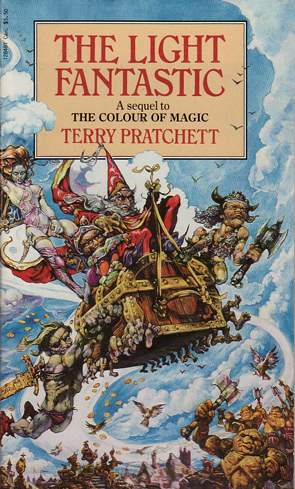
Two Reviews by: Skep | Toriaz
The Discworld Series #2
- Category:Fantasy Fiction, Humorous Fiction
- Date Read:6 November 2025
- Pages:241
- Published:1986

In my review for The Colour of Magic, I posited that it was not worth completing the entirety of the book; that you could get away with reading the first third, then put it down and move on to another, better Discworld book. Having now finished my second reading of The Light Fantastic, I would like to say the following:
Boy, I sure was right.
If you do what I told you and jump straight in to what is ostensibly the sequel to The Colour of Magic, you will find that it opens where the last book left off: with Rincewind plummeting off the edge of the Disc. “Yes, that sounds about right,” you might say to yourself, because if an author is going to write a book series about a world shaped like a drink coaster, a character needs to fall off of it at some point. I would consider this a corollary to the Chekhov’s Gun principal.
Unfortunately, as exciting as this all is, Pratchett gives us a whopping “most of a page” to enjoy this predicament before plucking Rincewind from his breathless tumble and slapdashedly placing him in a pine tree in the middle of the Disc, on the grounds that there’s no convincing way to resolve the situation anyway, so why bother.
My point here is that, because the last book had exactly zero plot to speak of, and we’re more or less starting fresh with this one, you can pretty much just jump into the series with The Light Fantastic and be okay.
Here, at least, Pratchett is starting to find his groove. For one, there’s kind of a driving force behind the narrative this time! Sure, the protagonists still mostly just float from place to place until they end up where they need to be at the end, but at least there’s some semblance of progression this time. He has also seemingly taken my criticism about the slow pacing to heart, because instead of lingering in scenes that overstay their welcome, we’re now flying through them so fast that occasionally we don’t even have time to adequately describe a setting before we’re on to the next one. See? Improvement!
Although sadly, we haven’t seen the last of gags being run into the ground. The worst offender comes in the form of Cohen, who travels along with Rincewind and Twoflower for . . . well, I’m sure there were reasons, but I forget what they were.
Let me back up first. A character in The Colour of Magic I neglected to mention (and who you would not have encountered if you heeded my reading directions) was Hrun the Barbarian, a big muscly heroic guy who wears nothing but a leather banana hammock and boots. It’s a fine enough schtick, and having such a character siding with Rincewind and Twoflower is sorely needed since those two nincompoops are rarely able to resolve a dangerous situation on their own. However – possibly owing to a contract dispute with the actor – Hrun doesn’t get brought back in The Light Fantastic. Instead, we get COHEN the Barbarian, a big muscly heroic guy who wears nothing but a leather banana hammock and boots.
(I have a sneaking suspicion that Pratchett submitted his final draft of The Colour of Magic sometime around 1981 or 82 – right before the release of the Conan the Barbarian film adaptation, which would have been ripe for parody had his book not already been sent off to the publisher. He was probably kicking himself for a while, but ultimately decided that adding a barbarian named Cohen was a good enough joke for his sequel anyway.) (It wasn’t.)
But even Pratchett knows he can’t just have two functionally-identical characters in back-to-back books, so he twists the formula: Cohen is an old man now – somewhere in his 80s or 90s – still adventuring as he did in his prime, but now coping with a body that is failing him. On paper, this is a strong concept, and I could forgive his inclusion in the story . . . except this is Discworld, so instead of being impactful, the character has to be funny. And thus, he is little more than a vessel for every tired “old person” joke you can think of. Oh, he’s always complaining about his joints aching. Haha, his back gave out. Teehee, his saddle has a haemorrhoid ring built in. Bahaha, all his teeth have fallen out so he alwaysh talksh like thish.
Only the last of these is amusing to any degree, and even then it’s only because my mind doesn’t read this as “he has no teeth”, but instead as “he is doing a bad Sean Connery impression”. Even Pratchett grows weary of this by the end because he eventually gives Cohen dentures, which has no impact except for making his dialogue readable. Still, what this means is that instead of being a character with a schtick like Hrun was, Cohen is a character with two schticks, which surely we can all agree is simply too many schticks for a single individual. Trying to cram too much funny into one package only succeeds in making it unfunny.
Another character joins the group alongside Cohen; this is Bethan, a “maiden in distress” who was about to be sacrificed by druids before the intervention of Twoflower. Bethan, it turns out, is extremely displeased by this turn of events, as the real sacrifice here was that of her teenage years, shuttering herself away and avoiding the temptations of youth, preserving her virginity so that, one day, she COULD be sacrificed to the gods; and now her big day is devastatingly ruined. Now, I think there is a potential for some laughs as this character tries to find a new purpose in life and enjoy the things she was never able to before, while also navigating the occasional misunderstandings that certain gaps in her education might cause; but this kind of humour would have to be handled very delicately (and should certainly require aging up Bethan, who is explicitly stated to be 17). Thus, Pratchett’s decision to more or less avoid this avenue of comedy altogether is probably a wise course of action, but it does unfortunately leave Bethan with little else to contribute aside from being the one who applies Cohen’s ointments. She does get a few moments in the finale where Cohen is separated from the group and SOMEbody needs to take action to, you know, prevent the total destruction of the Discworld, though in these cases she’s mostly just pushing the other characters into action rather than doing much herself.
Also, Cohen and Bethan announce their intention to get married halfway through the book. Of course, the huge age gap isn’t exactly a cute look; but it is the end of the world after all, and their relationship comes across as entirely platonic. Fine, whatever; if it reads less “romantic chemistry” and more “home health service provider” then I guess I can overlook it.
But what Pratchett has yet to fully understand by his second book is that gag characters and humorous settings does not comedy make. Instead, it’s how these elements interact with each other that makes the magic happen. The thing is . . . he’s getting there. Rincewind and Twoflower are not complex characters by any stretch of the imagination, and being complete un-heroes – a failed wizard whose primary concern is saving his own skin and a tourist who sees the world through rose-tinted glasses – it is clear that, like the others, they were created because Pratchett found them to be amusing concepts. But these two actually work due to how they constantly play off of each other. Twoflower isn’t funny because he’s blissfully ignorant of the danger surrounding him at every turn. He’s funny because Rincewind is bitterly aware of how much of a threat Twoflower is to his well-being on any given day. Twoflower isn’t totally blind to this; and when the chips are down and Rincewind resolutely marches off to confront the big bad in the face of certain doom, the tourist finds confidence in knowing that if Rincewind isn’t worried for once in his life, then there must truly not be anything to worry about.
Yes, the barrage of jokes and the snide commentary about life are important to the tone of these books; but it’s this dynamism that breathes life into the series, that makes these characters so memorable and their send-off at the end so heartwarming. This is Discworld, finally beginning to show itself.
So, despite all the complaints I’ve levied in this review, I can’t in good conscience tell you to skip this one. There’s still plenty here to like, and as an introduction to the series . . . you could do a lot worse.

There was no real need for the torches. The Octavo filled the room with a dull, sullen light, which wasn’t strictly light at all but the opposite of light; darkness isn’t the opposite of light, it is simply its absence, and what was radiating from the book was the light that lies on the far side of darkness, the light fantastic.
The Light Fantastic is basically The Colour of Magic part two, as we pick up the storyline straight from the end of the last book. Rincewind and Twoflower are saved from the predicament they were in at the end of The Colour of Magic, then continue to fall from one life threatening danger to the next. This makes the first part of the book very episodic. The Octavo (the book containing the eight seven most powerful spells on the Disc) becomes a useful plot device for keeping Rincewind alive. It actually comes out and tells him that they, the spells in the Octavo, need him and that eighth spell which is lodged in Rincewind’s brain. Gradually, the main story starts to unfold when a new red star appears in the sky and seems to be on a collision course with the Disc. All the separate storylines start heading towards dealing with the problem of the red star and the spells in the Octavo. And along with the red star, there is a power-hungry wizard out to take the power of the Octavo for himself, and a rabid mob of doomsday cultists who want to destroy all the wizards, whom they believe are the problem the red star is coming to destroy.
I think Pratchett was getting more confident with this second book, and was starting to develop the full humour which became a characteristic of his writing later in the series. This book may still not be as good as some of the later ones, but the improvement over The Colour of Magic is noticeable. The cameos made by Death in particular, are up there with best classic Pratchett scenes. Pratchett weaves together a lot of references to the Bible, classical mythology, fairy tales and pulp fiction in this book. There is still a lot of poking fun at the standard fantasy stereotypes that featured so heavily in The Colour of Magic, but overall, there is a much clearer structure to The Light Fantastic, especially in the second half of the book. Rather than just simply being a collection of jokes, this book becomes a quest, with a hero’s journey, even if our hero is reluctant to do anything heroic and would rather just run away and hide. But just as Rincewind eventually does the right thing at various points over the book to save his friends, albeit it reluctantly, he also faces the inevitable and does what is needed to save the Disc at the end of the book.
There still is plenty of humour in the book. Of course, Pratchett is always very funny, with plenty of snarky jokes and great one-liners, and even the occasional groaner of a pun (such as “Rincewind, all the shops have been smashed open. There was a whole bunch of people across the street helping themselves to musical instruments, can you believe that?" "Yeah," said Rincewind. "Luters, I expect.” ). Pratchett’s Discworld series is one of the funniest series of books ever written, and The Light Fantastic, while still relying heavily on parody for its jokes, shows evidence of the development of Pratchett’s style.
The Light Fantastic is also the book which introduces several great characters of the Discworld who will become semi-regular throughout the rest of the series, such as the Librarian and Cohen the Barbarian. In later books, it is just accepted that the Unseen University Librarian is an orangutan. This is the book that explains how he came to be an orangutan. He’s only a minor character and his characteristics aren’t really defined in this book, but we do get his ‘creation’ story. Cohen is more a major character in the book, renowned across the Disc as a great warrior, already a very old man but still capable of handling anything the world can throw at him. It seems with every battle he faces, that it will be his last, but Cohen always seems to triumph. And of course, Death appears. Death is, I think, the only character who appears in every Discworld story, even if he has only a brief appearance. He gets a few scenes in The Light Fantastic, but isn’t a major character.
The Light Fantastic is a great read. It’s really funny, it has some memorable characters, and it sets up the setting of Discworld ready for the rest of the series to shine. Recommended.
Discworld Characters
“The Luggage said nothing, but louder this time.”
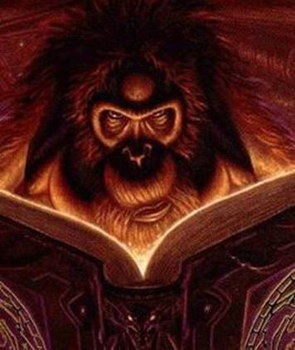
“The job of magical librarian, who has to spend his working days in this sort of highly-charged atmosphere, is a high-risk occupation. The Head Librarian was sitting on top of his desk, quietly peeling an orange, and was well aware of that.”
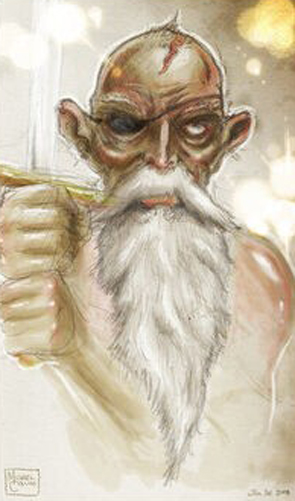
“I’m a lifetime in my own legend.”
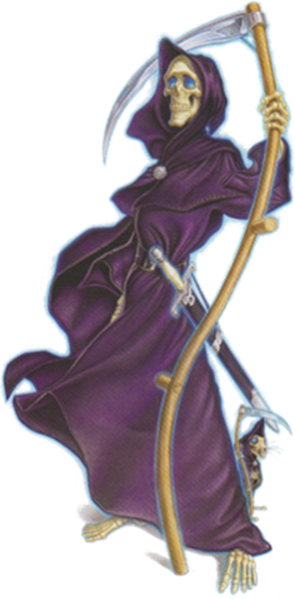
“The other skeletal hand held small cubes of cheese and pineapple on a stick. “WELL?” said Death, in a voice with all the warmth and colour of an iceberg. He caught the wizards’ gaze, and glanced down at the stick. I WAS AT A PARTY, he added, a shade reproachfully.”
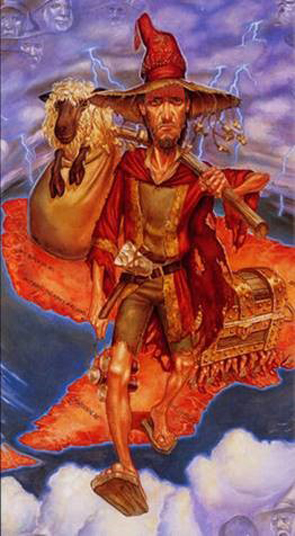
“Rincewind had in any case seen his past life flash in front of his eyes so many times that he could sleep through the boring bits.”
Around noon the following day they rode into a small, mud-walled city surrounded by fields still lush and green. There seemed to be a lot of traffic going the other way, though. Huge carts rumbled past them. Herds of livestock ambled along the crown of the road. Old ladies stomped past carrying entire households and haystacks on their backs.
“Plague?” said Rincewind, stopping a man pushing a handcart full of children.
He shook his head. “It’s the star, friend,” he said. “Haven’t you seen it in the sky?”
“We couldn’t help noticing it, yes.”
“They say that it’ll hit us on Hogswatchnight and the seas will boil and the countries of the Disc will be broken and kings will be brought down and the cities will be as lakes of glass,” said the man. “I’m off to the mountains.”
“That’ll help, will it?” said Rincewind doubtfully.
“No, but the view will be better.”