- Category:Fiction (General)
- Date Read:10 March 2026
- Year Published:2023
- Pages:184


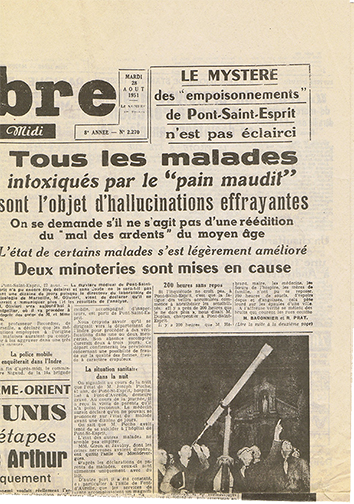
Based around the events of a real 20th century mass poisoning, Cursed Bread by Sophie Mackintosh takes place in the quiet little town of Point-Saint-Esprit, France, five years after the end of WWII. We see it through the perspective of Elodie, a middle-aged woman in a passionless, sexless marriage with the local baker.
Elodie's monotonous life is upturned by the arrival of new neighbours: a man only known as “the ambassador” and his wife, Violet. Elodie becomes infatuated with both spouses, especially with Violet, and her pathetic pining grows into a dangerous obsession as unexplainable events start happening in the town. Everybody who eats her husband’s bread seems to go mad.
The story is told as Elodie’s recollections of the events, interspersed with letters she wrote to Violet specifically one year after those events.
“What took place between the two of us, what took place between the three of us, left no proof [. . .] I have to remember and recount, even if you are the only one who will listen now.”
Cursed Bread, page 40
This is a fantastic novel. I couldn’t put it down. Mackintosh, in 180 packed pages, creates a decadent exploration of sexuality that doesn’t shy away from the unsavoury aspects of it. There is so much raw emotion in her writing, this vicious tone that kept me on edge the entire time, mixed with dreamlike cinematic scenes.
Elodie is a captivating protagonist. Years of repression result in her becoming obsessed with the spouses, heightened by deeply intimate moments she bears witness to – some because she is invited to witness, others because she is spying on them. Mackintosh masterfully places the reader in Elodie’s head and you follow her tale with the same tense anticipation she has, wondering when the pot will finally boil over.
Her behaviour becomes increasingly unhinged as she continues to recall her memories, and Elodie as the narrator is honest to a mortifying degree. She shares the most vulnerable, embarrassing and deviant details of her attraction. They range from wanting to lean closer to Violet so she would “accidentally” make skin contact, to wishing the ambassador would take the chance to assault her while alone.
At her core, Elodie is a deeply lonely woman. Her longing for intimacy with her estranged husband leads her down a self-destructive path. She wants Violet, she wants to be Violet, she wants Violet to steal her husband, and she wants Violet’s husband to cheat on Violet with her. She wants to be seen, touched and desperately yearns as she projects onto Violet. She wants to beat up Violet and kiss her at the same time.
All these perverse thoughts fester in her head alongside deep-seated feelings of inferiority. Elodie is always watching from afar, mentally cataloguing everything and, inevitably, comparing them to herself. It’s pathological, the constant comparison of the spouses to Elodie and her baker, obsessing over every glance, every hand placement, every word choice, and the painful conclusion is always that Violet is more loved than Elodie will ever be.
“I picture you picturing me. Do you see me in your mind’s eye, reeling with desperation? Do you see me with pity?”
Cursed Bread, page 31
I’ve noticed a deliberate portrayal of traditional gender roles. The ambassador is a handsome, alluring and carefully-rehearsed American man. He doesn’t have a name, just a title that inspires importance and authority. He dubiously comes onto Elodie and she allows it because he represents, in many ways, what she wishes her own husband was like: powerful, virile, dominant: “how a man should be”.
It’s so fascinating, because Elodie still loves her baker husband and tries to make the marriage work. She can’t initiate intimacy because when she does, she is awkwardly rejected. She has to wait for him to approach her first, which happens once in a blue moon. Even a small kiss is considered pushing her luck. He would rather work than be with her, to the point you wonder if he likes Elodie at all. She finds herself wishing he would cheat on her with Violet, that he would show his desire in any way: “the humiliation of [Elodie's] inability made delicious.” (page 115)
Violet is beautiful, fragile, incomprehensible but certainly, “the perfect wife”, better than Elodie in every way. She is almost vampiric with her unknown past and her refusal to eat the goods sold at the bakery. Her seduction of Elodie is more subtle and insidious than the ambassador’s: revealing graphic details about her sex life; tasking Elodie with keeping her secrets; inviting her into her house just the two of them; making her feel special; feeding into her delusions while pretending not to notice. She takes a cruel delight in leading Elodie on.
She’s quite a sinister character, and in Elodie’s letters you can feel her anger towards Violet. And yet, at the same time, she keeps writing these letters that probably never reach their destination. Violet appeared in her life one day, then disappeared just as suddenly, leaving Elodie in shambles. All she has felt is those memories, as humiliating as they are.
“Are you still listening, Violet? Would you tell me your side of the story if you were here? Would you tell me to stop ruminating, to stop tripping myself up – tell me I should know better, I’m still alive after all [. . .]”
Cursed Bread, page 173
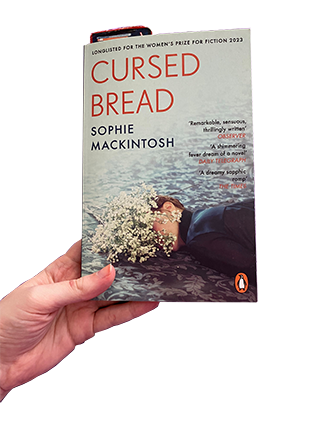
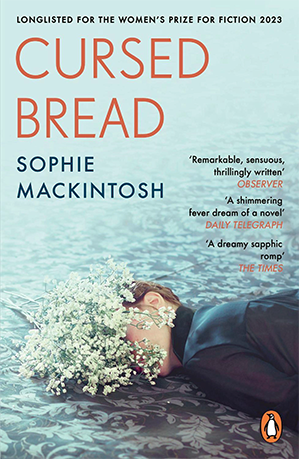
I could go on and on psychoanalysing these three. In conclusion, Cursed Bread is one of my favourite books now! It’s such a surreal, dark and delicious story. I only have one complaint, but it’s more about the marketing of this book rather than the book, itself. On the cover blurb there is praise from The Times, calling it “a dreamy sapphic romp”. It’s more of a “bisexual romp”. Elodie is equally horny towards the man as she is towards the woman.