- Category:Fantasy Fiction, Young Adult Fiction
- Date Read:9 February 2026
- Year Published:2017
- Pages:407


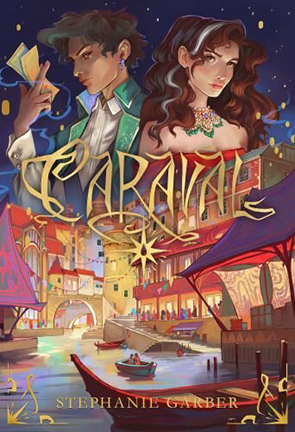
I received Caraval by Stephanie Garber as a Secret Santa gift from work! It is a gorgeous edition with a hand-drawn map, embellished pages and graphics throughout. I remember seeing it in book compilations across the internet and hearing that it’s the first part of a trilogy, but otherwise I didn’t know anything about it. Here is what I found out:
The Caraval is a dazzling and mysterious travelling performance. It is “the grandest show on land or by sea [ . . .] A world built for make-believe.” (pages 76-77). Each year it has a “game” where the audience is required to participate along with secret organizers to win the grand prize: a wish that will come true. It is an elaborate, city-wide interactive show, promising five nights of fantastical adventure.
On the Isle of Trisda we meet our protagonists: Scarlett Dragna and Donatella “Tella” Dragna, two sisters living in isolation with their abusive father, Governor Marcello Dragna. Ever since she was a child, Scarlett wanted nothing more than to attend Caraval and, at long last, she receives three tickets. Unfortunately, it will interfere with her arranged marriage to the Count, a man she has never met, but whom she believes to be her only option to escape their father. Tella has a different escape plan in mind, involving the Caraval and a charming sailor named Julian.
After some sisterly kidnapping, they arrive at Caraval. The game this time is a manhunt: a member of the audience has to be found before the end of the five nights. The target is none other than Tella, something Scarlett discovers when Tella is snatched away by the Caraval Master, a man only known as “Legend”. Thus begins a race against time for Scarlett to retrieve her sister and return home for the wedding.
The Caraval, as a concept, is extremely fun. Garber does an excellent job at painting a wacky and vibrant world, with elements of the Venetian Carnival and various fairy tales incorporated into the story. It’s a colourful, fanciful, reality-bending location that makes the child in Scarlett (and myself!) very happy.
The challenges Scarlett goes through and the people she encounters are kind of forgettable, though. There’s a pattern: Scarlett arrives at a set-piece, somebody gives her a choice to make, she overthinks it, and she makes her choice and deals with the consequences; rinse and repeat. As I’m reading, I find it hard to care about any of the side stories for longer than a chapter or two. In a similar vein (and without spoilers), the latter chapters have an increasingly darker tone, but the ending retroactively cancels out that darkness. Like, “Oh, never mind! All’s well!”, which is pretty anticlimactic.
Something I like about Caraval is the relationship between Scarlett and Tella. I really like Scarlett! She is a realistic depiction of a paranoid and insecure girl. She worries so much about everything she does, whether or not she has done the right thing. She goes on and on, agonising for entire pages over every possible outcome, and she gets frustrated with herself, which is accurate! We see less of Tella due to plot reasons, but the way Scarlett talks about her, their memories, what they’ve been through, and what annoys them about each-other, feels so real and so heart-warming. I see my sister and myself in them.
I also like the portrayal of the sisters’ trauma; how it manifested differently for each of them. Tella is angry, impulsive and defiant, whereas Scarlett is cautious, quiet and resigned. Yet at no point do the sisters ever stop thinking about the other’s wellbeing. Freedom for one has no point if their sister is still miserable. Leaving her behind is unthinkable.
The novel is around 400 pages long, but the font size is quite big and, as I mentioned, there’s a lot of graphics that take up space. The book reads very fast and the language is flowery without feeling overwhelming. A lot of the descriptions focus on the olfactory aspect, which I found neat.
Scarlett could still smell her father’s perfume. It smelled like the colour of his gloves: anise and lavender and something akin to rotten plums. (page 25)
[ . . .] the crooked halls of La Serpiente smelled like the end of the night, sweat and fading fire smoke mixed with lingering breath from words whose ghosts still haunted the air. (page 105)
The language does go a little overboard sometimes with the descriptions. One passage that stuck with me was early in the book, where Scarlett “could smell the moon, thick candle wax dancing with the salty scent of the ocean, full and glowing”. (page 35)
For me, the weakest part of Caraval is the romance. Garber really pushes it in your face, especially during times when I wish the characters would focus on solving the mystery, instead. Emotions are way too strong, way too fast. Julian, Scarlett’s main love interest, does have some strong scenes that make him endearing, but he’s a painfully cliché bad boy. The reoccurring gag, that he calls Scarlett “Crimson”, made me groan the first time it happened, and then, to my despair, he wouldn’t stop saying it every other page.
Legend, on the other hand, is so compelling as the mysterious mastermind. This mythical showman who can wield real magic, who was driven mad by it, communicates through scattered notes that always find their destination. When he speaks in person he’s so cheesy, it’s awesome. I like him much better as an ally to the sisters rather than a love interest.
To sum up my thoughts, I like Caraval. It’s good, but not amazing. It’s a solid “okay”. I recommend it if you want to pass the time with a whimsy little adventure. I don’t feel any particular urge to read the rest of the trilogy. One book about these characters was enough.