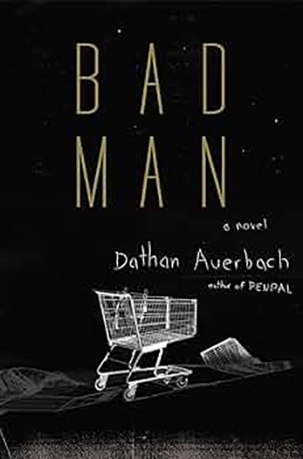


Bad Man by Dathan Auerbach is an atmospheric horror, set primarily in a grocery store. If a nightshift stocking shelves in a grocery superstore sounds creepy to you, I recommend picking this up. The setting truly makes the novel. Auerbach draws from his own experience as a grocery stockboy, offering illustrative descriptions of mundane yet threatening equipment: the thunderous air conditioning, the industrial freezer, and, most hauntingly, the cardboard baler, a massive mechanical press that condenses cardboard into large, heavy bricks. Auerbach immerses the reader in the ghostliness of the afterhours store and the mugginess of the Florida nights. He compels the reader to almost wish they could explore the empty grocery store themself. It feels like there is an infinity of secrets to find there, especially because, in the opening of the story, it is revealed that the protagonist’s brother, a toddler at the time, disappeared there, seeming to vanish into the very air.
The novel kicks off with twenty-year-old Ben getting a job at the same grocery store five years after his brother disappeared. He is suspicious of everything: his coworkers, his boss, the graffiti on the walls. The novel delights in dipping in and out of delusion. Ben isn’t exactly an unreliable narrator – the novel is narrated in the third person – but the story follows his investigations closely, draws the reader into his thinking, and then reveals his detective work to be hasty and sometimes, utterly misguided. Ben is a fun character to follow. He makes more mistakes than not, but he reads as charmingly human. That said, Ben’s questionable self-awareness could occasionally be frustrating for me as a reader.
In the novel, key information is sometimes omitted for the sake of a cheap reveal later on. For example, one character is heavily implied to be dead only for him to be alive forty pages later. The story reveals Ben had even visited him in the hospital, which is annoyingly hidden from the reader until after the fact. In another instance, Ben buys a disposable camera for his investigation and later notices that several pictures have been mysteriously taken with it by someone other than himself. Then, he chooses not to look at the pictures once they are developed. To me, it felt like the mystery was just hidden by the text itself, rather than by bad actors in-universe, which I personally found frustrating. I was really sad to find myself with a number of lingering questions (such as the mysterious photos) at the end of the novel.
However, the fact that I feel so stuck on the loose ends is because I was so deeply invested. I found myself caring a great deal about the characters and rooting for the friendship between Ben and his coworker Marty. The banter between them is really fun and endearing, and the dialogue throughout most of the novel is fairly true-to-life, save for a couple of comically evil characters. I really hated the police officer Duchaine, but I also think he serves as an interesting foil to Ben. Where Ben continuously makes mistakes by acting too hastily, Duchaine botches the investigation by doing nothing at all. On the other hand, Marty is a lone beacon of reliability. I think he’d be the favorite character of most readers. He was certainly mine. All of the characters in and around the grocery store are compelling, though. The characters and the setting are the jewels of this book.
Auerbach is a master of crafting suspense as well. I read this book in two or three sittings because I was so eager to see the mystery unfold. As I have mentioned, I wasn’t fully satisfied with the ending. There are a couple of loose ends, but, more than that, I really wish the climax centred around the grocery store, its maze of back rooms, and its haunting industrial equipment. The store is such a well-established and emotionally resonate setting by the end of the book. I was disappointed when the investigation moved away from the store, the climax ultimately taking place in the nearby forest. It felt like the novel had thrown away its greatest strength.
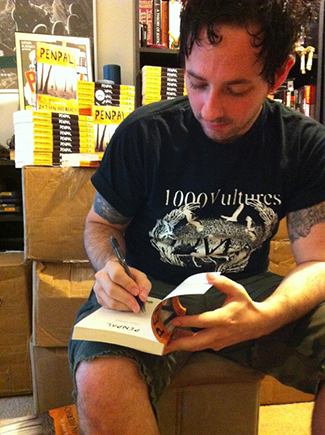
Notably, this is also sort of a spiritual successor to Auerbach’s other novel, Penpal. Penpal is definitely more widely known and loved than Bad Man, but I think both are excellent, although Penpal is punchier and more complete in my opinion. The subversion at the end of Bad Man is a little bit similar to that in Penpal, so I think my familiarity with Auerbach’s other work might have dampened the potentially shocking end for me.
Even though the plot didn’t tie up perfectly, Auerbach’s writing was a joy to read. He prioritizes embellishment over clarity sometimes, but his colourful descriptions added to the atmosphere. He has a great style and is extremely skilled when it comes to building characters and setting. I heard recently in an interview that he’s working on another book, so I hope he builds on all the strengths of Bad Man and maybe fleshes out cleaner plot. I’ll definitely be picking up whatever he writes in the future.